BUNIA, Congo – Congolese health authorities have placed nearly 200 passengers from a riverboat under quarantine near Kinshasa after a traveler who had disembarked earlier in the journey died with symptoms consistent with Ebola, prompting precautionary measures despite the capital recording no confirmed cases.
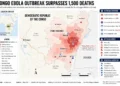
The quarantine comes as the Democratic Republic of the Congo battles its largest Ebola outbreak caused by the Bundibugyo virus and one of the fastest-growing epidemics in the country’s history. According to Africa Centres for Disease Control and Prevention (Africa CDC), confirmed infections have surpassed 4,000 since the outbreak was declared in May, with more than 1,800 reported deaths.
The passenger became ill during the voyage and left the boat nearly three weeks ago in Pimu, Mongala province, along the Congo River, more than 1,000 kilometers (620 miles) north of Kinshasa. Africa CDC Director-General Dr. Jean Kaseya said the individual later died, prompting authorities to identify and monitor everyone who remained aboard the vessel.

Officials have not disclosed the vessel’s exact location other than confirming it is near Kinshasa. They also have not said whether passengers are being quarantined aboard the boat or at another location, nor how long the precautionary isolation will continue while laboratory testing is completed.
Kaseya said authorities decided to quarantine all passengers, including those without symptoms, to minimize the risk of undetected transmission.
Ebola spreads through direct contact with the blood or other bodily fluids of an infected person, as well as contaminated materials such as clothing and bedding.
Precautionary Measures Aim to Prevent Spread to the Capital
The suspected Ebola-related death has heightened concern because the boat arrived near Kinshasa, although health officials emphasized that no confirmed Ebola cases have been detected in the capital.
The current outbreak has expanded rapidly across eastern Democratic Republic of the Congo, with health authorities reporting that between 60% and 70% of new infections are now being identified through community transmission rather than existing contact-tracing networks.
■ Related News



Officials say the trend indicates that transmission is increasingly occurring outside known chains of infection, making containment more difficult.
Health Worker Protests Complicate Response
The country’s Ebola response is also facing operational challenges after dozens of healthcare workers in Ituri province protested Thursday over unpaid salaries and outbreak-related allowances.
The demonstrations took place outside the governor’s office in Bunia, the capital of Ituri province, which remains the epicenter of the outbreak and accounts for the majority of confirmed infections.
Protesting healthcare workers said they have not received wages or emergency compensation since response operations began in mid-May in communities affected by Ebola and ongoing armed violence.
Authorities have previously attributed payment delays to logistical difficulties but had not publicly responded to the latest protests.
The welfare and safety of frontline responders remain a persistent concern. Healthcare workers and treatment facilities have repeatedly faced attacks by armed groups and hostility in some affected communities, further complicating response operations.
During a visit to the Democratic Republic of the Congo this week, World Health Organization Director-General Tedros Adhanom Ghebreyesus urged authorities and international partners to strengthen support and protection for frontline Ebola responders.
Contact Tracing Struggles to Keep Pace
Medical humanitarian organization Doctors Without Borders said this week that the outbreak continues to spread at an “alarming and unprecedented rate,” despite expanded surveillance and response activities.
Government figures indicate that hundreds of Ebola patients are currently receiving treatment in isolation, most of them in Ituri province.
Authorities say they are actively monitoring approximately three-quarters of identified contacts, but acknowledge that many newly confirmed infections continue to emerge from previously unknown transmission chains, particularly in remote areas where armed conflict, population displacement and illegal mining restrict access for health teams.
The quarantine near Kinshasa reflects the government’s effort to prevent the virus from spreading beyond the outbreak’s primary affected regions while laboratory testing continues and surveillance measures are expanded.
This report is based on reporting by The Associated Press.