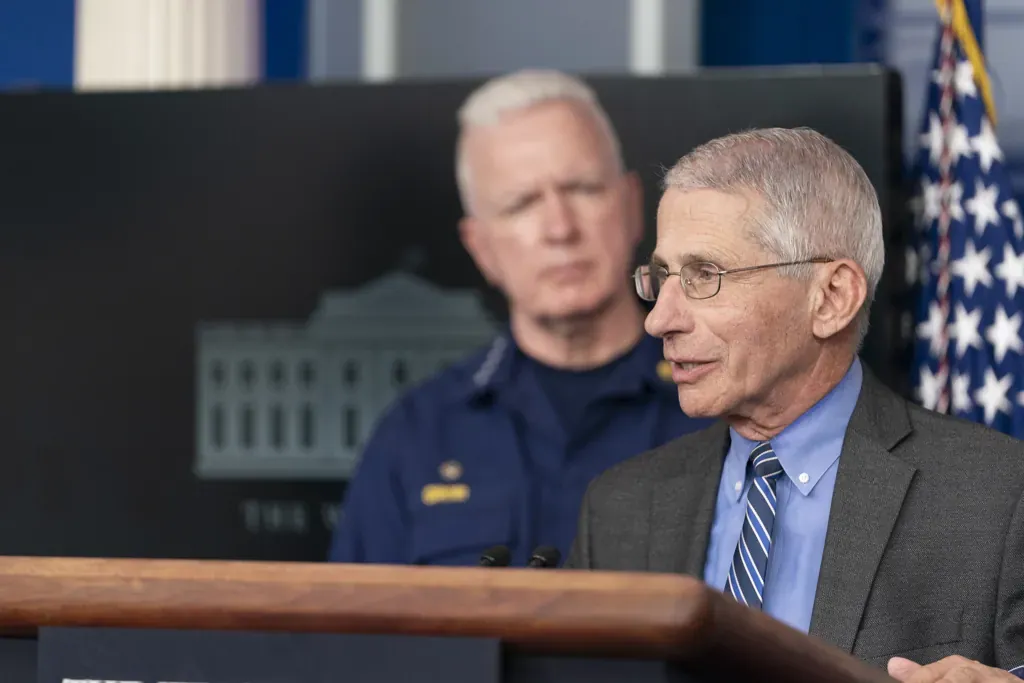
WASHINGTON – Dr. Anthony Fauci repeatedly invoked his Fifth Amendment right against self-incrimination during a Republican-led Senate committee hearing Wednesday, declining to answer more than 100 questions about his role in the U.S. response to the COVID-19 pandemic and his previous congressional testimony.
Fauci said in his opening statement that he was acting on the advice of his attorney in refusing to answer questions during the hearing, which had been called by Sen. Rand Paul, R-Ky., through a subpoena requiring Fauci to testify under oath.
Paul, who has repeatedly accused Fauci of misleading Congress during previous testimony, said the committee will vote next week on whether to hold the former National Institutes of Health official in contempt for refusing to answer lawmakers’ questions.

The hearing marked the latest chapter in a yearslong political dispute over the origins of COVID-19, federal pandemic policies and the conduct of public health officials during the global health emergency.
Hearing Focuses on Constitutional Rights and Prior Testimony
During the nearly three-hour hearing, Republican senators questioned Fauci about previous statements concerning the origins of COVID-19, federal research funding and pandemic-related policies.
Fauci declined to respond, repeatedly invoking his Fifth Amendment protections.
The Fifth Amendment to the U.S. Constitution protects individuals from being compelled to provide testimony that could incriminate themselves in criminal proceedings.
Democratic senators defended Fauci during the hearing, arguing that his decision to invoke the constitutional protection was lawful and that the proceedings were politically motivated.




Fauci has consistently denied allegations that he knowingly misled Congress.
He said he believed the hearing was intended to pressure him into making statements that could be used to support calls for criminal prosecution.
Contempt Vote Planned
Paul announced that the committee intends to vote next week on whether to hold Fauci in contempt of Congress because of his refusal to answer questions.
He did not specify whether he would seek a criminal contempt referral to the U.S. Department of Justice or pursue another enforcement mechanism.
Earlier in 2025, former President Joe Biden granted Fauci a presidential pardon. During the hearing, lawmakers discussed questions surrounding the legal implications of that pardon and Fauci’s continued reliance on Fifth Amendment protections.
Fauci’s attorney, David Schertler, was removed from the hearing after attempting to speak without being recognized by the committee chair.
Schertler later criticized the decision, calling the proceeding unfair and rejecting the allegations against Fauci.
Pandemic Origins Remain a Central Dispute
Questions about the origins of COVID-19 and federally funded research remained central to Republican lawmakers’ questioning.
Paul and other Republicans have argued that Fauci was not truthful about whether National Institutes of Health-funded research in China could have contributed to the emergence of the coronavirus.
Fauci has repeatedly rejected those allegations.
He has said he supports continued investigation into multiple possible origins of the virus while maintaining that available scientific evidence more strongly supports a natural origin than a laboratory-related explanation.
The hearing also revisited questions about gain-of-function research conducted at laboratories in Wuhan, China.
The NIH previously awarded grants to EcoHealth Alliance, a New York-based nonprofit organization that collaborated with a laboratory in Wuhan studying bat coronaviruses.
Fauci has previously said he was referring to a specific scientific definition of gain-of-function research involving enhanced risks when testifying before Congress. He has also maintained that the NIH-funded experiments cited by critics could not have produced the virus responsible for the pandemic.
According to the supplied material, a Republican-led congressional subcommittee that investigated the origins of COVID-19 in 2024 found no evidence linking Fauci to wrongdoing.
Political Debate Continues
The hearing reflected continuing divisions over the federal government’s handling of the pandemic.
Ahead of the hearing, Paul released more than 1,000 pages from Fauci’s personal pandemic diary, arguing the documents revealed differences between Fauci’s private views and his public statements.
According to the supplied material, portions of the diary had previously appeared in Fauci’s 2024 memoir and earlier public interviews.
Supporters of Fauci argued that allegations against him have not been supported by credible evidence.
More than 150 infectious disease specialists and other scientists signed a public letter before the hearing defending Fauci and stating that no credible evidence had been produced to substantiate the accusations against him.
Fauci served as a senior public health adviser under seven U.S. presidents and became one of the most recognizable public health officials during the COVID-19 pandemic.
He has also received death threats related to his public role during the health crisis.
The committee’s planned contempt vote is expected to determine the next congressional step in the continuing dispute over Fauci’s refusal to answer questions under oath.
This report is based on reporting by The Associated Press.