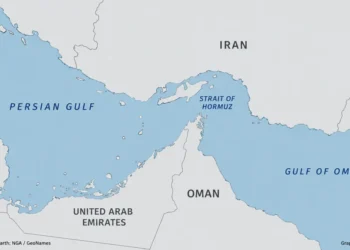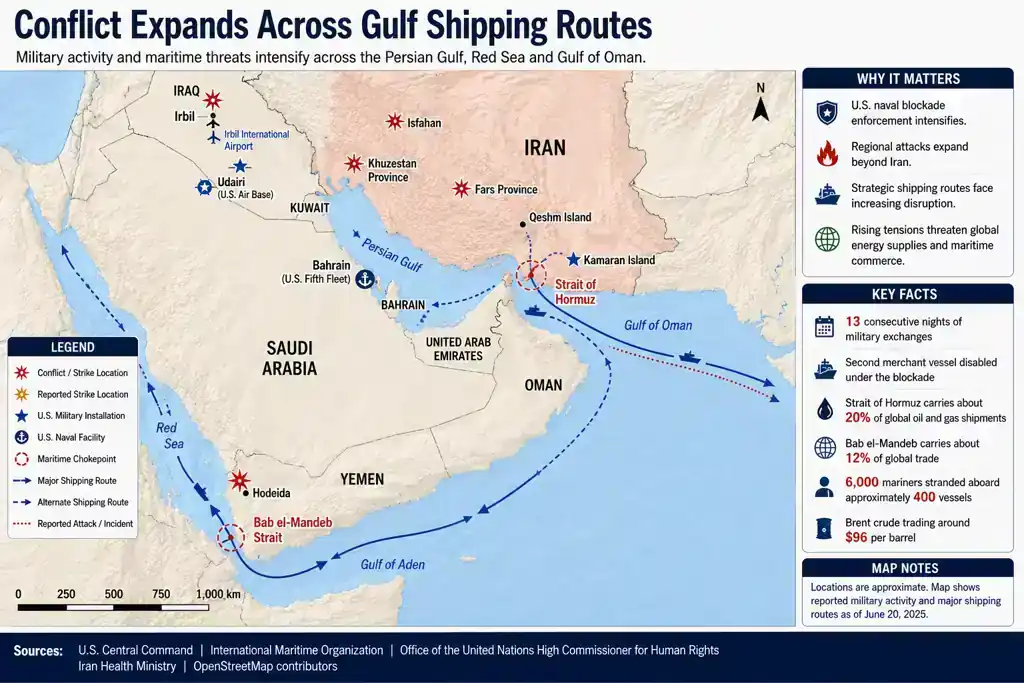
According to the U.S. military, American forces fired into the engine room of the M/T Lavine in the Gulf of Oman after the vessel ignored repeated warnings and attempted to pass through the blockade four times. Capt. Tim Hawkins, a spokesperson for U.S. Central Command, told The Associated Press the crew had been warned before the ship was disabled. It marked the second commercial vessel disabled since the blockade was reimposed.
The latest maritime confrontation unfolded during the 13th consecutive night of military exchanges between the United States and Iran, with neither government signaling any immediate willingness to de-escalate. The continuing conflict has increasingly threatened international shipping, regional security and global energy markets.
U.S. and Iran Maintain Military Pressure
President Donald Trump met Friday with senior national security advisers to review the administration’s strategy toward Iran and consider whether to maintain its current military campaign or expand operations, according to a U.S. official who spoke on condition of anonymity because the discussions were not public. The White House did not immediately comment on the meeting.

Speaking later in the Oval Office, Trump described ongoing negotiations with Iran as “by far the most serious that we’ve seen,” while saying he was “not in a hurry” to end the conflict despite continuing daily U.S. strikes.
Iranian Foreign Minister Abbas Araghchi rejected the prospect of yielding to American pressure, saying Tehran would not bow to U.S. “bullying.” In remarks carried by the semiofficial Tasnim news agency, Araghchi said Iran remained engaged in discussions with China and Russia and would not surrender under pressure.
Regional Attacks Expand Beyond Iran
Military activity widened across the region as U.S. and allied positions came under renewed attack.
Security officials in Irbil, Iraq, said U.S.-led forces intercepted five explosive drones targeting the northern city, where American military advisers are stationed. Multiple explosions were reported near Irbil International Airport, which hosts U.S. forces. U.S. military officials did not immediately comment on the reported attacks.
Iran’s Islamic Revolutionary Guard Corps separately claimed responsibility for attacks on the U.S. base at Udairi in Kuwait, saying it destroyed three ammunition and storage facilities. It also claimed to have struck a watchtower supporting the U.S. Navy’s Fifth Fleet headquarters in Bahrain.
■ Related News



U.S. Central Command did not immediately respond to the claims, which could not be independently verified.
Bahrain and Jordan each reported intercepting Iranian aerial attacks on Friday.
The United States also continued strikes inside Iran. Iranian semiofficial news agencies Fars and ISNA reported attacks on a Revolutionary Guard naval installation in northern Iran. Additional strikes were reported on Qeshm Island, as well as in Isfahan, Khuzestan and Fars provinces.
U.S. Central Command said the operations were intended to further reduce Iran’s capability to threaten civilian shipping and commercial vessels operating in regional waters.
Strategic Shipping Routes Face Growing Risks
The conflict has increasingly centered on maritime corridors that carry a substantial share of the world’s energy supplies.
Iran’s disruption of shipping through the Strait of Hormuz has pushed fuel prices higher and increased uncertainty across global energy markets. During normal conditions, the waterway carries roughly one-fifth of global oil and natural gas shipments.
Diplomatic efforts continued alongside the fighting. Iran’s state news agency reported that an Omani delegation visited Tehran on Friday to discuss management of shipping traffic through the strait as Oman continued mediation efforts between Washington and Tehran.
Regional tensions also intensified after Iran-backed Houthi rebels in Yemen attacked two Saudi oil tankers in the Red Sea on Thursday following threats to block Saudi-linked shipping through the Bab el-Mandeb Strait.
A Saudi transport authority official also reported that another Saudi vessel sustained minor hull damage in a separate attack Friday.
In response, Saudi Arabia launched strikes early Saturday on Yemen’s port city of Hodeida. The Saudi-led coalition said the operation followed repeated Houthi attacks on commercial shipping in the Red Sea.
Houthi-run Al Masirah television reported that the strikes hit telecommunications facilities and targets on Kamaran Island, injuring one telecommunications employee and one woman.
Saudi Arabia said it would take all necessary measures to protect commercial shipping and warned that continued Houthi attacks would prompt additional military action.
Trump has also warned of “major military punishment” if attacks on commercial vessels continue.
Economic and Humanitarian Impact Deepens
The conflict’s consequences have extended beyond military operations.
The Bab el-Mandeb Strait, linking the Red Sea with the Gulf of Aden, carries about 12% of global trade, including roughly one-quarter of worldwide container traffic. The route has become increasingly important as Saudi Arabia diverts oil exports to reduce reliance on the Strait of Hormuz.
Brent crude traded around $96 per barrel on Friday after easing slightly but remained well above its prewar level of about $72.
In the United States, the national average price of regular gasoline rose to $4.11 per gallon, according to AAA.
Iran’s Health Ministry said 3,434 people had been killed since the conflict began.
The International Maritime Organization reported that at least 6,000 mariners remained stranded aboard approximately 400 vessels near the Strait of Hormuz.
The Office of the United Nations High Commissioner for Human Rights said some seafarers had been abandoned by shipowners and lacked adequate food, water, fuel, electricity, medical care and reliable communication with their families.
Diplomatic Prospects Remain Uncertain
Despite continuing diplomatic contacts, there were no public indications that a breakthrough was imminent.
Pakistan’s Foreign Minister Ishaq Dar met Araghchi on Friday as Islamabad sought to encourage dialogue between the parties. Before the meeting, however, Araghchi suggested further mediation was unnecessary, arguing that Washington would first need to change its position before meaningful negotiations could progress.
The United States and Israel launched military operations against Iran on Feb. 28, stating that their objectives included degrading Iran’s nuclear program and, at times, encouraging political change in Tehran.
Israel also signaled continued coordination with Washington.
Prime Minister Benjamin Netanyahu’s office announced that he will travel to the United States next week for talks with Trump, indicating that military operations and diplomatic efforts remain closely linked as the conflict enters a new phase.
This report is based on reporting by The Associated Press.