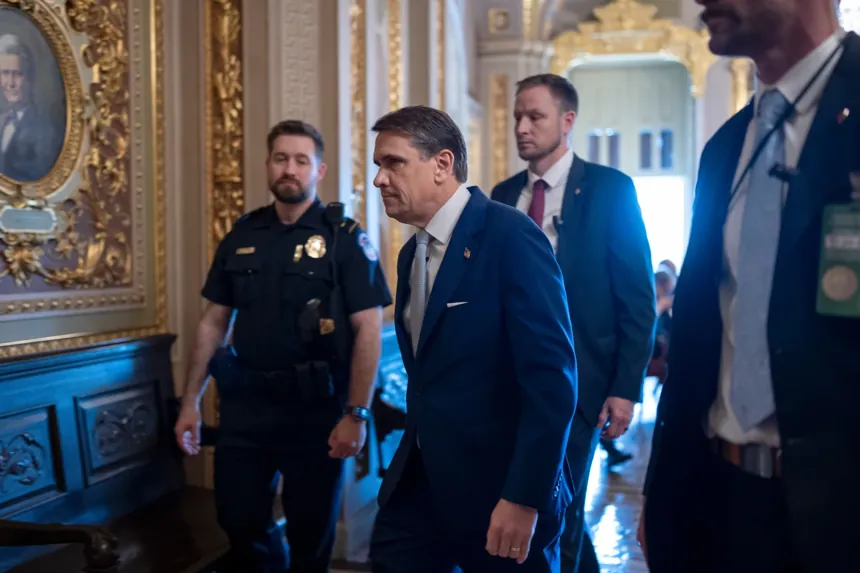
The Justice Department’s second-highest official has become the focus of growing Republican criticism after his involvement in reviewing a controversial settlement tied to financier Jeffrey Epstein, highlighting broader tensions over loyalty and accountability within former President Donald Trump’s political orbit.
According to Todd Blanche and officials familiar with the matter, scrutiny has intensified around the handling of a $1.8 billion victims compensation fund connected to Epstein’s estate, placing renewed political pressure on Justice Department leadership as Republicans debate institutional trust and allegiance to Trump.
The controversy has emerged as Blanche, a former defense attorney for Trump who now serves in a senior Justice Department role, attempts to reinforce his standing among conservative allies skeptical of perceived internal resistance within federal institutions. According to The Associated Press, Republican criticism has increasingly focused on whether senior officials are sufficiently aligned with Trump’s broader political agenda.

The episode reflects a wider pattern of institutional pressure facing Justice Department officials linked to Trump, particularly as Republican lawmakers and activists intensify scrutiny of legal oversight decisions tied to politically sensitive investigations.
Leadership Pressure Builds
Republican figures have questioned Blanche’s role in discussions involving the Epstein victims compensation arrangement, arguing that the matter has become politically symbolic beyond its legal dimensions. Critics have framed the issue as part of a broader debate over whether Trump-aligned officials inside federal agencies are willing to aggressively challenge prior institutional decisions.
Blanche has sought to defend his position by emphasizing his support for Trump and his record during high-profile legal battles involving the former president. His allies argue that the criticism reflects growing ideological divisions inside conservative circles over how aggressively the administration should reshape federal law enforcement institutions.
The dispute also underscores the increasingly narrow political space for senior Justice Department officials operating within Trump’s orbit. Loyalty tests and public scrutiny have become central dynamics as Republican factions seek greater influence over prosecutorial priorities and oversight mechanisms.
Institutional Accountability Expands
The political attention surrounding the Epstein-related fund has amplified concerns about transparency and internal decision-making within the Justice Department. While no allegations of wrongdoing have been formally established against Blanche, the controversy has fueled calls among some Republican activists for greater disclosure regarding how politically sensitive legal matters are handled.




Legal analysts note that the Justice Department has historically attempted to maintain operational independence from partisan political pressures. However, Trump-era political dynamics have increasingly blurred the line between institutional governance and loyalty-driven expectations from party supporters.
The issue may also carry broader implications for future staffing and leadership decisions inside federal agencies should Trump regain political power. Republican lawmakers and conservative groups have repeatedly advocated for deeper restructuring of the Justice Department and other federal institutions viewed as resistant to Trump’s agenda.
Political Stakes Continue to Grow
The controversy arrives at a politically sensitive moment as Trump allies continue shaping campaign narratives around government accountability, federal oversight, and institutional reform ahead of the 2026 election cycle. Justice Department officials connected to Trump remain under close observation from both Republican supporters and political opponents.
For Republicans, the debate surrounding Blanche reflects broader concerns about how loyalists inside government navigate legal controversies tied to politically explosive cases. For Justice Department leadership, the dispute highlights the continuing challenge of balancing institutional credibility with escalating partisan expectations.