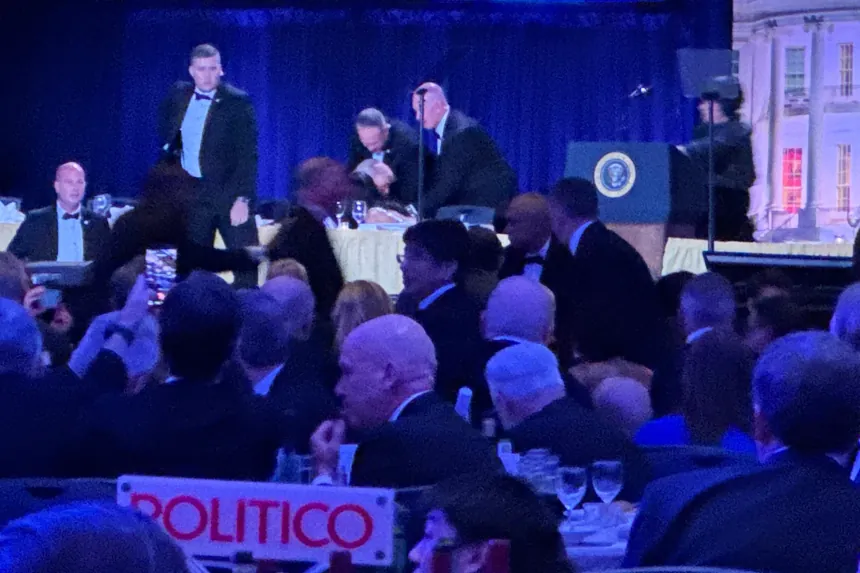
A sudden security scare disrupted the annual White House Correspondents’ Dinner in Washington, casting a sharp spotlight on the fragility of even the most tightly controlled political events. According to reporting by the Associated Press, gunfire erupted as an armed individual attempted to approach the venue, triggering an immediate law enforcement response and raising fresh concerns about protective protocols surrounding senior political figures, including Donald Trump.
Authorities confirmed that the former president, who was present at the event, was not harmed. The incident unfolded rapidly, with security personnel engaging the suspect before he could breach the ballroom area where journalists, officials, and public figures had gathered.
Command Response Tested Under Immediate Threat
The sequence of events placed security forces under intense, real-time pressure. Eyewitness accounts cited by the Associated Press describe a chaotic moment as law enforcement officers confronted the approaching suspect, with shots fired during the intervention. The suspect was ultimately neutralized before reaching the inner perimeter.

Officials have not disclosed full operational details, but the rapid containment suggests layered security measures functioned as designed—though not without exposing the narrow margins for error in such high-profile environments. The response is now expected to undergo formal review, particularly regarding perimeter control and early threat detection.
This incident reflects a broader pattern in which public-facing political gatherings increasingly require military-grade coordination, even in traditionally ceremonial settings.
High-Profile Gathering Exposes Perimeter Vulnerabilities
The White House Correspondents’ Dinner, hosted annually by the White House Correspondents’ Association, is widely regarded as a controlled environment with extensive pre-screening and coordination between federal and local agencies. Yet the suspect’s ability to approach the vicinity underscores a persistent challenge: managing external threat vectors beyond the immediate secure zone.
While the inner security ring remained intact, the breach attempt highlights the difficulty of securing transitional spaces—areas where public access intersects with restricted zones. These gray areas often present the highest risk, particularly during large-scale events involving multiple entry points and moving crowds.
Security analysts note that such incidents, even when contained, can recalibrate threat assessments for future gatherings involving political leadership or symbolic targets.



Political and Media Event Faces Renewed Risk Calculus
The dinner itself, a convergence of political leadership and the press corps, has long symbolized the intersection of governance and media accountability. However, the evolving threat landscape has steadily transformed its risk profile.
In recent years, heightened political polarization and increased threats against public officials have forced organizers to rethink event logistics. The attempted breach adds urgency to those discussions, potentially prompting stricter access controls, expanded surveillance perimeters, and reduced public-facing elements in future iterations.
For the White House Correspondents’ Association, the incident introduces a new layer of complexity: balancing openness and tradition with the imperative of security.
Federal Authorities Launch Investigation Into Motive and Gaps
Law enforcement agencies have initiated a full investigation into the suspect’s identity, motives, and possible affiliations. Authorities are also expected to examine whether any intelligence signals were missed in the lead-up to the event.
The outcome of this investigation could carry implications beyond a single incident. If systemic vulnerabilities are identified, adjustments may extend to other high-profile government and media events across the United States.
For now, the immediate takeaway is clear: even in environments designed for maximum control, the margin between order and disruption remains narrow. The incident at the correspondents’ dinner serves as a reminder that symbolic venues can quickly become focal points for security threats, requiring constant recalibration of protective strategies in an increasingly volatile landscape.