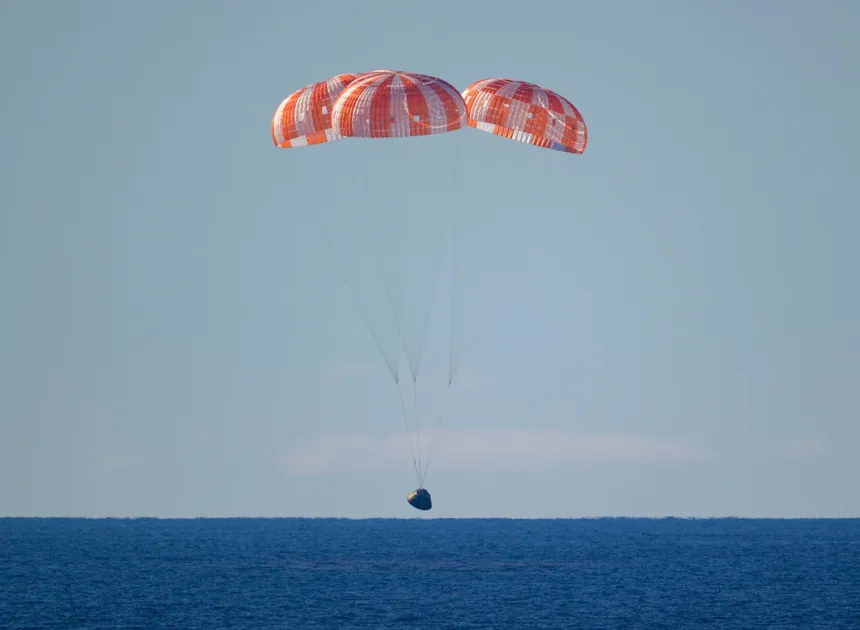
NASA’s Artemis II mission concluded with a Pacific splashdown after nearly 10 days in deep space, delivering the first crewed lunar flyby return in more than 50 years and generating critical engineering data for future moon missions. The flight’s most significant scientific value lies in its validation of Orion’s high-speed reentry systems, thermal protection architecture, and crew survivability under lunar-return conditions.
The mission did not attempt a landing or lunar orbit insertion, but it successfully tested the integrated performance of NASA’s Space Launch System and Orion spacecraft during a full crewed cislunar profile. Engineers will now use the reentry, communications blackout, and heat-shield performance data to refine spacecraft models ahead of the next phases of the Artemis program, which target docking rehearsals and eventual south polar surface operations.
Aboard the Orion capsule were NASA astronauts Reid Wiseman, Victor Glover, Christina Koch, and Canadian Space Agency astronaut Jeremy Hansen, whose mission also marked several historic firsts in crew diversity for lunar exploration. Beyond symbolism, the mission provided NASA with operational human-factors data on long-duration crew systems, consumables, and habitat performance in deep space.

Study Design and Mission Systems Validation
From a research and engineering perspective, Artemis II functioned as a full-scale experimental flight of NASA’s lunar transportation stack. The spacecraft traveled roughly 694,000 miles on a free-return trajectory that pushed the crew to a record 252,756 miles from Earth, surpassing Apollo 13’s human-distance benchmark.
The most consequential systems test came during atmospheric reentry, when Orion struck Earth’s upper atmosphere at roughly Mach 33. During this phase, the capsule encountered extreme plasma heating, causing a planned communications blackout that served as a real-world validation point for thermal simulations and reentry guidance models.
NASA and recovery teams are expected to conduct post-flight inspections of the ablative heat shield, parachute deployment sequence, and capsule structural integrity. These analyses are essential because lunar-return velocities impose substantially higher thermal and mechanical stress than low-Earth orbit missions.
Key Scientific and Operational Findings
The mission produced significant observational value despite its engineering-first design. Crew members documented unprecedented human-view imagery of the lunar far side and captured a total solar eclipse during the flyby, offering visual and positional datasets that may assist future mission planning and public science outreach.
Operationally, the flight also surfaced several manageable system anomalies, including valve-related issues affecting drinking water and propellant subsystems, as well as sanitation malfunctions. These are not minor footnotes in aerospace research reporting; such anomalies provide crucial failure-mode data that informs redundancy design and life-support upgrades for later Artemis missions.
■ Related News



One major insight from this phase is that the spacecraft maintained full mission success despite subsystem inconveniences, suggesting robust fault tolerance in Orion’s architecture.
Limitations and Uncertainty
While the splashdown represents a major milestone in space systems research, the mission remains a test flight rather than proof of readiness for sustained lunar surface operations. A flyby profile does not replicate the complexity of orbital rendezvous, lunar descent, surface habitat deployment, or extended polar mission logistics.
The spacecraft also returned with a limited sample size of one crewed reentry under lunar conditions. Aerospace engineers will need additional repeated mission data before confirming long-term reliability trends, especially for heat-shield wear, avionics resilience, and human-system performance.
Further uncertainty remains around budgetary, scheduling, and hardware readiness factors that could affect downstream Artemis timelines.
Broader Scientific Context
Artemis II’s strongest contribution to research lies in reducing uncertainty for future human lunar science campaigns. By demonstrating safe crew transport beyond Earth orbit and back, NASA has materially advanced the evidence base required for more complex exploration objectives, including south polar geology missions and eventual lunar infrastructure development.
The data from this mission is likely to shape not only Artemis III and IV flight rules, but also long-term systems engineering for Mars transit vehicles, where reentry protection, crew autonomy, and life-support resilience become even more critical.
Rather than a symbolic return to Apollo-era achievements, Artemis II represents a modern experimental platform for validating the technologies needed for sustained human research beyond Earth.