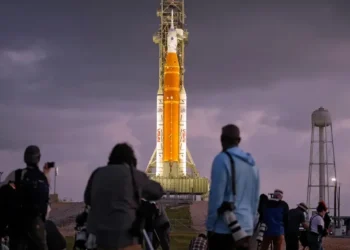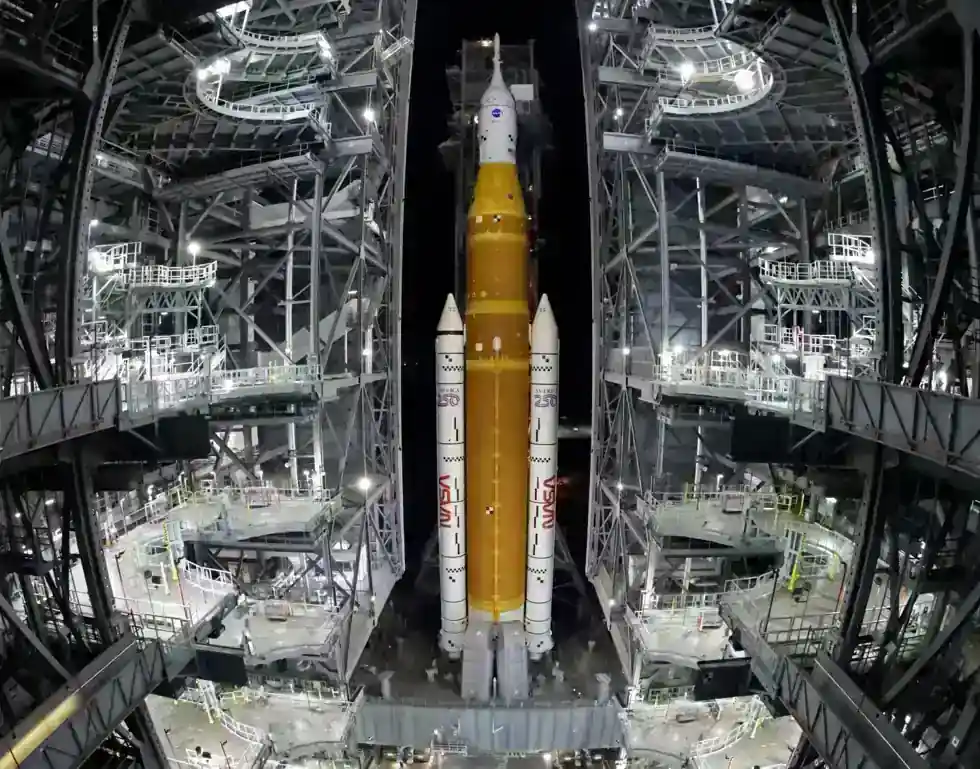
NASA has returned its massive Space Launch System (SLS) rocket to the launch pad at Kennedy Space Center, marking a renewed effort to launch the Artemis II mission following weeks of technical repairs and testing. The mission, which aims to send four astronauts on a lunar flyaround, could launch as early as April 1 if final checks proceed as planned.
According to NASA, the rocket had previously been rolled back to the Vehicle Assembly Building in late February after engineers identified hydrogen fuel leaks and issues within the helium system. The recent relocation to the pad follows corrective work intended to resolve those problems and prepare the vehicle for flight readiness.
The mission represents a key step in NASA’s broader Artemis program, which is designed to reestablish human presence around the Moon and eventually support future lunar landings.

Launch preparations and mission profile
The SLS rocket, standing 322 feet (98 meters) tall, was transported to the pad using NASA’s crawler-transporter, a system originally developed during the Apollo era. The slow 4-mile (6.4-kilometer) journey took roughly 11 hours and was delayed for several hours due to high winds.
NASA plans for the Artemis II mission to carry three American astronauts and one Canadian astronaut on a mission that will orbit the Moon before returning directly to Earth. The flight will not involve landing, but it is intended to validate the spacecraft’s systems in deep space conditions.
Technical challenges and delays
The current launch timeline follows a two-month delay caused by technical issues. Hydrogen fuel leaks detected during earlier testing required repairs at the launch pad, while complications in the helium system necessitated a return of the rocket to the assembly building.
Helium is used to pressurize and maintain proper fuel flow within rocket systems. NASA engineers determined that addressing the helium issue required controlled conditions inside the Vehicle Assembly Building, rather than on the launch pad.
Such delays are not uncommon in complex spaceflight programs, where multiple integrated systems must function precisely to ensure mission safety.
■ Related News



Artemis II in the broader scientific context
Artemis II is part of NASA’s effort to expand human spaceflight beyond low Earth orbit, a goal not achieved since the Apollo program. The last crewed lunar mission was Apollo 17 in 1972, marking more than five decades since humans last traveled to the Moon.
NASA has stated that the Artemis program will support long-term exploration goals, including establishing a sustained lunar presence and preparing for future missions to Mars. Artemis II serves as a critical crewed test flight for the Orion spacecraft and the SLS rocket, both of which are central to these ambitions.
Expert perspective and program implications
Spaceflight analysts note that Artemis II’s success is essential for validating the hardware and operational procedures required for future missions. While the mission does not land on the Moon, it will provide data on spacecraft performance, life support systems, and navigation in deep space.
NASA has emphasized that safety remains the top priority, and that all systems must meet strict technical requirements before launch approval. The current preparations reflect a cautious approach to human spaceflight testing, particularly following earlier delays tied to propulsion system concerns.
Limitations and ongoing uncertainty
Despite progress, NASA has not confirmed the final launch date, and further adjustments remain possible depending on final system checks and weather conditions. The recent delays highlight the complexity of integrating multiple systems in a human-rated launch vehicle.
Engineers will continue monitoring the rocket and capsule in the days leading up to the potential launch window. Additional tests may still be required before the mission is cleared for liftoff.