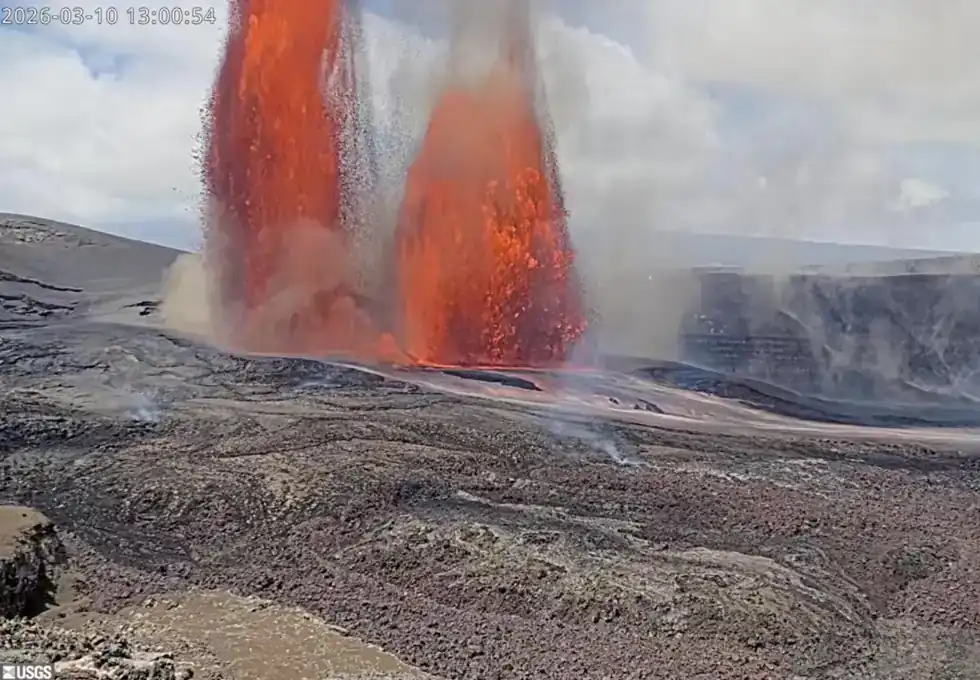
The latest Kilauea lava fountains surged to roughly 1,000 feet (300 meters) on Tuesday, according to officials monitoring the eruption on Hawaii’s Big Island. The activity triggered temporary closures within Hawaii Volcanoes National Park and sections of a nearby highway as volcanic ash and debris fell across surrounding areas.
Scientists say the eruption remains confined to the summit crater of Kīlauea, one of the world’s most active volcanoes. While no homes or buildings have been threatened, falling volcanic fragments—known as tephra—have affected nearby communities and transportation routes.
The latest episode is the 43rd eruptive phase recorded since the volcano began its current cycle in December 2024.

Eruption Activity and Measured Observations
Livestream monitoring showed two bright-red lava fountains and a plume of volcanic gases rising from the summit crater early Tuesday. According to volcanologists, fountain heights reached approximately 1,000 feet at peak intensity.
Observations indicate the molten rock remains contained within the crater. Eruptive episodes during the current cycle have varied in duration, lasting from a few hours to several days, scientists say.
Data collected by monitoring stations show periodic bursts of lava fountaining rather than a continuous eruption, reflecting fluctuations in underground magma pressure.
Ashfall and Tephra Impacts
Falling volcanic material prompted authorities to close areas around the summit of Hawaii Volcanoes National Park. Sections of Highway 11—an important transportation route circling the island—were also temporarily shut due to ash and tephra accumulation.
The ashfall warning was issued by the National Weather Service, which advised that airborne volcanic fragments could spread across nearby communities depending on wind direction.
■ Related News

County officials noted that tephra particles—small fragments of volcanic glass and rock—can irritate the eyes, skin, and respiratory system.
Community and Infrastructure Considerations
Officials in Hawaii County opened a temporary shelter at a district gymnasium for residents or visitors affected by the road closures or ashfall. Authorities reported that no evacuees had used the facility shortly after it opened.
Local authorities also warned that volcanic debris can clog water catchment systems, which many households on the Big Island rely on for rainwater collection.
During previous episodes in the eruption cycle, ash accumulation required civil defense crews to assist communities in clearing debris from homes and public spaces.
Scientific Context
Kīlauea has been erupting intermittently since December 2024, producing repeated lava fountain events within its summit crater. Volcanologists note that this type of eruption—characterized by episodic fountaining—can occur when gas-rich magma rises rapidly through volcanic conduits.
Because the activity remains within the crater, scientists say the immediate risk to residential areas is limited. However, ashfall and airborne volcanic fragments can still affect air quality, transportation, and infrastructure.
Researchers continue to monitor seismic activity, gas emissions, and magma movement to determine whether the eruption will intensify or subside.
What Remains Uncertain
Scientists say the duration of the current lava-fountaining episode is unclear. Past events during the eruption cycle have ended within hours, while others have continued for several days.
Wind conditions will also determine the extent of ashfall affecting nearby communities and roadways.
Volcanic monitoring agencies emphasize that conditions at active volcanoes can change rapidly, requiring ongoing observation and periodic public safety advisories.