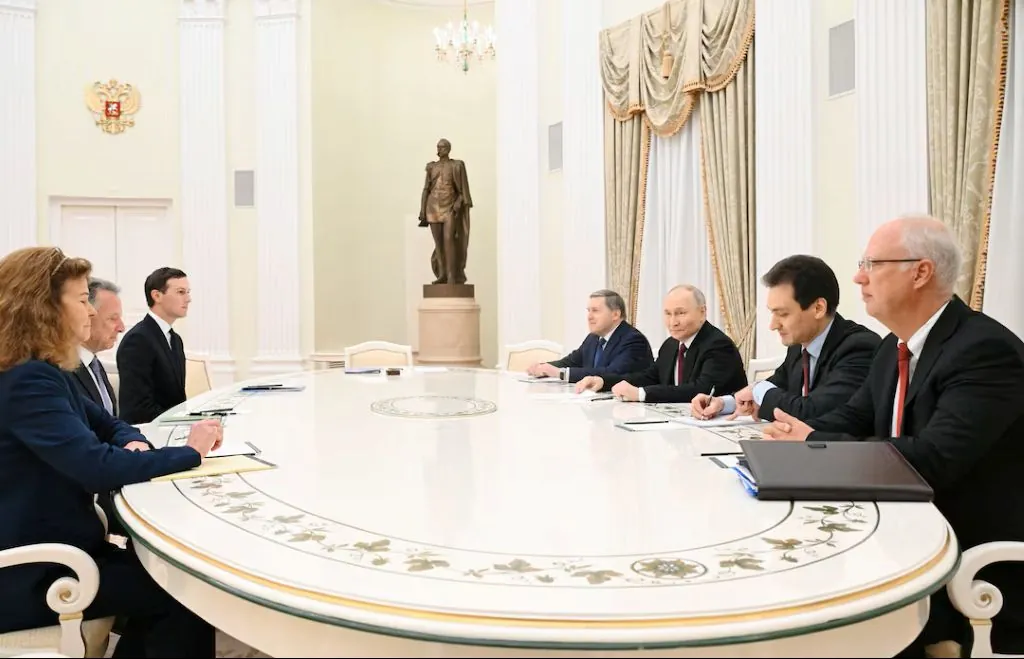
The Kremlin says discussions were exhaustive but produced no agreement on core territorial questions at the heart of the nearly three-year war.
Russia and the United States ended a rare, extended round of talks in Moscow without finding common ground on a potential peace framework for the war in Ukraine — a conflict that has reshaped European security, strained global alliances, and repeatedly tested Washington’s diplomacy. The Kremlin said the five-hour meeting between President Vladimir Putin and envoys representing U.S. President Donald Trump yielded no breakthrough, though both sides described the exchanges as serious and detailed.
The discussions, which stretched past midnight inside the Kremlin, marked one of the most direct attempts in months to explore a path toward ending Europe’s deadliest conflict since World War Two. Yet officials from both countries emphasized the distance that remains between their respective positions, particularly on the future of Ukraine’s eastern territories.

Trump, who has long characterized the war as an unresolved foreign-policy burden, sent real-estate executive Steve Witkoff and adviser Jared Kushner to Moscow as part of a push to establish what the White House called “exploratory channels.” The delegation’s visit, while informal in structure, signaled Washington’s interest in testing Russia’s stance amid shifting diplomatic dynamics and growing pressure from European governments wary of a fragmented peace process.
Putin Pushes Back on Key U.S. Ideas
Kremlin foreign-policy aide Yuri Ushakov, who attended the meeting alongside Putin, said the Russian president rejected several elements of the U.S. proposals. While he declined to reveal the specifics — reflecting a mutual decision to keep the substance of the talks private — Ushakov noted that Washington’s draft concepts contained “formulations unsuitable for Russia,” particularly concerning territorial arrangements.
Ushakov added that “compromises have not yet been found” and cautioned that further discussions would be essential before any framework could take shape. He emphasized that no follow-up meeting between Trump and Putin had been scheduled, describing the path ahead as technically complex and politically sensitive.
The talks were also attended by Kirill Dmitriev, head of Russia’s sovereign wealth fund and a long-time participant in back-channel U.S.–Russia outreach.
Following the meeting, Witkoff visited the U.S. embassy in Moscow to brief officials, according to the Kremlin. The White House later said the envoys were operating with the president’s full knowledge but stressed that no agreement had been tabled.
Territorial Questions Remain the Core Obstacle
One of the central points of contention remains the status of Donbas — a region Russia claims in full, though Ukrainian forces still control significant territory. Internationally, nearly all governments continue to recognize the entire region as part of Ukraine.
Ushakov referred to the issue as the “territorial problem,” repeating a phrase the Kremlin uses when framing its demands. Despite acknowledging that some U.S. draft proposals were “more or less acceptable,” he insisted the current gap between the two sides would require “detailed and sustained work.”
The conflict, now nearing its third anniversary since Russia’s February 2022 invasion, has resulted in tens of thousands of casualties and triggered the most severe confrontation between Moscow and the West in decades. The war has also upended energy markets, driven a wave of military reinvestment across Europe, and left Ukraine reliant on Western support as it absorbs repeated missile and drone attacks.
European Allies Uneasy About U.S. Diplomatic Track
The Moscow meeting came weeks after the leak of 28 U.S. draft peace proposals, which sparked anxiety among some European and Ukrainian officials. Critics said the documents appeared too accommodating of Russian territorial demands, raising fears of a settlement that would leave Kyiv with diminished sovereignty.
In response, key European states developed a counter-proposal, after which Washington and Kyiv worked on what they called an “updated and refined peace framework.” European leaders have repeatedly stressed that any settlement must safeguard Ukraine’s internationally recognized borders and avoid undermining long-standing international norms governing territorial integrity.
Ukrainian President Volodymyr Zelenskiy, speaking in Dublin ahead of the Moscow talks, warned that negotiations must be transparent and free of “games behind Ukraine’s back.” He signaled apprehension about the United States potentially shifting its position under political pressure, adding that “no easy solutions” were available for a conflict of this scale.
Kyiv’s concerns intensified after Putin issued fresh warnings over Ukraine’s access to the Black Sea — a critical channel for the country’s economy and global grain exports. The Russian president threatened to sever that access in response to recent drone strikes on Russian tankers linked to what analysts call Moscow’s “shadow fleet.”
Ukraine’s foreign minister, Andrii Sybiha, said those remarks demonstrated that Russia was not yet ready to consider a sustainable end to the war.
A War With No Quick Diplomatic Path
As Russia and the U.S. move cautiously through a renewed round of indirect diplomacy, both appear intent on projecting firmness. Trump told an audience in Washington that his representatives were in Moscow “to see if we can get it settled,” calling the situation “a mess” and citing monthly casualty figures that reflect the grinding nature of the conflict.
Putin, speaking separately, said Russia did not seek war with Europe but warned that if a conflict escalated, it would be resolved on Moscow’s terms. European policymakers interpreted the remarks as an attempt to pressure Western capitals at a moment of internal debate about long-term support for Ukraine.
Despite symbolic gestures — including the Trump envoys’ walk through Red Square before entering the Kremlin — the messaging from both governments suggests little immediate momentum toward a negotiated agreement. Instead, the talks reflect an early probe into whether any diplomatic architecture might eventually emerge.
For now, the path to peace remains as murky as ever, shaped by battlefield realities, domestic political pressures, and incompatible territorial claims. Both sides say dialogue will continue. Neither expects quick results.
This article was rewritten by JournosNews.com based on verified reporting from trusted sources. The content has been independently reviewed, fact-checked, and edited for accuracy, neutrality, tone, and global readability in accordance with Google News and AdSense standards.
All opinions, quotes, or statements from contributors, experts, or sourced organizations do not necessarily reflect the views of JournosNews.com. JournosNews.com maintains full editorial independence from any external funders, sponsors, or organizations.
Stay informed with JournosNews.com — your trusted source for verified global reporting and in-depth analysis. Follow us on Google News, BlueSky, and X for real-time updates.