U.S. stock indexes closed at fresh record highs Monday even as oil prices climbed sharply following renewed concerns over tensions involving Iran and the potential impact on global energy supplies.
Market data reported by the Associated Press showed investors largely looked past the jump in crude prices, with gains among major technology companies helping push the benchmark S&P 500, the Dow Jones Industrial Average, and the Nasdaq Composite to new highs. Oil prices rose after renewed fighting threatened a ceasefire involving the United States and Iran, raising concerns about energy shipments through the Strait of Hormuz.
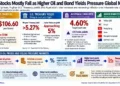
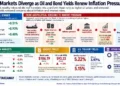
The S&P 500 advanced 0.3% to 7,599.96, while the Dow added 46.42 points to finish at 51,078.88. The Nasdaq Composite gained 0.4% and ended at a record 27,086.81, according to market data cited by AP.

Oil Market Pressure Fails to Derail Stocks
Brent crude settled at $94.98 per barrel, up 4.2% on the day, recovering part of its recent decline and remaining significantly above levels seen before the conflict intensified. Higher oil prices have contributed to inflationary pressures and raised concerns about the broader economic impact of elevated energy costs.
Companies with significant fuel expenses came under pressure as crude prices increased. Airline stocks were among the notable laggards, with United Airlines and Alaska Air Group posting declines during the session.
Despite those concerns, investors appeared encouraged by expectations that diplomatic efforts could eventually reopen the Strait of Hormuz and restore more stable oil flows from the Persian Gulf, easing pressure on energy markets and inflation.
Technology Giants Continue to Drive Market Gains
Large-cap technology companies remained the primary force behind the market’s advance.
Chipmaker NVIDIA surged 6.2% after Chief Executive Officer Jensen Huang unveiled several product updates during a company conference. Because of its large market capitalization, the stock’s movement had a substantial influence on the broader market indexes.


The concentration of market leadership among the largest technology companies continues to shape overall index performance. AP reported that the 10 biggest stocks now account for nearly half of the S&P 500’s total market value, highlighting the outsized role of a small group of companies in driving market gains.
Corporate Developments Add Support
Strong corporate earnings also contributed to investor confidence.
Science Applications International Corporation climbed 10.4% after reporting quarterly profit that exceeded analyst expectations and raising its outlook for future financial performance. Corporate disclosures cited by AP showed the company also benefited from newly secured government contracts.
Meanwhile, Berkshire Hathaway announced an agreement to acquire Taylor Morrison Home for $6.8 billion. Shares of Taylor Morrison surged more than 22% following the announcement, while Berkshire Hathaway finished modestly lower.
In another notable deal, MGM Resorts International jumped 16.1% after an offer emerged from Barry Diller’s company, formerly known as IAC, to purchase the remaining shares it does not already own.
Bond Yields and Economic Signals Remain in Focus
The bond market also reflected the influence of rising oil prices.
The yield on the 10-year U.S. Treasury briefly approached 4.52% before easing to 4.46% by the end of trading. Market data indicated yields were supported by both higher energy prices and stronger-than-expected manufacturing growth figures.
Higher borrowing costs remain a concern for smaller companies and interest-rate-sensitive sectors. The Russell 2000 index, which tracks smaller U.S. businesses, declined 0.5% as investors weighed the implications of elevated financing costs.
Global Markets Show Mixed Performance
International markets delivered a mixed picture.
Japan’s benchmark Nikkei 225 rose 0.9% to a record high, supported by strong gains in technology-related shares. In South Korea, the Kospi index advanced 3.7% after official trade data showed exports increased sharply in May, helped by robust global demand for semiconductors. European markets, however, generally moved lower.
While higher oil prices continue to pose risks for inflation and economic growth, investors appeared focused on corporate earnings strength and ongoing momentum in technology stocks, allowing Wall Street’s major indexes to continue their record-setting advance.