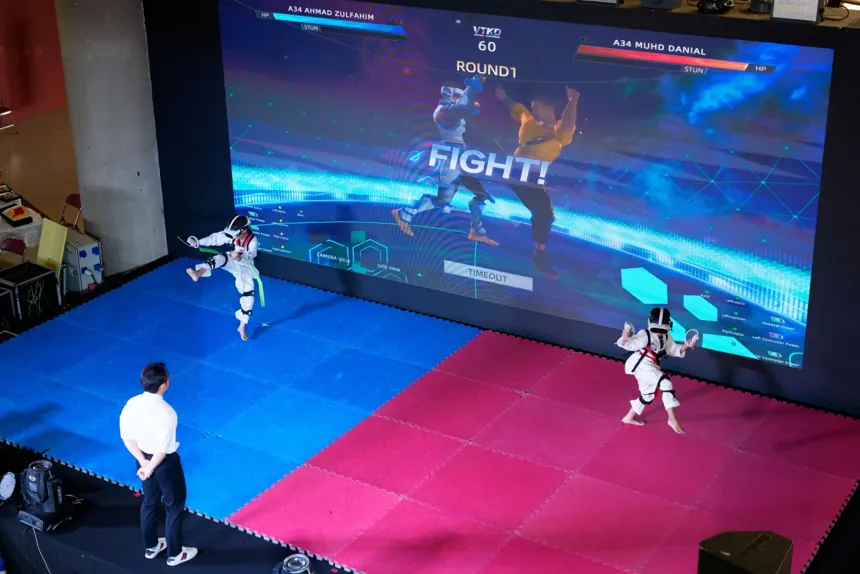
KUALA LUMPUR, Malaysia – Virtual taekwondo is moving from an experimental concept to an organized international competition as the discipline prepares to make its debut at this year’s Asian Games in Japan, reflecting growing interest in virtual reality-based sports across Asia.
Developed jointly by World Taekwondo and Singapore-based technology company Refract Technologies, the sport combines traditional taekwondo techniques with virtual reality technology. Athletes compete inside immersive digital environments while performing real physical movements, creating a non-contact competition that organizers say preserves athletic performance while reducing injury risks.
The technology has evolved rapidly since its early demonstrations. After being showcased during Singapore’s Olympic Esports Week in 2023, virtual taekwondo hosted its inaugural World Championships in Singapore in 2024. It is now scheduled to appear at the Asian Games and is expected to be included in the 2027 Southeast Asian Games in Malaysia, signaling broader institutional recognition.

Vietnamese athlete Nguyen Thanh Hien Linh experienced that evolution firsthand. Competing in her first virtual taekwondo event in Singapore in 2024, she said she initially struggled to understand both the technology and competition strategy despite already being an elite national taekwondo champion.
Two years later, Nguyen captured a gold medal at a virtual taekwondo competition in Malaysia after adapting to the distinct tactical and technical demands of the digital format.
How Virtual Reality Changes Competition
Unlike conventional taekwondo, athletes wear virtual reality headsets that place them inside a three-dimensional digital arena while motion-tracking sensors attached to their spine, thighs and shins capture body movements.
Competitors control digital avatars through physical kicks, movement and positioning. Rather than scoring physical contact, successful attacks reduce an opponent’s virtual health bar, with timing, speed and accuracy determining competitive performance.
The format also differs from traditional taekwondo by placing competitors of different ages, genders and weight classes into the same virtual competition environment.


According to coaches involved in the sport, athletes continue to perform authentic taekwondo techniques—including front kicks, turning kicks and spinning kicks—but success depends primarily on execution speed, positioning and decision-making rather than impact force.
Physical Demands Remain Central
Although the matches eliminate physical contact between opponents, athletes and coaches say the discipline remains physically demanding.
Malaysian coach Henry Lee said training begins with improving stamina, muscular endurance and flexibility before progressing to tactical decision-making and movement strategies inside the virtual environment. He said speed effectively replaces striking force as the key competitive advantage.
Athletes must also develop strong spatial awareness because they cannot directly see their opponents outside the virtual display. Instead, they rely on anticipation, movement prediction and rapid reactions while navigating the immersive arena.
Twelve-year-old Malaysian athlete Victoria Siow described the challenge as learning when to move and attack despite not physically seeing the surrounding space, saying the experience feels both game-like and dream-like.
Regional Interest Continues to Grow
Participants and coaches across Southeast Asia say interest has expanded steadily, particularly among younger athletes familiar with digital gaming.
Singapore national athlete Brian Peh said he entered the 2024 championship alongside his son out of curiosity, with both eventually winning gold medals. He now teaches virtual taekwondo at his training hall, arguing the technology channels children’s enthusiasm for gaming into physical activity.
Cambodian coach Vandy Yiv said families have increasingly embraced the discipline because competitors can participate without the injury risks associated with full-contact sparring. During one local tournament earlier this year, he said virtual taekwondo attracted more participants than traditional divisions.
Some newcomers reported experiencing dizziness while adapting to virtual reality headsets, though coaches said athletes generally become accustomed to the immersive environment over time.
Technology Access Remains a Challenge
Malaysia’s national virtual taekwondo coach Tony Lee said the sport remains in its early stages of development despite growing momentum.
He acknowledged that virtual reality equipment remains expensive, potentially limiting access in some parts of the region. However, he said increasing demand is encouraging clubs to invest in the technology, while Malaysia has already introduced national development programs and coaching certification courses to support expansion.
Lee also said younger generations’ familiarity with gaming technologies positions virtual taekwondo for continued growth as competitive virtual sports become more established.
For athletes such as Raja Mardiah Idris, the technology offers opportunities unavailable in conventional competition. She said virtual taekwondo allows older competitors and women to compete on equal terms in a non-contact environment, where success depends on technique, strategy and physical fitness rather than physical impact.
This report is based on reporting by The Associated Press (AP).
Topics: Virtual Taekwondo | Virtual Reality | Asian Games | Sports Technology | Motion Tracking | Refract Technologies | World Taekwondo | Southeast Asia