SEOUL, South Korea – Artificial intelligence is becoming an increasingly personal part of the grieving process in South Korea, where a growing number of families are commissioning AI-generated videos that recreate deceased relatives delivering heartfelt messages to surviving loved ones.
The emerging technology is offering comfort to some bereaved families by digitally recreating the appearance and voice of those who have died. At the same time, experts are raising concerns about the psychological and ethical implications of using AI to simulate the dead.
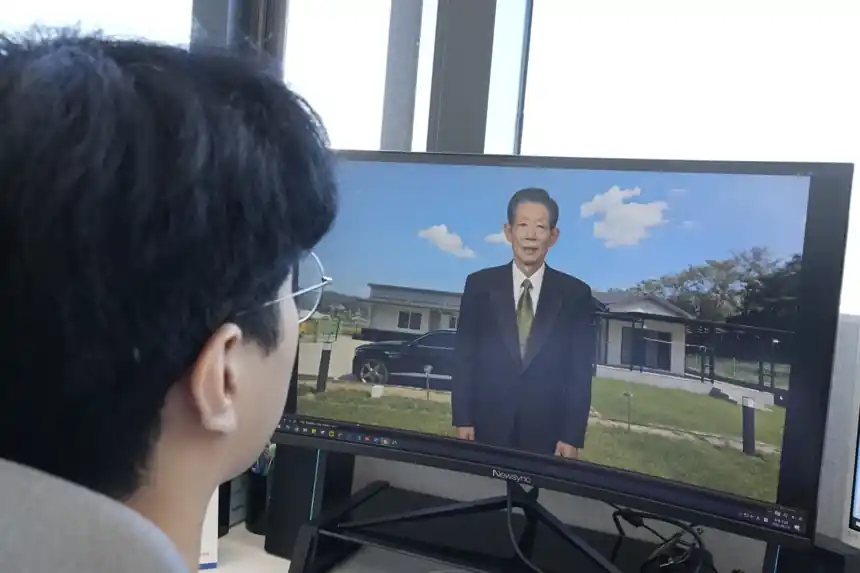
One such customer is 28-year-old office worker Lee Geon Hui, who commissioned an AI-generated video of his late grandfather as a gift for his father. Lee wrote the script himself, imagining the words his grandfather might have wanted to say.

The virtual recreation addressed Lee’s father as “my most precious son,” expressed regret for making him work on the family farm during childhood and apologized for opposing his decision to pursue a career as a hairstylist.
Lee said his father initially refused to watch the video but later viewed it and became emotional.
“My father said he wouldn’t watch the video. But then he did, and he shed tears. So I felt rewarded,” Lee said. “I wrote the script … as it was what I actually wanted to tell my father.”
Lee’s grandfather died in a car accident before Lee was born. He said seeing his father’s emotional reaction highlighted how deeply he still missed his own father decades later.
AI Memorial Videos Become a Growing Industry
South Korea has seen increasing interest in AI-powered memorial services as advances in generative AI make digital recreations more realistic.
■ Related News



Seoul-based startup Vaice says it now serves around 300 customers each month. According to CEO Jeongu Won, most clients are people in their 40s and 50s seeking AI-generated videos of deceased parents, while others create videos of grandparents as gifts for their parents.
The company typically requires several photographs and short voice recordings to recreate a person’s likeness. A standard three- to five-minute video costs approximately 600,000 won (about $390).
Won said families frequently play the videos during traditional memorial ceremonies or major Korean holidays when relatives gather to remember loved ones.
Many of the personalized scripts include expressions of love, unresolved regrets or messages of forgiveness that surviving family members wished they had shared before the person’s death.
Another company, JL Standard, introduced a similar service about five years ago. Executive Choi Yu Ha said public skepticism has eased over time as audiences have become more familiar with AI-generated recreations, including televised appearances featuring digital versions of deceased entertainers.
Experts Warn of Emotional and Ethical Risks
While supporters believe the technology can provide emotional closure, researchers caution that recreating deceased individuals also raises difficult questions about consent, privacy and mental health.
Yong Man Ro, an AI researcher at the Korea Advanced Institute of Science and Technology, described the technology as both beneficial and potentially disruptive because it directly affects human emotions.
“It’s a double-edged sword, as it deals with human emotions,” Ro said. “As AI technologies become part of people’s lives, they can also bring about cultural experiences and shocks that we have never experienced.”
Legal experts argue that clearer regulations are needed as AI becomes capable of producing increasingly lifelike digital replicas.
Choung Wan, an emeritus professor at Kyung Hee University Law School, said laws should protect the dignity and posthumous rights of deceased individuals. He suggested AI recreations should not be permitted if the individual explicitly opposed such use before death and called for limits on commercial use of a person’s image and voice.
Future AI ‘Griefbots’ Present New Challenges
Researchers believe ethical concerns could become even more complex if AI systems evolve beyond one-way video messages into interactive “griefbots” capable of carrying on extended conversations with bereaved family members.
Several startups are already experimenting with conversational AI designed to simulate deceased individuals.
Choung warned that healthy grieving typically involves accepting the reality of loss and that prolonged conversations with AI replicas could interfere with that process.
“Psychologically, a healthy mourning involves a process to acknowledge the absence of the deceased and pass through the pains of their losses,” Choung said. “But speaking with an AI system simulating a living person could undermine the process of accepting deaths and rather cause a negative effect of leaving bereaved families trapped in a fantasy.”
Won said Vaice is proceeding cautiously regarding conversational AI because unsupervised interactions could create unforeseen ethical issues.
Technology Advances Continue
AI-generated memorials are becoming increasingly realistic as image generation and voice synthesis technologies improve.
Choi said today’s systems can reproduce details as fine as facial wrinkles and skin texture, leading many customers to feel the digital recreations closely resemble their loved ones.
Ro, whose own parents died last year, created a one-minute AI-generated video that he shared with his siblings during a family gathering. The digital versions of their parents encouraged them not to worry and to take care of themselves.
Although the experience was deeply moving, Ro said the family viewed the video only once.
“One time was enough to watch it to honor our late parents who were quite elderly. We moved on,” he said.
Tags: Artificial Intelligence, AI Memorials, Generative AI, South Korea, Digital Afterlife, AI Ethics, Grief Technology, Emerging Technology, Digital Humans, AI Regulation