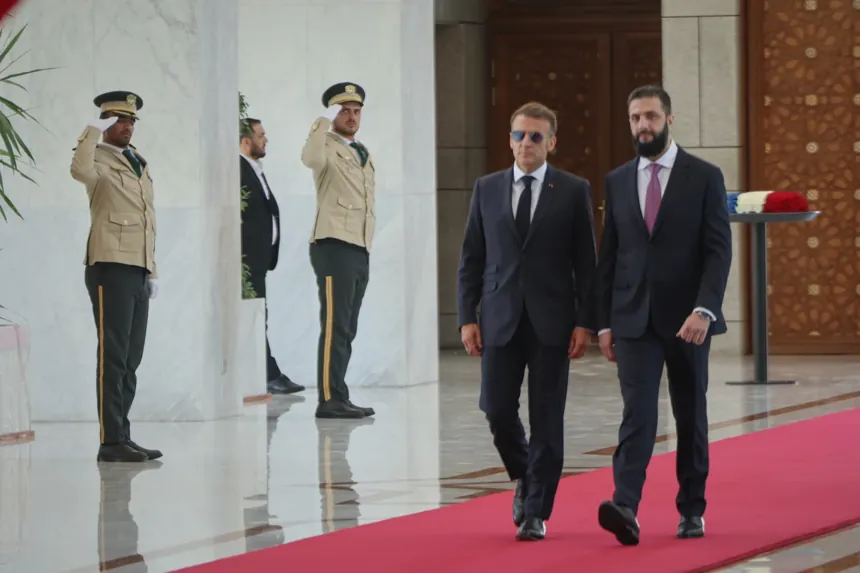
DAMASCUS, Syria – Explosions struck central Damascus on Tuesday while French President Emmanuel Macron was meeting Syrian President Ahmad al-Sharaa, injuring at least four people and underscoring the security challenges facing Syria as it seeks international engagement and post-war reconstruction.
According to Syrian state media, two explosions occurred near the Four Seasons Hotel, where Macron was reportedly staying during his visit. The French president’s office confirmed he was safe and that his meeting with al-Sharaa at the presidential palace continued as scheduled.
Macron is the first major Western leader to visit Syria since al-Sharaa assumed power following the ouster of Bashar Assad in 2024. The visit comes ahead of Macron’s planned attendance at a NATO summit in Ankara, Turkey.

Explosive Devices Hit Central Damascus
Syrian state television, citing an unnamed security official, reported that the blasts were caused by two explosive devices. One had been placed inside a garbage bin, while the other was hidden in a parked vehicle.
Authorities said four people were injured, including several police officers. No fatalities were immediately reported.
Security officials launched an investigation into the attack.
A large plume of smoke rose above the area, which is located on a busy street near the Ministry of Tourism and the Damascus National Museum.
Videos circulating on social media showed a van and a motorcycle engulfed in flames, while bloodstains were visible on the roadway.
■ Related News



No group immediately claimed responsibility for the attack.
Macron Presses Ahead With Diplomatic Visit
Despite the explosions, Macron continued his diplomatic meetings with Syrian officials.
His visit is intended to strengthen ties with Syria’s new leadership and encourage international investment as the country begins rebuilding after more than a decade of conflict.
Macron arrived in Damascus on Monday with a business delegation and is expected to sign several memorandums of understanding with al-Sharaa aimed at expanding economic cooperation.
The French president has been among the strongest advocates in Europe for easing international sanctions on Syria, urging both European and U.S. leaders to lift many of the restrictions imposed during the Assad era.
Before meeting al-Sharaa, Macron also held discussions with representatives of Syrian civil society, although French officials did not disclose the participants.
Security Challenges Persist
Tuesday’s explosions came only days after another bombing near the Justice Palace in Damascus, where an explosive device detonated inside a café, killing at least 10 people and injuring more than 20.
The latest attack highlights the ongoing security risks confronting Syria’s new government despite efforts to restore stability.
Since taking office, al-Sharaa has sought to consolidate control across the country, reassure minority communities concerned about his Islamist-led administration and strengthen relations with Western governments.
Although Damascus has remained relatively calm compared with other parts of Syria, sporadic violence continues as authorities work to establish nationwide security.
Reconstruction Remains a Priority
Syria continues to face enormous reconstruction challenges after nearly 14 years of civil war.
The conflict killed nearly half a million people, displaced millions more and devastated much of the country’s infrastructure.
While several governments and international companies have pledged investment, economists estimate that rebuilding Syria will require hundreds of billions of dollars to restore infrastructure, revive the economy and address widespread poverty.
Macron’s visit reflects growing international engagement with Syria’s new leadership as the country seeks diplomatic normalization and financial support for reconstruction despite persistent security concerns.
This report is based on reporting by The Associated Press.
Topics: Syria | France | Emmanuel Macron | Damascus | Ahmad al-Sharaa | Middle East | Reconstruction | World News