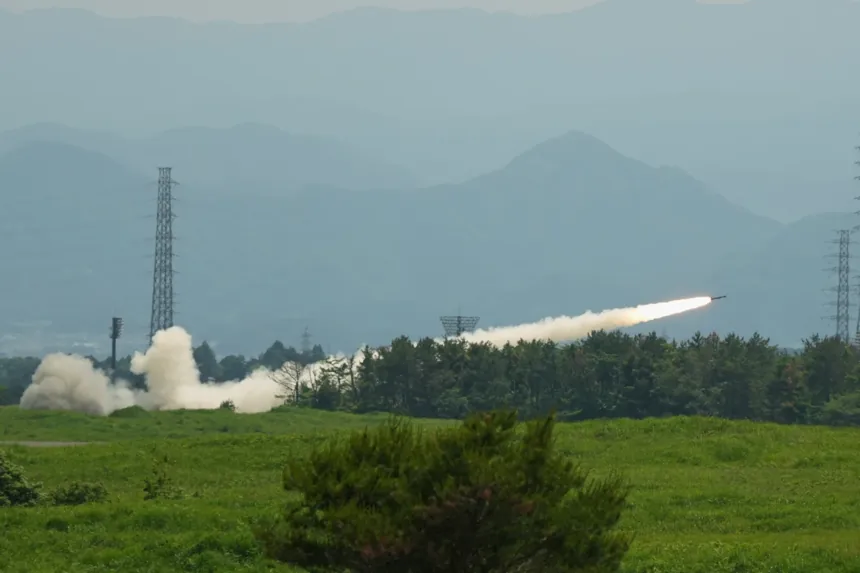
GOTEMBA, Japan — U.S. Marines conducted a rapid-fire rocket exercise near Japan’s Mount Fuji this week, underscoring deepening military coordination between Washington and Tokyo as regional tensions in the Indo-Pacific continue to rise. The drill showcased the High Mobility Artillery Rocket System (HIMARS), a mobile precision-strike platform increasingly central to U.S. deterrence planning in Asia.
The exercise took place at Camp Fuji, southwest of Tokyo, where U.S. forces launched a dozen dummy rockets during what military officials described as a “shoot and scoot” operation designed to test rapid deployment and repositioning capabilities. The tactic allows launchers to fire quickly and relocate before enemy counterstrikes can target their position.
Military analysts say the drills reflect growing concern over modern battlefield threats, particularly the expanding use of drones and long-range surveillance systems that make static military positions increasingly vulnerable. HIMARS launchers are mounted on highly mobile trucks, enabling rapid concealment and redeployment across contested environments.

Indo-Pacific Deterrence Strategy Intensifies
The exercise also carries broader geopolitical significance as the United States and its regional allies strengthen military preparedness amid concerns over China’s expanding military activity near Taiwan and across the East China Sea.
According to defense analysts, HIMARS systems equipped with advanced precision-guided missiles could potentially strike targets across the Taiwan Strait if deployed on Japanese or nearby allied islands. The systems have become a major component of U.S. expeditionary warfare planning in the Pacific region.
China claims Taiwan as part of its territory and has repeatedly stated it reserves the option of using force to achieve reunification. Washington has increased joint exercises with regional allies in recent years to reinforce deterrence and demonstrate rapid-response capabilities.
Japan-US Military Cooperation Deepens
Japanese military forces coordinated closely with U.S. Marines during the operation, including temporary road closures near the firing zone to ensure public safety. Officials described the exercise as part of broader bilateral defense cooperation aimed at improving operational readiness.
This marked only the second HIMARS live-fire exercise conducted at Camp Fuji, highlighting Japan’s growing willingness to support advanced allied military training amid shifting regional security conditions. Analysts noted that Tokyo has steadily expanded defense cooperation with the United States following recent increases in regional missile activity by China and North Korea.



The HIMARS system has previously been used in conflicts in Iraq and Afghanistan and was recently referenced by U.S. Central Command in operations involving precision-guided strikes in the Middle East. Its mobility and long-range capability have made it one of the most closely watched artillery systems in modern warfare.
Regional Security Concerns Continue
The Mount Fuji exercise comes amid wider efforts by the United States and its allies to improve military interoperability across the Indo-Pacific. Security experts say the region is increasingly becoming the central theater for strategic competition between Washington and Beijing.
Defense officials have emphasized that the drills are defensive in nature, though Beijing has repeatedly criticized expanded U.S.-Japan military cooperation as destabilizing to regional security.