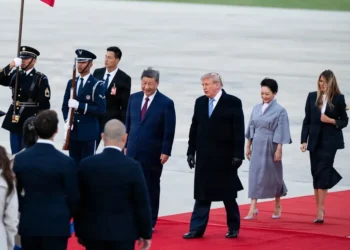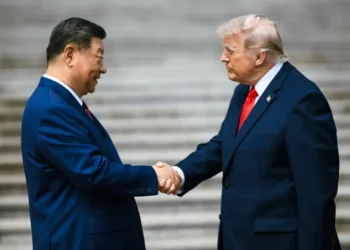
The United States’ expanding military commitment in the Iran conflict is forcing a renewed contraction of its strategic footprint in Asia, complicating Washington’s long-stated effort to prioritize the Indo-Pacific at a moment of rising friction with China. As first reported by The Associated Press, the diversion of military assets and senior-level attention has already delayed President Donald Trump’s planned summit with Chinese leader Xi Jinping, sharpening concerns among allies that regional deterrence may be weakening.
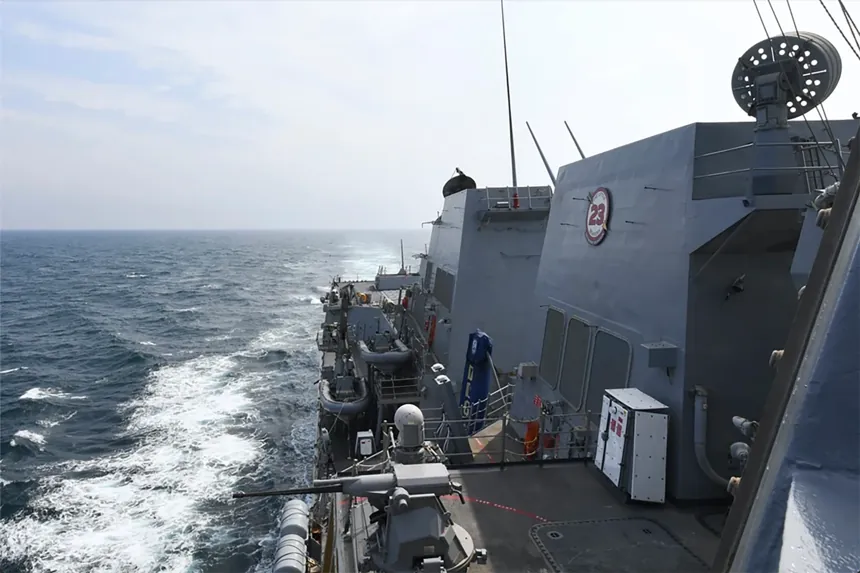
What had been framed for years as the central theater of long-term U.S. competition is now facing immediate resource compression. Missile defense systems, naval capacity, and crisis-management bandwidth are increasingly tied to the Gulf, forcing policymakers in Tokyo, Taipei, Seoul, and Manila to reassess how durable Washington’s Asia commitments remain if the Middle East war extends deeper into 2026.
The strategic significance goes beyond troop movement. Trump’s postponed China trip now lands in a more difficult diplomatic environment, one in which Beijing can approach the summit with fresh evidence that U.S. force projection remains vulnerable to multi-theater stress.

Strategic Depth in Asia Narrows Under Middle East Pressure
Fifteen years after Washington’s original “pivot to Asia,” the current Iran war is exposing the same structural weakness that has repeatedly constrained U.S. grand strategy: simultaneous crisis management across multiple theaters. According to AP reporting, military resources previously positioned to reinforce deterrence in the western Pacific have been reallocated as Washington intensifies pressure on Iran’s missile and nuclear capabilities.
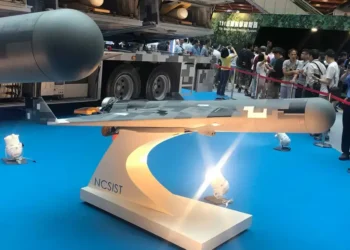
This narrowing of strategic depth is especially consequential for Taiwan contingency planning. Any perception that U.S. munitions stockpiles, naval readiness, or rapid reinforcement capabilities are being thinned by Middle East operations could alter Beijing’s assessment of timing and risk.
The contraction is therefore not merely logistical. It is strategic signaling, and both allies and adversaries are reading it in real time.
Alliance Confidence Faces a New Deterrence Test
Across Asia, the longer-term concern is credibility rather than immediate force levels. Regional governments have historically calibrated their defense postures around assumptions of U.S. availability during simultaneous crises. That assumption is now under renewed scrutiny.
As regional officials cited in broader defense discussions have warned, prolonged Gulf commitments could weaken the visible reassurance mechanisms that underpin U.S.-led deterrence architecture — from rotational deployments to missile defense interoperability and joint exercises.




Japan and South Korea may respond by accelerating autonomous defense procurement, while Taiwan could press for faster weapons transfers and domestic stockpiling. Southeast Asian partners, already wary of policy inconsistency, may increasingly hedge toward Beijing if Washington’s military focus appears structurally overstretched.
That dynamic turns a Middle East war into an Asia credibility problem.
Beijing Gains Diplomatic Leverage Before the Summit
The delay in Trump’s China meeting alters more than scheduling optics. It gives Beijing additional leverage in shaping summit expectations around trade, Taiwan, maritime security, and semiconductor access.
With Washington’s top-level foreign policy machinery partially consumed by Iran, China enters the diplomatic window with a narrower need to react and a broader opportunity to observe. Analysts have increasingly noted that Beijing can study U.S. operational patterns, alliance coordination speed, and political tolerance for prolonged conflict — lessons directly relevant to any future Taiwan Strait scenario.
The summit, once expected to project U.S. strategic steadiness, may now instead unfold under the shadow of force dilution.
That perception alone can reshape negotiating leverage.
A Two-Theater Burden Redefines America’s Strategic Priorities
The deeper policy question is whether the United States can sustain credible primacy in Asia while re-entering large-scale Middle East confrontation.
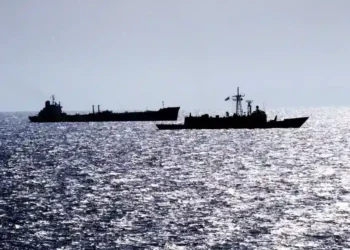
The Iran war is increasingly testing not only military inventories but also Washington’s hierarchy of priorities. A prolonged blockade, wider regional retaliation, or sustained naval deployment in the Strait of Hormuz would intensify this compression further, raising difficult choices over carrier positioning, missile defense allocation, and Indo-Pacific contingency readiness.
The consequence is a familiar but now more acute reality: the Indo-Pacific remains the declared strategic priority, yet the Middle East continues to dictate operational urgency.
That contradiction may define the Trump-Xi summit before either leader enters the room.