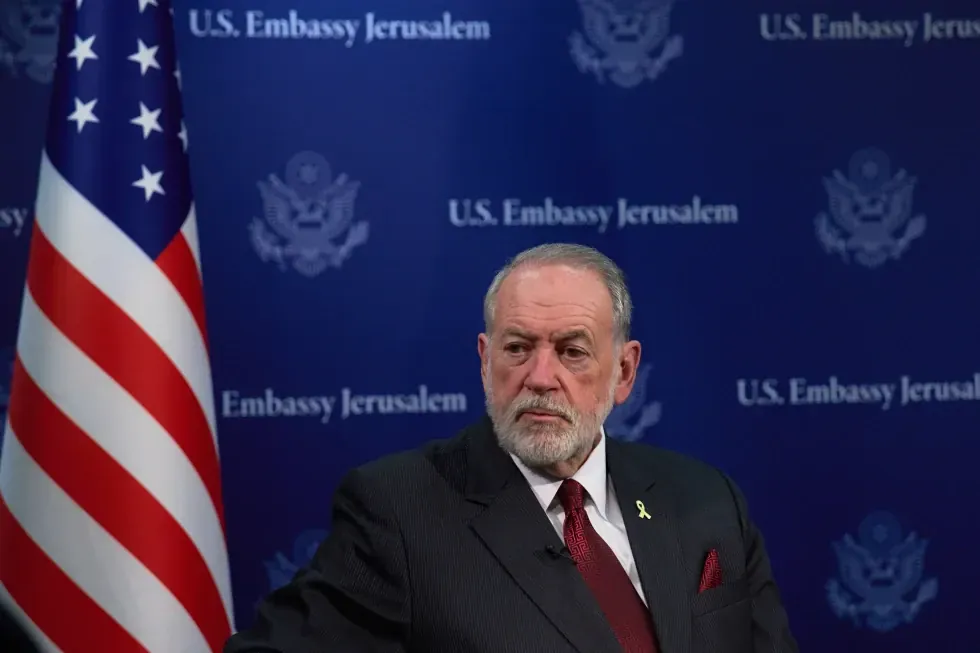
TEL AVIV, Israel (Journos News) – The U.S. ambassador to Israel, Mike Huckabee, has drawn sharp criticism from Arab and Muslim governments after suggesting in a televised interview that Israel would be justified in claiming extensive territory across the Middle East. The remarks, made during a conversation with conservative commentator Tucker Carlson, prompted formal rebukes from several regional powers and multilateral organizations.
The comments have added to diplomatic tensions at a time of fragile ceasefires and shifting front lines across the region. While there was no immediate response from Washington or Jerusalem, the statements were widely interpreted by neighboring countries as contradicting long-standing international consensus on borders and sovereignty.
In the interview, which aired Friday, Carlson cited biblical passages describing land promised to the descendants of Abraham and asked Huckabee whether Israel had a right to that territory — an area that would encompass much of the modern Middle East. Huckabee replied: “It would be fine if they took it all,” before adding that Israel is not seeking territorial expansion and has a right to security within the land it legitimately holds.

Saudi Arabia’s Foreign Ministry described the comments as “extremist rhetoric” and “unacceptable,” calling on the U.S. State Department to clarify its position. Egypt said the remarks constituted a “blatant violation” of international law and reiterated that Israel holds no sovereignty over occupied Palestinian territory or other Arab lands.
The League of Arab States said such statements were “extremist and lacking any sound basis,” warning they could inflame religious and national sentiments. Condemnations also came from Jordan, Kuwait, Oman and the Organization of Islamic Cooperation, reflecting broad regional unease.
Historical Borders and Ongoing Disputes
Since its establishment in 1948, Israel has not had fully recognized borders. Its frontiers have shifted through wars, armistice agreements, annexations and peace treaties. The status of territories captured during the 1967 Arab-Israeli war remains central to the Israeli-Palestinian conflict.
In that war, Israel took control of the West Bank and east Jerusalem from Jordan, Gaza and the Sinai Peninsula from Egypt, and the Golan Heights from Syria. Israel later returned the Sinai to Egypt under a peace agreement following the 1973 war and withdrew from Gaza in 2005. The West Bank and east Jerusalem, however, remain occupied territories under international law, a designation Israel disputes.
In recent months, Israel has expanded settlement construction in the West Bank, legalized certain outposts and implemented administrative changes consolidating its control. Palestinians seek an independent state in the West Bank and Gaza Strip, with east Jerusalem as its capital — a position backed by much of the international community.
■ Related News



Huckabee, an evangelical Christian and longstanding supporter of Israel and the West Bank settlement movement, has previously opposed the two-state framework that has underpinned decades of international diplomacy. In past interviews, he has also rejected the use of the term “Palestinians” to describe Arab residents whose families lived in the territory during the British Mandate period.
During the Carlson interview, the host referenced the biblical Book of Genesis and described territory stretching “from the Nile to the Euphrates,” encompassing areas of present-day Jordan, Syria, Lebanon, Saudi Arabia and Iraq. Huckabee responded cautiously to the geographic scope but did not retreat from his broader assertion.
Regional Tensions Amid Ongoing Conflict
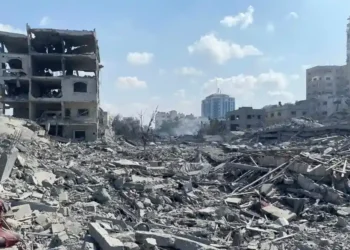
The controversy unfolds against the backdrop of continuing hostilities and ceasefire arrangements following the Hamas-led attack on southern Israel on Oct. 7, 2023, which triggered Israel’s war in Gaza. Under a current ceasefire framework, Israeli forces have withdrawn to designated buffer zones but retain control over significant portions of the territory. The agreement does not specify a firm timeline for further withdrawals.
Beyond Gaza, Israel has also asserted control in other border areas. After the ouster of Syrian President Bashar Assad at the end of 2024, Israeli forces moved into a demilitarized buffer zone in Syria established under a 1974 ceasefire agreement. Israel described the move as temporary and aimed at safeguarding its frontier.
In Lebanon, Israeli troops continue to occupy several hilltop positions following a brief conflict with Hezbollah in 2024. These developments have reinforced regional sensitivities regarding territorial claims and military presence.
While Huckabee’s comments were made in a personal interview rather than an official policy statement, their diplomatic impact has been immediate. Arab governments, already wary of shifting geopolitical dynamics, appear to view such remarks as undermining established legal frameworks governing sovereignty and occupation.
As of Saturday, neither the U.S. State Department nor Israeli officials had publicly clarified whether the ambassador’s comments reflect current U.S. policy. For now, the episode underscores the enduring volatility of territorial questions in the Middle East — issues rooted in history, religion and international law, and capable of igniting controversy far beyond a single interview.
Source: AP News – US ambassador causes uproar by claiming Israel has a right to much of the Middle East