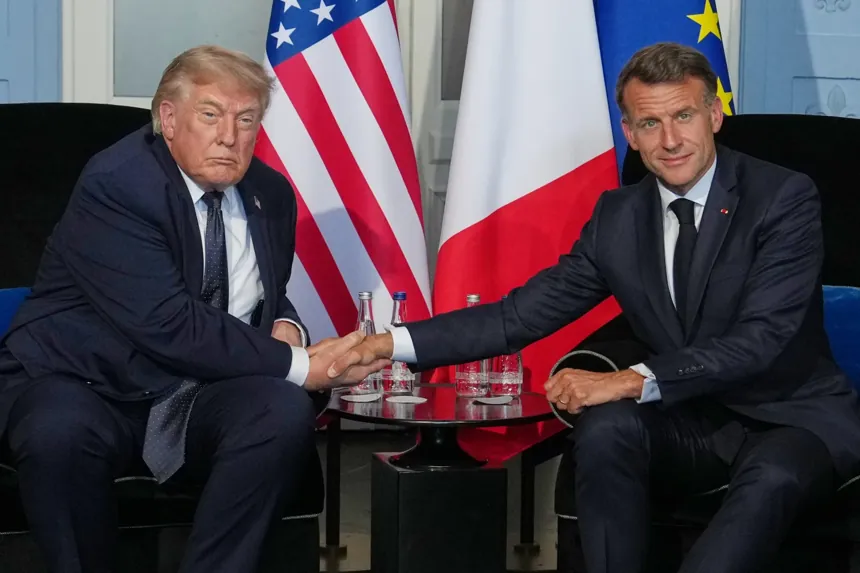
EVIAN-LES-BAINS, France – U.S. President Donald Trump arrived at the Group of Seven summit in France on Monday seeking to build momentum from a newly announced agreement aimed at ending the conflict between the United States and Iran, a development he described as a potential breakthrough for international stability and global energy markets.
Speaking alongside French President Emmanuel Macron in Evian-les-Bains before joining fellow leaders for summit discussions, Trump portrayed the agreement as a significant diplomatic achievement that could improve security in the Middle East and ease economic pressures linked to the conflict.
“The Iran deal that we made is going to bring a lot of success to the world,” Trump said, while also pointing to falling oil prices and rising stock markets as signs of growing investor confidence.

While Trump outlined broad expectations for the agreement, several key provisions remain under negotiation. He said a memorandum of understanding is expected to be finalized later this week, with further talks scheduled over the next two months.
Iran Agreement Alters Summit Dynamics
The announcement comes as Trump meets leaders from several allied nations that had previously criticized Washington’s handling of the 15-week conflict with Iran.
French President Emmanuel Macron welcomed the reported breakthrough, describing it as an important development for international peace.
The agreement is expected to feature prominently during the three-day summit, where leaders are discussing global security, economic stability and ongoing conflicts affecting international markets.
One immediate priority involves restoring commercial shipping through the Strait of Hormuz, a strategic waterway that plays a critical role in global energy supplies.
■ Related News



According to senior U.S. officials, the agreement includes provisions allowing the reopening of the strait and the lifting of a U.S. naval blockade. However, officials cautioned that it could take several weeks before shipping traffic returns to normal levels.
France and Britain have expressed interest in assisting demining operations in the region, with Macron stating that French assets, including mine-clearing vessels, could be deployed within days if needed.
Macron has also invited leaders from Egypt, Qatar and the United Arab Emirates to participate in a Middle East-focused session during the summit, where developments involving Iran are expected to dominate discussions.
Questions Remain Over Nuclear Provisions
Despite Trump’s optimism, important details concerning Iran’s nuclear program remain unresolved.
The president has repeatedly argued that the 2015 nuclear agreement negotiated under former President Barack Obama failed to prevent Iran from advancing its nuclear capabilities. Trump withdrew the United States from that accord in 2018.
In comments published by The New York Times, Trump rejected comparisons between the new agreement and the earlier deal, arguing that the current negotiations were conducted from a position of strength.
However, the administration has not yet fully explained how compliance with the agreement will be monitored or how Iran’s stockpile of highly enriched uranium will be handled.
Senior U.S. officials told reporters that the memorandum includes potential sanctions relief, access to frozen Iranian funds and the creation of a $300 billion reconstruction fund. Officials said these measures would be linked to benchmarks designed to address U.S. concerns regarding Tehran’s future conduct.
Political Debate Emerges in Washington
The emerging agreement has already generated debate among lawmakers in Washington.
Some Democratic lawmakers have questioned how the proposed financial incentives differ from provisions included in the Obama-era nuclear agreement.
Sen. Mark Warner, the ranking Democrat on the Senate Intelligence Committee, argued that the earlier accord included extensive international oversight and participation from major global powers.
Republican Sen. Lindsey Graham, a close ally of Trump who has long advocated a tougher stance on Iran, also expressed concerns about differences between public statements from U.S. negotiators and positions expressed by Iranian officials.
Graham said Congress should review and vote on any final nuclear agreement before it takes effect.
Trade and Ukraine Remain Key G7 Issues
Beyond the Middle East, G7 leaders are also expected to address trade disputes and the ongoing war in Ukraine.
Trump renewed criticism of France’s digital services tax and warned that the United States could impose substantial tariffs on French wine imports if the issue remains unresolved.
French exports of wines and spirits to the U.S. currently face tariffs imposed on European Union goods, while Macron maintained that U.S. officials should not dictate French or European legislation.
The summit will also include discussions on Ukraine, with Ukrainian President Volodymyr Zelenskyy invited to participate in a working session focused on the war with Russia.
Although no bilateral meeting between Trump and Zelenskyy had been scheduled as of Monday, Trump recently held separate phone conversations with both Zelenskyy and Russian President Vladimir Putin.
According to Russian presidential aide Yuri Ushakov, Trump emphasized the need to end the conflict and indicated a willingness to encourage European allies and Kyiv to support diplomatic efforts.
A Ukrainian official familiar with the matter told The Associated Press that Zelenskyy had proposed a meeting involving Trump, Putin and European leaders during the summit, though the Kremlin did not respond to the suggestion.
Focus Shifts to Broader Global Diplomacy
With negotiations involving Iran advancing, Trump suggested that Washington could devote greater diplomatic attention to efforts aimed at ending Russia’s war against Ukraine.
The G7 gathering is expected to test whether the apparent progress with Tehran can translate into broader cooperation among Western allies on security challenges, energy stability and ongoing geopolitical conflicts.
As leaders continue discussions in France, the summit has become a focal point for diplomacy across multiple international crises that continue to shape global politics and economic conditions.
Tags: United States, Iran, G7 Summit, Donald Trump, Ukraine, France