NEW YORK – Oil prices fell sharply in early trading Sunday after the United States and Iran went a second consecutive day without launching military strikes in the Persian Gulf, easing some of the immediate concerns that had driven crude prices to their highest levels in two months.
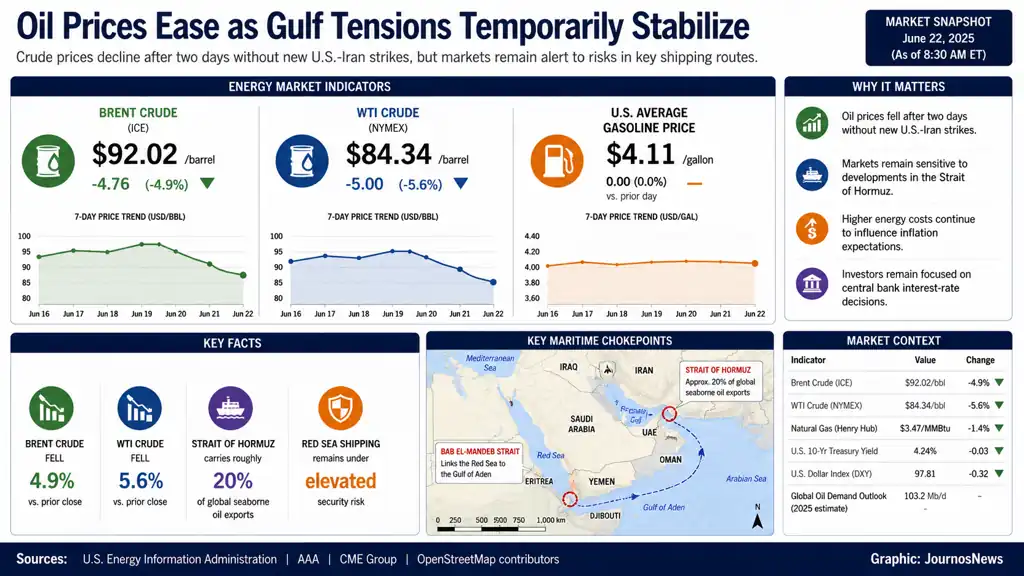
Brent crude for September delivery fell 4.9% to $92.02 per barrel shortly after trading resumed, extending Friday’s 3.9% decline. The international benchmark had briefly climbed above $102 per barrel last week, its highest level since May, after rising roughly $30 from early-month levels.
West Texas Intermediate (WTI) crude for September delivery also declined, falling 5.6% to $84.34 per barrel after dropping 3.1% on Friday.

Middle East Conflict Continues to Shape Oil Markets
Oil prices have climbed throughout the month as the conflict in the Middle East fueled concerns that a broader regional war could disrupt global crude supplies.
A key focus for energy markets remains the Strait of Hormuz, the narrow waterway along Iran’s southern coast through which roughly one-fifth of the world’s seaborne oil exports normally pass. Shipping through the strategic passage has faced significant disruption since the United States and Israel launched military operations against Iran earlier this year.
Oil-producing countries have increasingly relied on alternative export routes, but those corridors have also come under pressure. Last week, attacks targeted Saudi oil tankers transiting the Red Sea, highlighting continuing security risks for global energy shipments.
Analysts say any sustained disruption to oil exports could tighten global supplies and place renewed upward pressure on crude prices.
Higher Energy Costs Continue to Raise Inflation Concerns
Although oil prices eased on Sunday, fuel costs remain elevated.
■ Related News




According to AAA, the national average price for a gallon of regular gasoline in the United States stood at $4.11 on Sunday, compared with $3.90 one month earlier and $3.15 a year ago.
Higher energy prices can increase transportation and production costs across global supply chains, contributing to higher prices for consumer goods and services.
The recent rise in crude prices has also complicated the inflation outlook after price pressures had shown signs of moderating earlier this year.
According to CME Group data, financial markets currently assign a 36% probability that the Federal Reserve will raise its benchmark interest rate at an upcoming policy meeting.
Borrowing Costs Remain a Key Market Concern
Higher interest rates can help slow inflation by reducing demand, but they also increase borrowing costs for households and businesses.
Long-term U.S. mortgage rates have climbed to their highest levels in nearly a year, adding pressure to the housing market.
Higher financing costs could also affect investment in sectors requiring significant capital spending, including artificial intelligence infrastructure and data centers that have helped support recent U.S. economic growth.
Despite Sunday’s decline in oil prices, investors continue to monitor developments in the Middle East closely, with uncertainty surrounding regional security and major energy shipping routes expected to remain an important driver of global markets.
This report is based on reporting by The Associated Press.