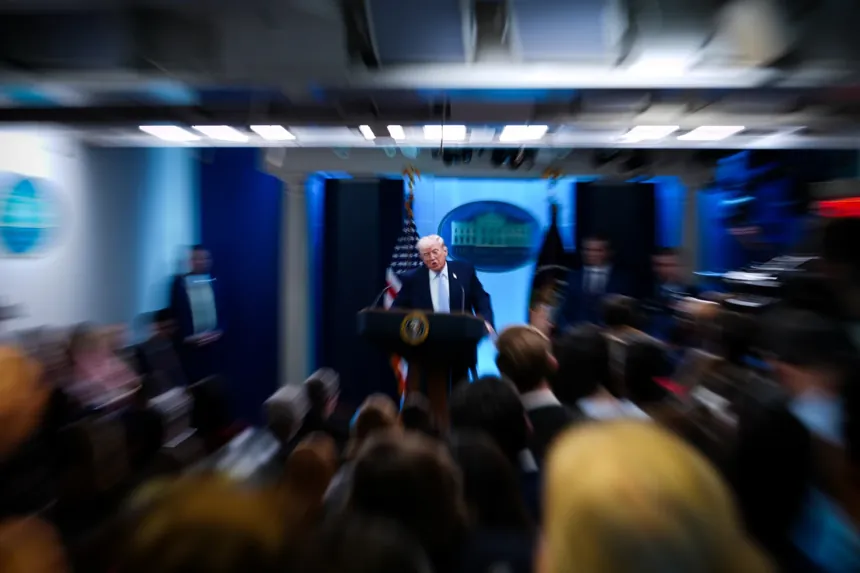
The Trump administration is facing mounting scrutiny after conflicting public statements from senior officials created uncertainty over efforts to restore commercial shipping confidence in the Strait of Hormuz, one of the world’s most strategically vital maritime corridors.
The renewed confusion comes as tensions between the United States and Iran continue to influence regional security calculations across the Gulf, with international shipping firms and energy markets closely monitoring Washington’s diplomatic and military posture. The narrow waterway handles a significant share of global oil exports, making any disruption a matter of immediate international concern.
According to reporting by The Associated Press, officials within the administration have delivered inconsistent messages regarding whether the United States expects Tehran to guarantee safe maritime passage or whether Washington intends to apply additional pressure on Iran to secure regional shipping lanes.

Diplomatic Pressure Builds Across Gulf Shipping Routes
The uncertainty surrounding the administration’s position has complicated broader international efforts aimed at stabilizing maritime trade through the Gulf. Analysts say the contradictory messaging risks weakening deterrence while simultaneously increasing market anxiety among oil importers and commercial carriers.
Several allied governments in Europe and Asia remain heavily dependent on uninterrupted Gulf energy flows, making the Strait of Hormuz a central concern for global economic stability. International shipping companies have reportedly increased monitoring measures while insurers continue reassessing regional risk exposure.
The administration’s mixed signals emerged amid ongoing debates in Washington over how aggressively to confront Iran following heightened regional tensions. While some officials have emphasized the need for diplomatic pressure and sanctions enforcement, others have suggested that reopening secure shipping access requires a calibrated approach that avoids direct military escalation.
Regional Stability Tested by Unclear Strategic Messaging
Security experts warn that inconsistent communication from Washington can create uncertainty not only for allies but also for regional actors attempting to interpret US intentions. Gulf states have increasingly sought clearer assurances regarding maritime security coordination as energy infrastructure and shipping networks remain vulnerable to disruption.
The Strait of Hormuz connects the Persian Gulf to international waters and serves as a critical export route for crude oil shipments from Saudi Arabia, Iraq, Kuwait, the United Arab Emirates and other major producers. Even limited instability in the area can trigger immediate fluctuations in energy pricing and freight costs.
■ Related News



Officials speaking in recent televised interviews appeared divided over whether negotiations with Iran were actively underway or whether the administration’s primary objective remained economic and strategic pressure. The differing narratives have complicated international diplomatic messaging at a time when regional governments are seeking signs of de-escalation.
Economic Fallout Extends Beyond Energy Markets
The uncertainty has also drawn attention from global financial institutions concerned about broader supply chain disruptions. Shipping interruptions in the Gulf can rapidly affect fuel prices, transportation costs and inflation trends across multiple regions, particularly in Asia and Europe.
Market analysts interviewed by international financial media noted that investor confidence often depends as much on strategic clarity as on military capability. Conflicting statements from senior policymakers can amplify volatility even in the absence of direct confrontation.
At the same time, Iran’s role in regional maritime security remains central to broader geopolitical negotiations involving sanctions, nuclear diplomacy and regional proxy conflicts. Western governments continue to balance efforts to contain escalation while protecting critical commercial infrastructure.
International Response Intensifies as Allies Seek Clarity
Several US partners have privately urged Washington to establish a more coherent public strategy regarding Gulf security, according to diplomats familiar with regional discussions. International mediation efforts have focused on preventing maritime incidents that could trigger a wider regional confrontation.
Regional observers say the administration’s challenge now lies in demonstrating both strategic consistency and credible deterrence. The absence of a unified message risks creating confusion among allies while providing adversaries opportunities to test international resolve.
As diplomatic engagement continues, the future stability of the Strait of Hormuz is expected to remain a defining issue for global energy markets and broader Middle East security calculations. Governments across Europe, Asia and the Gulf are likely to continue pressing for clearer coordination mechanisms aimed at reducing the risk of further disruption.