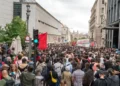
MADRID, Spain – Millions of Spanish workers took part in a nationwide general strike on Wednesday, November 11, protesting soaring housing costs, stagnant purchasing power and the difficulty of securing affordable accommodation, as demonstrations in Madrid and Barcelona ended in clashes with police.
The 24-hour walkout was the country’s first general strike supported by its largest trade unions in 14 years. Organized under the slogan “Salaries, Housing, Prices,” it disrupted public transport, ports, factories, distribution centers and other businesses across Spain.
The Reuters report cited union estimates that approximately four million workers participated, representing around one-fifth of Spain’s workforce. The strongest participation was reported in industrial and coastal regions, with unions claiming stoppages of up to 90% in some automotive and port operations.

The strike was called by the General Union of Workers (UGT) and the Workers’ Commissions (CCOO), alongside tenants’ organizations and other labor groups. Their demands included higher wages, stronger tenant protections, more affordable housing and measures to address rising living costs.
Clashes follow demonstrations in Madrid and Barcelona
Most demonstrations remained peaceful, but confrontations broke out after marches in Spain’s two largest cities.
In Barcelona, some protesters smashed shop windows, set fires and threw objects as riot police moved to disperse groups in the city center. An attempt to break into an Apple store was also reported. Police used crowd-control measures as the disturbances escalated.
In Madrid, riot police used tear gas, pepper spray and foam projectiles to disperse demonstrators around Plaza de España, according to a Reuters witness. Police also reported road blockades and other incidents connected to the strike.
Authorities and news organizations reported different arrest totals as the operation continued. Reuters cited at least 73 arrests nationwide by 21:00 GMT, while an earlier Associated Press account reported 49. The differences reflect reporting at different stages of the day’s incidents and should not be treated as a single final consolidated figure.
■ Related News



Housing affordability drives public anger
The demonstrations reflected growing frustration over the cost of renting and buying homes in Spain.
Average monthly rent reached approximately €1,176, according to figures cited by Reuters, equivalent to nearly 99% of the average monthly salary of a young person in the country. Spain also faces a housing shortage estimated at approximately 750,000 homes, which could exceed one million by 2028.
The protests gained momentum after the September eviction of 87-year-old María del Carmen Abascal from her Madrid apartment. Known as Maricarmen, she had lived in the property for decades and became a symbol of the housing insecurity facing older people and lower-income households.
She died after the eviction, prompting public demonstrations and renewed criticism of Spain’s housing policies.
Housing organizations have called for stronger tenant protections, automatic lease renewals, restrictions on speculative property investment and greater public housing provision. Unions have also demanded higher wages and improved labor conditions to help workers cope with the rising cost of living.
Unions and business groups dispute strike’s impact
UGT and CCOO described the walkout as successful, pointing to major interruptions in manufacturing, transport, logistics and other sectors.
The employers’ association CEOE, however, disputed the unions’ assessment and said participation was limited in much of the economy. It argued that many businesses continued operating normally and criticized the strike as ineffective.
The conflicting assessments reflected uneven participation across industries and regions. Industrial workplaces and transport operations experienced substantial disruption, while retail, hospitality and other service businesses reported more varied levels of activity.
The strike also took place ahead of Spain’s November 29 snap general election, adding political significance to demands that have become central to the country’s public debate.
Housing crisis remains central challenge
The nationwide action has placed renewed pressure on political leaders and employers to address housing affordability alongside wages and employment conditions.
For tenants’ organizations, the protests represent a demand for stronger protections against rent increases and evictions. For unions, the crisis is also a labor issue because housing costs increasingly determine whether workers can maintain an adequate standard of living.
The demonstrations have brought these demands into the national spotlight, but the competing assessments of the strike and the absence of an agreed policy response leave the underlying housing dispute unresolved.
Primary Sources: Unión General de Trabajadores (UGT), “UGT registra la convocatoria de huelga general del 11 de noviembre para reclamar soluciones a la crisis de vivienda y mejoras laborales,” October 19, 2026: documents the formal strike call alongside CCOO and other labour organisations, identifying demands concerning housing access, wages, collective bargaining and social rights; Confederación Sindical de Comisiones Obreras (CCOO), “Campaña Huelga 11N,” published ahead of November 11, 2026: sets out the union’s stated reasons for the general strike, including housing affordability, wages, prices and public services; CCOO, “Las empresas amplían sus márgenes a costa de las familias trabajadoras que pagan el encarecimiento de la vida,” November 6, 2026: presents the union’s economic arguments concerning housing prices, corporate margins and household purchasing power. Official consolidated police records establishing the final nationwide arrest and injury totals were not independently retrieved; the figures in the article are attributed to contemporaneous reporting.