Philippines, Manila – A powerful offshore earthquake struck the southern Philippines on Monday, killing at least 35 people, injuring more than 200 others and causing widespread destruction across several provinces as emergency crews raced to search for survivors.
According to Philippine disaster officials, the magnitude 7.8 earthquake hit off the coast of Mindanao early Monday morning, triggering building collapses, landslides and tsunami waves that reached nearby coastal communities. Authorities reported that most fatalities resulted from collapsing structures and falling debris, while a deadly landslide accounted for several deaths in Sarangani province.
The disaster prompted immediate response efforts from the Philippine government and expressions of support from several international partners, including the United States, Japan, France and New Zealand.

Strong Quake Rocks Mindanao Region
The earthquake struck at 7:37 a.m. local time and was centered offshore near Mindanao, the Philippines’ second-most populous island.
Teresito Bacolcol, director of the Philippine Institute of Volcanology and Seismology, said the quake occurred at a depth of approximately 33 kilometers (20 miles) and was located about 32 kilometers southwest of Maasim town in Sarangani province.
Bacolcol described the earthquake as the strongest recorded in the Philippines this year and warned residents to exercise caution before re-entering damaged homes and buildings because of the risk posed by aftershocks.
The shaking was felt across much of southern Mindanao, sending residents rushing into streets and open areas.
Rod Sosmeña, a regional director of the Office of Civil Defense, told The Associated Press that the shaking was extremely strong and caused widespread panic among residents.
■ Related News



Buildings Collapse as Casualties Rise
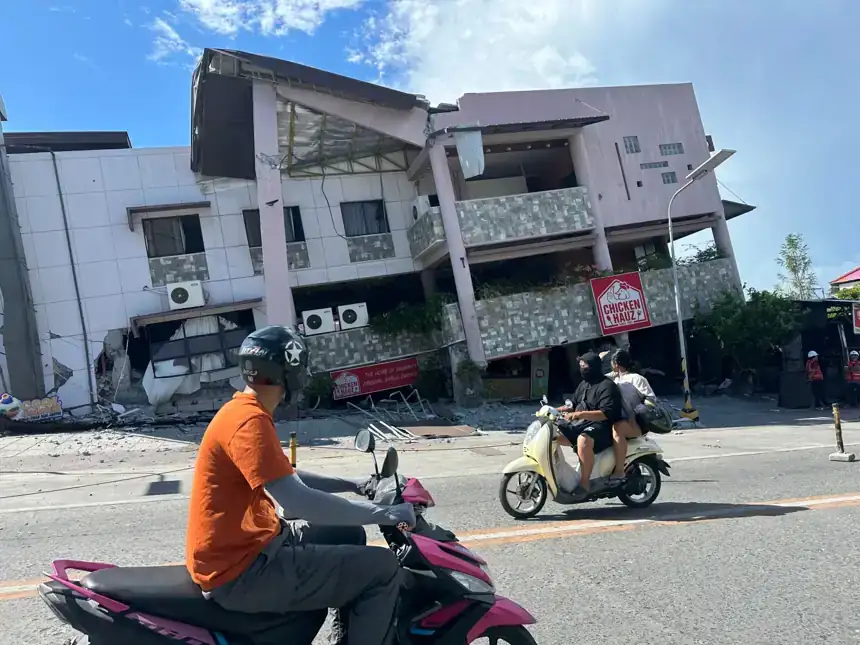
Significant structural damage was reported in General Santos, a major port city and commercial hub in southern Mindanao.
Several low-rise buildings either collapsed or suffered severe damage, prompting large-scale search and rescue operations. Officials said rescuers were searching damaged structures, including a supermarket, warehouse and school buildings, for individuals who may still be trapped.
At least four people remained missing as rescue operations continued.
The earthquake also disrupted transportation services. The Civil Aviation Authority of the Philippines said operations at General Santos International Airport were temporarily suspended and 17 domestic flights were canceled while authorities assessed infrastructure damage.
Elsewhere, a four-story commercial building partially collapsed, according to reports by the DZRH radio network. Staff members evacuated safely and no injuries were reported at the facility.
Landslide Adds to Death Toll
One of the deadliest incidents occurred in Glan, a municipality in Sarangani province, where a landslide triggered by the earthquake buried part of a village.
Provincial disaster-mitigation official Rene Punzalan told the DZBB radio network that 13 people were killed in the landslide. Four additional fatalities were reported elsewhere in Sarangani.
Other deaths were reported in South Cotabato, Davao Occidental and Balut Island, where collapsing structures and falling debris caused casualties, according to disaster-response officials.
First Day of School Turns Chaotic
The earthquake struck as schools across parts of the Philippines reopened following a two-month summer break.
In the rural town of Malita in Davao Occidental province, more than 100 students and several teachers had gathered for a flag-raising ceremony when the ground began shaking.
School principal Rosavel Cachuela told The Associated Press that many children became frightened as the quake unfolded. While some students cried and screamed, no injuries were reported after staff helped maintain order during the emergency.
A motorcycle was damaged when part of a nearby structure collapsed during the shaking.
Tsunami Waves Reach Coastal Communities
The earthquake generated tsunami waves that affected several coastal areas in the southern Philippines.
The Pacific Tsunami Warning Center reported that tsunami threats largely subsided about five hours after the earthquake. Philippine authorities lifted local tsunami warnings later in the day.
Officials reported damage to several stilt houses in a coastal village in Zamboanga del Sur province after elevated waves reached shore.
Bacolcol said tsunami waves measuring approximately one meter (three feet) were recorded in Sarangani and Sultan Kudarat provinces, while a wave reaching 1.4 meters (4.6 feet) was observed in Kiamba town.
Outside the Philippines, tsunami gauges recorded an 83-centimeter wave near Indonesia’s Sulawesi island. Smaller waves were also measured in Palau and Japan, where authorities detected sea-level fluctuations on Chichijima Island and in Kushimoto.
Government Mobilizes Response
President Ferdinand Marcos Jr. ordered the suspension of classes in affected areas and directed national disaster agencies to accelerate relief and recovery efforts.
In a statement, Marcos said the national government was fully engaged in assisting communities affected by the earthquake across Mindanao.
Emergency teams continued assessing damage, restoring services and searching for missing residents as authorities worked to determine the full scale of the disaster.
Disaster Risks Remain High
The Philippines is among the world’s most disaster-prone countries due to its location along the Pacific Ring of Fire, a seismically active zone that generates frequent earthquakes and volcanic activity.
The country is also regularly affected by tropical cyclones and severe storms, creating recurring challenges for disaster preparedness and emergency response agencies.
Officials warned that aftershocks could continue in the coming days and urged residents to follow safety advisories while inspections of damaged infrastructure remain underway.
Tags: Philippines, Earthquake, Mindanao, Tsunami, Disaster Response