Paraguay and Taiwan reaffirmed their longstanding diplomatic partnership on Friday as Beijing renewed efforts to persuade the South American nation to sever formal ties with Taipei, highlighting intensifying geopolitical competition over Taiwan’s shrinking circle of international allies.
During an official visit to Taipei, Paraguayan President Santiago Peña pledged continued support for Taiwan, describing the relationship as rooted in shared democratic values and strategic cooperation. Paraguay remains Taiwan’s only diplomatic ally in South America and one of just 12 countries worldwide that formally recognize Taipei instead of Beijing.
The visit came a day after China publicly urged Paraguay to “come to the right side of history” by recognizing Beijing under the “One China” principle. Chinese officials repeated those calls during briefings in Beijing, underscoring how Taiwan’s remaining diplomatic partnerships have become an increasingly important battleground in broader U.S.-China strategic rivalry.

Officials speaking to Reuters said the reaffirmation of ties reflects Taiwan’s broader effort to prevent further diplomatic isolation as China expands political and economic influence across Latin America. Over the past several years, countries including Honduras, Nicaragua and Nauru have switched diplomatic recognition from Taiwan to China.
Strategic Competition Expands Across Latin America
The public display of unity in Taipei highlighted the growing strategic importance of Paraguay within the wider contest between China and Taiwan for diplomatic legitimacy.
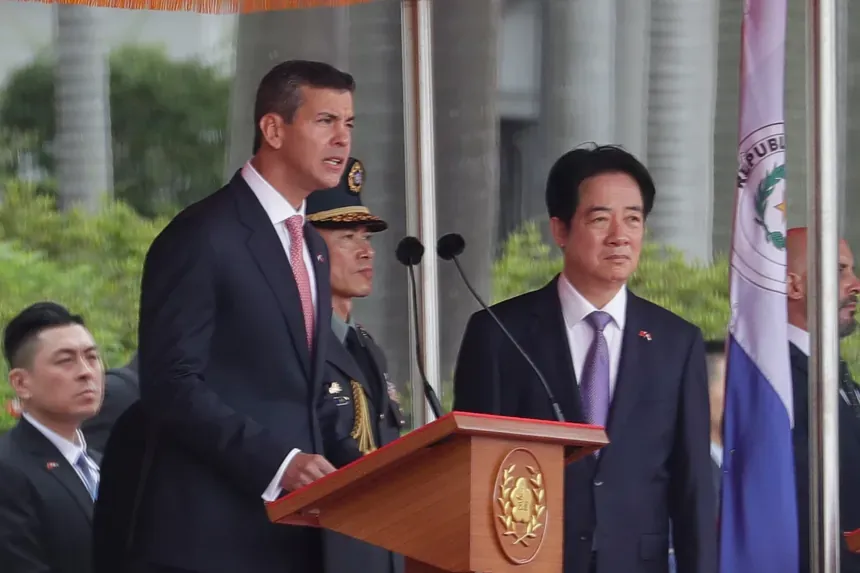
At a military welcome ceremony alongside Taiwanese President Lai Ching-te, Peña said Paraguay would continue promoting bilateral cooperation based on “democracy, freedom and human rights,” according to interpreters quoted in Associated Press reporting. Lai thanked Paraguay for consistently supporting Taiwan’s participation in international organizations despite pressure from Beijing.
The two governments also signed several bilateral agreements covering technology cooperation, cybersecurity, finance and artificial intelligence infrastructure investment. Paraguay additionally welcomed Taiwan’s decision to expand market access for Paraguayan poultry exports, a significant development for the country’s agriculture-driven economy.
Analysts say economic incentives remain central to Beijing’s diplomatic strategy in Latin America, where China has become a dominant trade partner and infrastructure investor. Reuters reporting published earlier this year detailed efforts by Chinese officials to build influence among Paraguayan lawmakers and business leaders through outreach programs and economic engagement campaigns.
■ Related News

Taiwan’s Diplomatic Space Faces Renewed Pressure
China considers Taiwan part of its territory and opposes any official government-to-government recognition of the self-ruled island. Beijing has intensified both military activity near Taiwan and diplomatic efforts to reduce Taipei’s international presence.
Taiwan’s government rejects Beijing’s sovereignty claims and argues that only Taiwan’s population can determine the island’s future. During Friday’s meeting, Peña publicly called on the international community to recognize Taiwan’s right to participate more fully in global institutions, including the United Nations system.
The diplomatic tensions come as Taiwan seeks to reinforce relations with its remaining allies across Latin America, the Pacific and Africa. Earlier this month, President Lai visited Eswatini, Taiwan’s only remaining diplomatic partner in Africa, after reports that Chinese pressure complicated regional travel arrangements for the trip.
Taiwan’s remaining allies now include small states in the Caribbean and Pacific alongside Paraguay and the Vatican. Beijing has steadily reduced that number over the past decade through a combination of economic incentives, infrastructure investment and diplomatic pressure campaigns.
Washington Watches Regional Alignment Closely
Paraguay’s decision to maintain relations with Taiwan also carries broader implications for U.S. influence in Latin America as Washington seeks to counter expanding Chinese economic and political reach in the region.
President Peña has maintained close ties with the United States and recently strengthened cooperation with Washington on defense and strategic minerals initiatives, according to Reuters reporting. Analysts say continued Paraguayan recognition of Taiwan aligns with broader U.S. efforts to limit Chinese geopolitical influence in the Western Hemisphere.
Attention has also focused on political developments in Honduras, which switched diplomatic recognition from Taiwan to China in 2023. Peña said he recently spoke with Honduran President Nasry Asfura during an international event, though he did not confirm whether Tegucigalpa may reconsider its relationship with Beijing.
The renewed commitments between Paraguay and Taiwan suggest Taipei has, for now, preserved one of its most strategically symbolic diplomatic partnerships. However, analysts warn that China’s expanding economic presence in Latin America means pressure on Taiwan’s remaining allies is likely to intensify further in the years ahead.