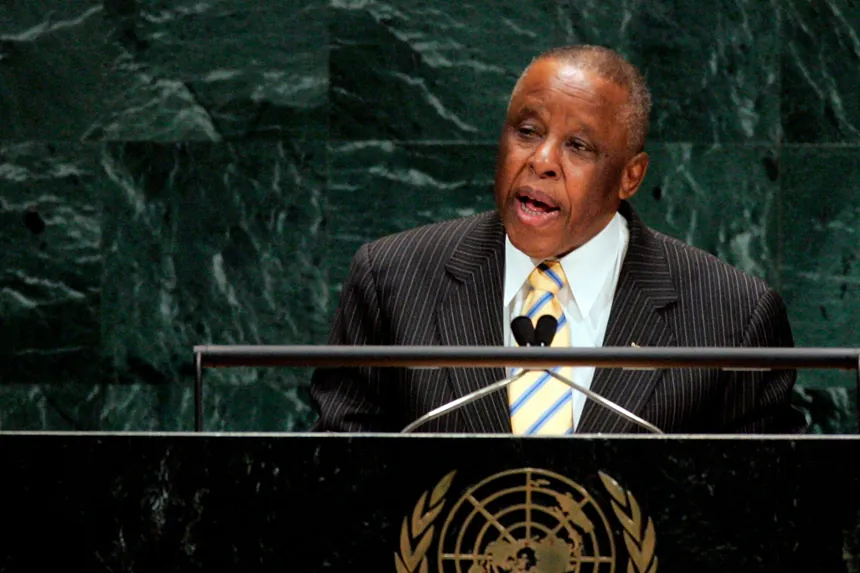
Botswana entered a period of national mourning on Friday following the death of former President Festus Mogae, whose leadership during the country’s HIV/AIDS crisis earned international recognition and helped shape Botswana’s reputation for democratic stability and public health reform.
The government announced that Mogae died at the age of 86, though no official cause of death was disclosed. President Duma Boko declared three days of national mourning, describing Mogae as a statesman who strengthened Botswana’s global standing through economic discipline, democratic governance and social reform.
Mogae served as Botswana’s third president from 1998 to 2008, overseeing one of Africa’s most internationally praised responses to the HIV/AIDS epidemic at a time when the country faced among the world’s highest infection rates. His administration expanded access to antiretroviral treatment and openly confronted the public health crisis when many governments across the continent remained hesitant to do so.

Reporting from The Associated Press and Reuters indicated that Mogae’s policies helped significantly reduce infection rates and improve life expectancy in Botswana, which had seen the epidemic threaten decades of economic development.
HIV/AIDS Response Became Defining Element of Presidency
Mogae’s government launched free public access to antiretroviral medication in 2002, making Botswana one of the first African countries to implement large-scale state-supported HIV treatment programs.
The policy emerged during a period when Botswana’s life expectancy had sharply declined because of the epidemic, creating fears that the country’s economic gains from diamond exports could be reversed by the health crisis. Public health researchers later cited Botswana’s response as an influential model for HIV/AIDS treatment strategies elsewhere in Africa.
International organizations and global health advocates frequently praised Mogae for addressing the epidemic publicly and framing it as both a national emergency and a development challenge. In 2008, he received the Ibrahim Prize for Achievement in African Leadership, one of the continent’s highest governance honors.
Former United Nations Secretary-General Kofi Annan previously credited Mogae with preserving Botswana’s stability during a period when HIV/AIDS threatened the country’s long-term future.
■ Related News




Economic Stability Reinforced Botswana’s International Reputation
Beyond healthcare reform, Mogae was widely associated with prudent economic management in Botswana, one of Africa’s leading diamond-producing nations.
An economist by training, he previously served as governor of the Bank of Botswana and finance minister before assuming the presidency. During his tenure, Botswana maintained its reputation for relatively stable democratic governance and orderly political transitions, distinguishing it from many neighboring states experiencing instability or authoritarian rule.
Botswana’s diamond sector remained central to the economy under Mogae’s administration, accounting for a substantial share of exports and government revenue. Analysts frequently cited Botswana during that period as an example of comparatively effective resource management in Africa.
Mogae also oversaw a peaceful transfer of power at the end of his constitutionally limited second term in 2008, reinforcing the country’s democratic institutions at a time when several African nations faced contested leadership transitions.
African Leaders Reflect on Governance Legacy
Tributes from across southern Africa emphasized Mogae’s role in promoting regional stability, democratic governance and international cooperation.
Botswana’s government said flags would be flown at half-staff during the mourning period as officials prepared state memorial arrangements in Gaborone. President Boko described Mogae as a “voice of reason, unity and progress,” according to remarks broadcast in national media.
Political analysts noted that Mogae’s legacy extends beyond Botswana because his presidency coincided with broader debates across Africa about governance standards, public health investment and economic reform.
His death also comes during renewed international focus on healthcare resilience and pandemic preparedness across developing economies, issues that defined much of his political leadership. Observers say Botswana’s handling of HIV/AIDS under Mogae remains one of the country’s most internationally recognized policy achievements.