Pakistan has commissioned its first Chinese-built Hangor-class submarine, marking a significant step in its naval modernization and reinforcing strategic alignment with Beijing in a region of growing geopolitical competition.
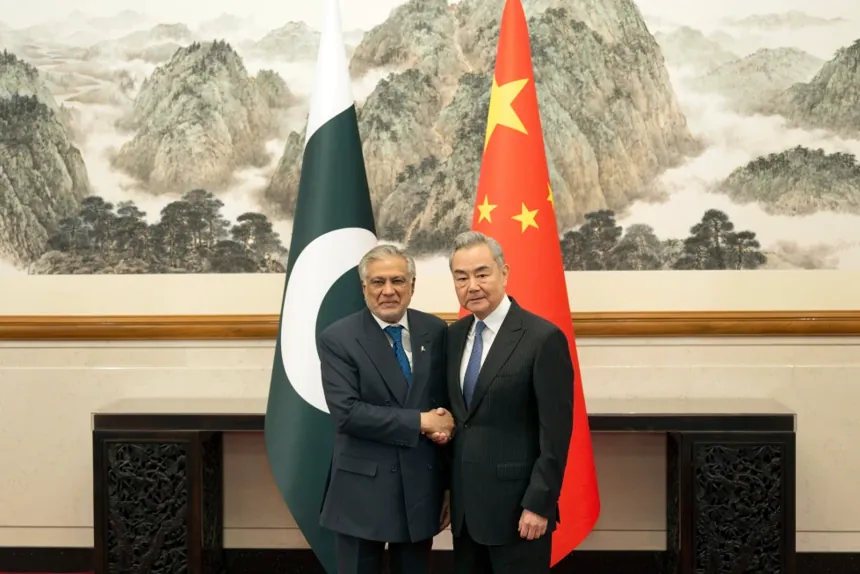
The induction ceremony took place in the Chinese port city of Sanya, attended by President Asif Ali Zardari and senior military officials from both countries. The development is widely viewed as a milestone in Pakistan’s efforts to expand its maritime capabilities and secure critical sea lanes across the Arabian Sea and wider Indian Ocean.
Strategic Realignment Through Defense Cooperation
The Hangor-class submarine program reflects deepening military cooperation between Pakistan and China, part of a broader strategic partnership that has expanded in recent years. Analysts note that the acquisition aligns with Beijing’s increasing role as Islamabad’s primary defense partner, particularly in advanced naval technologies.

According to reporting from The Associated Press, Pakistan plans to acquire a total of eight submarines under the program, with four to be constructed domestically under a technology transfer arrangement. This structure is seen as enhancing Pakistan’s long-term industrial and defense capabilities while embedding Chinese influence in its military infrastructure.
The submarine is based on China’s Type 039A design and is equipped with advanced sensors, torpedoes, and anti-ship missile systems, alongside air-independent propulsion that allows for extended underwater endurance.
Regional Stability Tested by Naval Expansion
The commissioning comes amid persistent tensions in South Asia, particularly between Pakistan and India, where maritime competition has increasingly complemented long-standing land disputes. Security analysts say the addition of advanced submarines could alter the regional deterrence balance, especially in contested waters.
Pakistan has historically relied on its submarine fleet as a strategic counterweight to India’s naval strength. The latest platform is expected to enhance Islamabad’s ability to operate covertly in key maritime corridors that are vital to global trade and energy flows.
Officials cited by Reuters emphasized that the submarines are intended to preserve maritime stability and deter potential threats, though regional observers warn that such developments may prompt further military investments by neighboring states.
■ Related News


Economic and Strategic Stakes in the Indian Ocean
Beyond security considerations, the move carries broader implications for global trade routes. The Indian Ocean remains a critical artery for energy shipments and commercial shipping, with disruptions at key chokepoints posing risks to international markets.
Pakistan’s naval chief has highlighted the growing vulnerability of these routes, pointing to the need for enhanced maritime security capabilities. Analysts suggest that the Hangor-class fleet could play a role in safeguarding infrastructure linked to the China-Pakistan Economic Corridor, a flagship component of Beijing’s Belt and Road Initiative.
The integration of advanced submarines into Pakistan’s navy also signals a shift toward more technologically sophisticated deterrence strategies, reflecting broader trends in regional military modernization.
International Implications and Future Outlook
The commissioning underscores an evolving strategic landscape in which China’s defense partnerships are reshaping power dynamics across Asia. For Western and regional stakeholders, the development highlights the growing intersection of economic and military interests in the Indian Ocean.
While officials frame the move as defensive, analysts caution that continued naval expansion by regional powers may intensify competition in already sensitive maritime zones. The trajectory of Pakistan’s submarine program will likely be closely monitored by neighboring countries and global security observers.
As additional submarines enter service in the coming years, the Hangor-class program is expected to play a central role in defining Pakistan’s maritime posture and influencing the broader balance of power in South Asia.