Global stock markets traded unevenly Monday as oil prices fluctuated sharply amid continuing uncertainty surrounding the conflict involving Iran and the security of energy shipments through the Strait of Hormuz, a critical route for global crude exports.
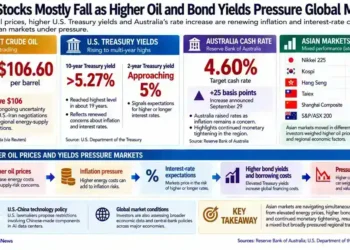
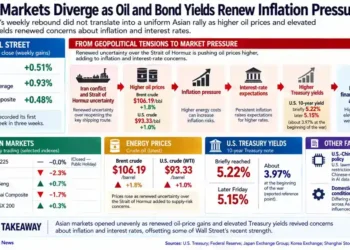
Brent crude briefly climbed above $112 per barrel before retreating to settle near $109, while U.S. benchmark crude also swung throughout the session. Investors weighed geopolitical risks against signs that military escalation could still be avoided after U.S. President Donald Trump delayed potential direct action against Iran.
The market volatility extended to equities and government bonds, reflecting growing concern that prolonged high energy prices could intensify inflation pressures and complicate monetary policy decisions for central banks globally.

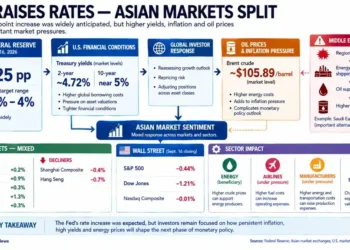
In the United States, the S&P 500 edged down 0.1%, while the Nasdaq Composite lost 0.5% amid weakness in technology and semiconductor shares. The Dow Jones Industrial Average managed a modest gain of 0.3%, supported partly by strength in energy-related stocks.
Energy concerns pressure global equities
European and Asian markets also retreated as investors responded to renewed uncertainty in energy markets. Japan’s Nikkei 225 fell roughly 1%, while South Korea’s Kospi and major European indexes posted declines after recent rallies pushed several benchmarks toward record levels.
Market analysts said the primary concern is not only the current level of oil prices but also the possibility that disruptions in Middle East supply routes could persist for an extended period.
The Strait of Hormuz remains central to investor attention because roughly one-fifth of global oil trade typically passes through the corridor. Continued instability has amplified fears of tighter energy supply, rising transportation costs, and renewed upward pressure on consumer prices worldwide.
Bond yields rise alongside inflation fears
The jump in oil prices also contributed to higher government bond yields across several major economies, as traders reassessed expectations for interest-rate policy.
■ Related News



The yield on the U.S. 10-year Treasury note climbed near 4.6%, while yields in Japan and Europe also moved sharply higher. Investors increasingly worry that sustained energy inflation could reduce the ability of central banks, including the Federal Reserve, to lower borrowing costs later this year.
Higher yields generally pressure equity valuations by increasing borrowing costs for businesses and consumers while reducing the attractiveness of high-growth sectors such as technology.
According to market strategists cited by MarketWatch, investors remain concerned that persistently elevated oil prices could raise the risk of stagflation — a combination of slower economic growth and stubborn inflation.
Corporate earnings and AI sector remain in focus
Despite broader market volatility, investors are also monitoring a heavy week of corporate earnings reports, particularly from major retailers and artificial intelligence-linked technology companies.
Nvidia’s upcoming earnings report is expected to serve as a key test of whether enthusiasm surrounding AI-related investment can continue offsetting broader macroeconomic pressures, including rising energy costs and geopolitical uncertainty.
Energy producers, meanwhile, outperformed broader markets as traders anticipated stronger revenues from elevated crude prices. Analysts noted that oil-sensitive sectors could remain volatile as geopolitical developments continue to drive short-term market sentiment.
Oil markets remain highly sensitive to geopolitical developments
Recent trading sessions have demonstrated how rapidly investor sentiment can shift in response to developments tied to Iran and Middle East diplomacy.
Oil prices have repeatedly surged and retreated in recent months as markets reacted to military developments, ceasefire discussions, and comments from political leaders. Analysts said continued uncertainty surrounding shipping access and regional security is likely to keep volatility elevated across commodities, equities, and currency markets.