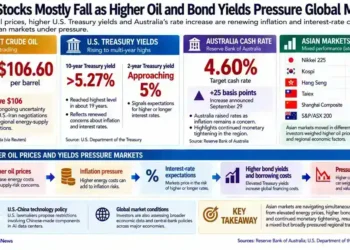
BANGKOK, Thailand (Journos News) – Global equity markets declined sharply Monday as crude oil prices surged past $110 per barrel, driven by escalating conflict involving Iran and renewed fears of supply disruptions across the energy-rich Persian Gulf region.
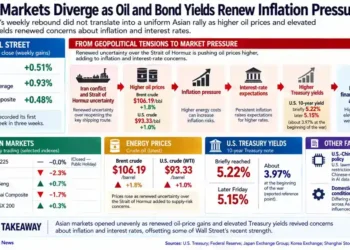
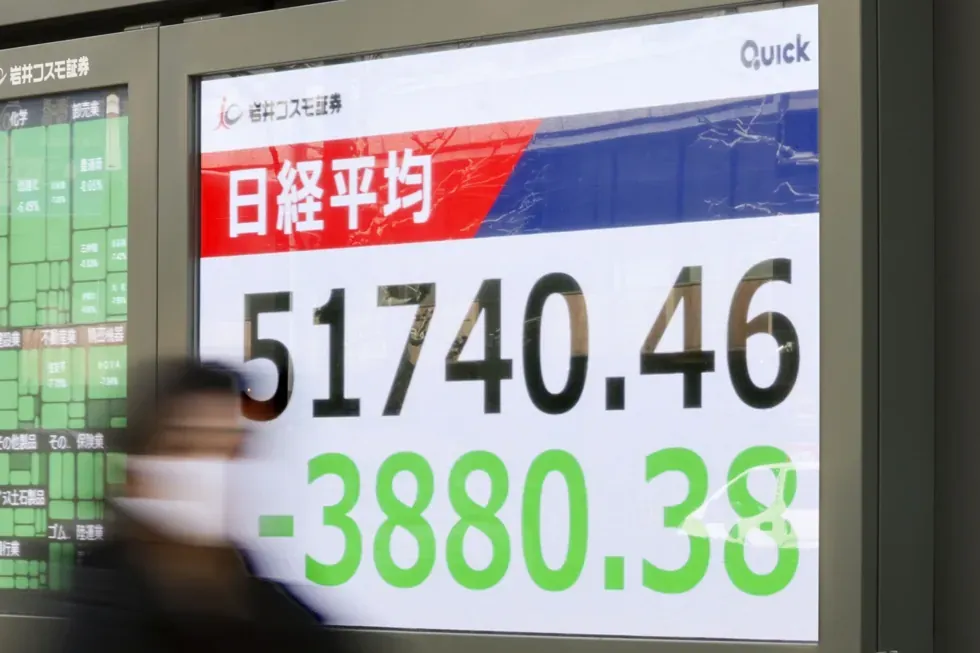
Asian markets led the downturn, with Japan’s Nikkei 225 falling more than 5% at one stage of trading, while South Korea’s Kospi dropped about 6%. The selloff followed a spike in global oil benchmarks and growing concerns that prolonged energy price increases could weigh on economic growth and complicate central bank policy responses.
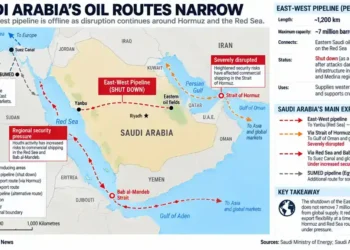
Oil markets reacted strongly after weekend military strikes targeted infrastructure across the region, raising the risk that supply routes critical to global energy markets could be affected.

Oil Prices Jump as Conflict Raises Supply Concerns
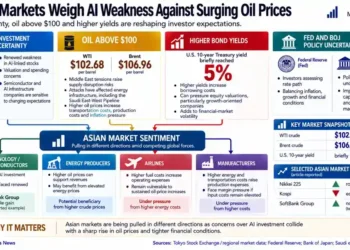
Brent crude traded at about $103.54 per barrel as of 0600 GMT, while U.S. benchmark West Texas Intermediate reached roughly $107.35, according to market data cited by global financial outlets. Both benchmarks were roughly 15% higher than their closing levels on Friday.
Energy prices briefly approached $120 per barrel during early trading, reflecting investor concerns that military actions could disrupt production or shipping lanes in the Persian Gulf, a region responsible for a significant share of global oil exports.
Analysts noted that oil prices had already been trending higher before the latest escalation. The surge marks the highest levels in more than a decade and echoes the price spikes that followed Russia’s invasion of Ukraine in 2022, which also tightened global energy supply.
Market strategists said the rapid move in oil markets signals heightened risk for economies heavily reliant on imported energy.
Asian Equity Markets Lead Global Decline
Japanese equities experienced the steepest drop among major Asian markets. The Nikkei 225 later trimmed some losses but still ended the session down 5.2% at 52,728.72, according to regional market data.




South Korea’s Kospi index declined 6% to 5,251.87, while Taiwan’s benchmark index dropped about 4.4%.
Chinese markets showed relatively smaller declines. Hong Kong’s Hang Seng Index fell 1.6% to 25,343.77, and the Shanghai Composite Index declined 0.7% to 4,097.69.
Futures tied to major U.S. stock indexes—including the S&P 500, Nasdaq Composite, and Dow Jones Industrial Average—also moved lower in early trading, each falling more than 1% after declining late Sunday.
Market participants said higher oil prices could increase input costs for businesses while reviving inflationary pressures that many central banks have been attempting to contain.
Governments Monitor Energy and Financial Market Volatility
Officials in several Asian economies signaled concerns about potential economic fallout from sustained energy price increases.
South Korean President Lee Jae Myung urged authorities to monitor financial markets closely and warned against panic buying or fuel market manipulation. Government agencies were asked to respond proactively to rising volatility in currency and financial markets.
Meanwhile, China’s special envoy to the Middle East, Zhai Jun, called for a halt to attacks and condemned strikes targeting civilians and non-military infrastructure.
Regional policymakers are also preparing to discuss energy price shocks during meetings scheduled this week in Manila, where Southeast Asian officials are expected to examine policy responses to higher import costs for fuel.
Inflation Risks Resurface for Global Economies
Economists warn that sustained increases in oil and natural gas prices could ripple through global supply chains, raising transportation costs and potentially lifting consumer prices.
Analysts at financial institutions said higher energy prices could complicate economic conditions already shaped by shifting trade policies and tariff adjustments affecting exports to the United States.
Data cited by global market analysts indicate that prolonged elevated oil prices could reignite inflation pressures just as many economies were stabilizing after earlier commodity shocks.
Industry observers note that while oil prices often retreat after geopolitical spikes, disruptions to supply routes or energy infrastructure could keep markets volatile for an extended period.
Currency Markets Reflect Safe-Haven Demand
Currency markets also reflected rising investor caution. The U.S. dollar strengthened modestly against several major currencies in early trading.
The dollar traded at about 158.46 Japanese yen, up from 158.09 yen late Friday. The euro was little changed at roughly $1.1558, according to market data.
Currency movements often reflect shifts in global risk sentiment, with investors historically turning to dollar-denominated assets during periods of geopolitical uncertainty.