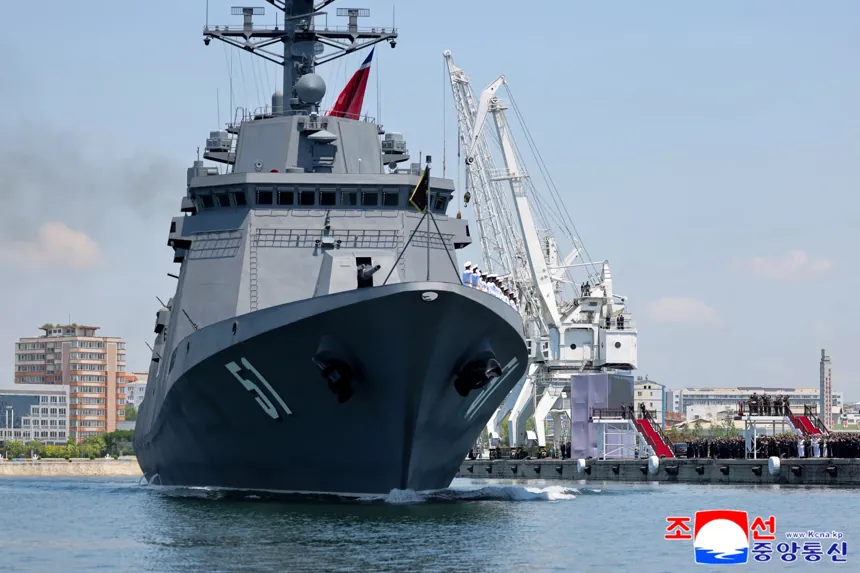
SEOUL, South Korea – North Korea has formally commissioned a newly built 5,000-ton destroyer, with leader Kim Jong Un presenting the vessel as evidence of the country’s advancing naval modernization and growing nuclear capabilities, according to state media reports released Wednesday.
The destroyer, named Choe Hyon, was officially placed into service during a ceremony held Tuesday at the western port city of Nampo, the Korean Central News Agency (KCNA) reported. The vessel is expected to serve along North Korea’s western coastline as part of the country’s broader effort to strengthen its maritime defense posture.
Kim used the event to emphasize what he described as steady progress in integrating nuclear capabilities into North Korea’s navy. KCNA reported that the leader told military officials and attendees that the country’s naval modernization program was proceeding according to plan and that the armed forces were expanding beyond a traditional coastal defense role.

The commissioning marks another step in Pyongyang’s recent efforts to develop naval assets capable of operating farther from its shores. Since the destroyer was first unveiled in April 2025, North Korean authorities have portrayed the vessel as a significant addition to the country’s military capabilities, particularly in terms of deterrence and long-range strike potential.
State media has previously stated that the Choe Hyon is equipped with multiple weapons systems, including anti-aircraft and anti-ship capabilities as well as ballistic and cruise missiles described by North Korea as capable of carrying nuclear payloads.
In remarks carried by KCNA, Kim said the navy was evolving into a military branch equipped with strategic assets as the country’s nuclear naval program advances. He also argued that North Korea’s maritime forces were no longer limited to defending coastal waters.
The vessel has undergone a series of tests in recent months before entering service. Among those trials were launches of cruise missiles that North Korea claimed were capable of carrying nuclear warheads. Independent verification of those capabilities was not immediately available.
The commissioning comes as Kim increasingly focuses on naval modernization after years of prioritizing ballistic missile development. North Korea has also announced plans to construct a nuclear-powered submarine and has repeatedly highlighted maritime capabilities as a central component of its long-term military strategy.
■ Related News




According to previous statements from North Korean officials, naval expansion formed part of broader defense objectives outlined during a Workers’ Party congress, including ambitions for advanced missile systems and enhanced strategic deterrence.
Regional security concerns have accompanied the development of the new destroyer. South Korean officials and some outside specialists have suggested the vessel may have been built with assistance from Russia amid strengthening military cooperation between Moscow and Pyongyang. The source material notes that questions remain among some analysts regarding the ship’s readiness for sustained operational deployment.
The commissioning also occurs against a backdrop of ongoing tensions between North and South Korea in the Yellow Sea, where maritime boundaries remain disputed. Kim has repeatedly rejected the Northern Limit Line, the sea boundary established by the U.S.-led United Nations Command following the 1950-53 Korean War. The area has been the site of several military confrontations over the years.
North Korea is simultaneously pursuing additional naval projects. A second destroyer of the same class, named Kang Kon, suffered damage during a failed launch in May 2025 at the northeastern port of Chongjin. North Korean authorities later announced that repairs had been completed and that the vessel was relaunched in June, although questions regarding its operational status remain.
During Tuesday’s ceremony, Kim indicated that the Kang Kon would soon enter active service. North Korea has also announced plans to develop a larger destroyer class with a displacement of approximately 10,000 tons.
The latest naval developments come as Pyongyang continues expanding its military capabilities following the collapse of nuclear negotiations with the United States in 2019. While maintaining a firm stance toward South Korea, North Korea has continued to signal that future dialogue with Washington remains possible if longstanding disagreements over denuclearization can be addressed.
Tags: North Korea, Kim Jong Un, Choe Hyon, Korean Central News Agency, North Korean Navy, Nuclear Weapons, Maritime Security, South Korea, Russia, Military Modernization, Yellow Sea, Asia Security