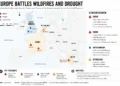
PARIS – France recorded its hottest national day ever on Tuesday as a severe early-summer heat wave spread across much of Europe, disrupting transportation, affecting schools and forcing major tourist attractions to shorten operating hours.
Meteo France reported that the country’s national thermal indicator, which measures average temperatures from 30 weather stations, reached 29.8 degrees Celsius (85.6 Fahrenheit). The figure surpassed previous national records set during major heat waves in 2003 and 2019.
Weather officials warned that temperatures could continue rising in the coming days, with additional records possible before conditions begin to ease.

France Faces Record-Breaking Temperatures
The heat wave has pushed temperatures above 40 degrees Celsius (104 Fahrenheit) in several parts of the country, while numerous local weather stations have registered new daily records.
Meteo France described the event as reaching a “plateau of severity,” with intense heat continuing both day and night. The weather service said more than half of France would remain under significant heat alerts as the extreme conditions expand northward.
Authorities expect the heat wave to continue through at least the weekend.
Daily Life Disrupted Across the Country
The soaring temperatures have affected schools, transportation services and outdoor workplaces throughout France.
In Paris, the Eiffel Tower closed earlier than usual because of the heat. The Louvre Museum also announced reduced visiting hours from Wednesday through Saturday.




Museum officials said the historic building remains vulnerable to extreme temperatures and is not fully adapted to the growing challenges posed by climate change. They noted that heat tends to accumulate during the afternoon and evening, particularly when visitor numbers are high.
Outdoor workers have also struggled with the conditions. Paris roofer Gin Dujardin said metal roofing surfaces became so hot that construction work was becoming increasingly difficult.
Rising Safety Concerns
French authorities reported a growing number of heat-related incidents as residents seek relief from the high temperatures.
Prime Minister Sébastien Lecornu said 40 people had died from drowning over the past week. Many entered rivers, lakes and other waterways despite warnings about the dangers of unsupervised swimming.
According to officials, most of the victims were young people.
Health experts continue to warn that prolonged exposure to extreme temperatures can lead to heat exhaustion and potentially life-threatening heat stroke.
Britain and Spain Also Under Heat Alerts
The heat emergency extends well beyond France.
In the United Kingdom, the Met Office issued heat warnings for Wednesday and Thursday as temperatures in southern England were forecast to approach 39 degrees Celsius (102.2 Fahrenheit).
Hundreds of schools planned to close or shorten their schedules because of the heat. Several rail operators also reduced services amid concerns that high temperatures could damage infrastructure and create safety risks.
Transportation companies urged passengers to avoid unnecessary travel during the hottest parts of the week.
Further south, Spain faced some of the most extreme temperatures in Europe.
The national weather agency Aemet issued red alerts for parts of Andalusia, where temperatures were expected to reach 44 degrees Celsius (111 Fahrenheit). Warnings were also issued in northern regions, including Cantabria and the Basque Country, where temperatures rarely reach such levels.
Aemet meteorologist Rubén del Campo said heat waves in Spain are becoming more frequent, lasting longer and increasingly occurring outside the traditional summer months of July and August.
Climate Change Driving More Extreme Heat
Scientists and climate agencies have linked the growing frequency and intensity of heat waves to human-caused climate change.
The European Union’s Copernicus Climate Change Service reports that Europe is warming faster than any other continent, with temperatures increasing at roughly twice the global average rate since the 1980s.
Copernicus found that 2024 was the hottest year ever recorded both globally and across Europe. The agency also reported that Europe experienced its second-highest number of heat-stress days during the year.
The World Health Organization’s Europe office said earlier this month that more than 200,000 people across the continent have died from heat-related causes over the past four years, with many of those deaths considered preventable.
Comparisons to the 2003 Heat Disaster
The current heat wave has already drawn comparisons with France’s devastating summer of 2003, one of the country’s deadliest weather events in modern history.
That heat wave caused an estimated 15,000 deaths across France, many involving elderly residents living in homes and apartments without air conditioning.
Scientists warn that rising global temperatures are increasing the likelihood of more frequent and intense heat waves, while also raising the risk of droughts and wildfires across Europe.
Tags: France, Europe Heat Wave, Climate Change, Meteo France, Paris, United Kingdom, Spain, Copernicus, World Health Organization, Extreme Weather, Heat Records, Public Safety