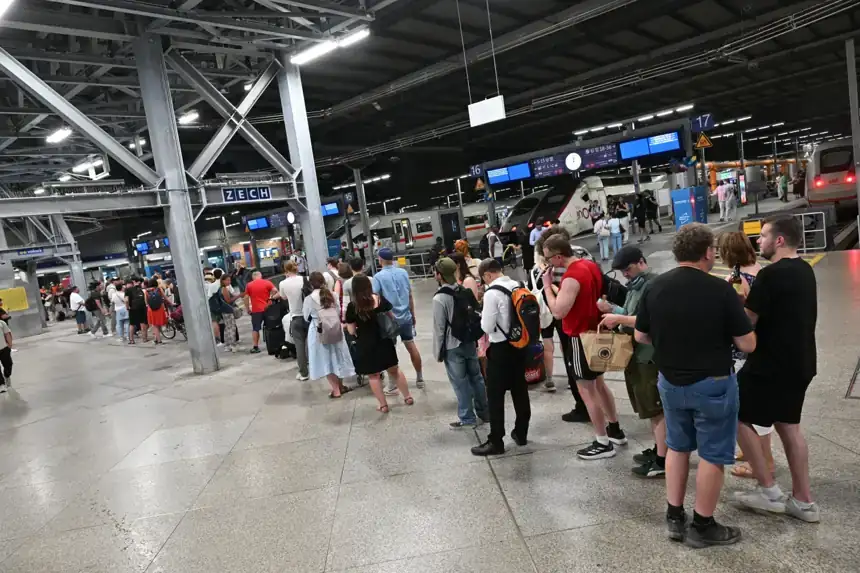
BERLIN, Germany – Germany’s rail network began gradually returning to normal early Wednesday after a nationwide communications failure forced trains across the country to stop, causing widespread disruption for travelers and delaying services on one of Europe’s busiest railway systems.
National rail operator Deutsche Bahn said shortly before 1 a.m. that the technical issue had been resolved and train operations were resuming in stages. The outage had affected services for nearly two and a half hours after the company first reported the problem.
Communication Failure Brings Network to a Standstill
Deutsche Bahn said the disruption was linked to a nationwide malfunction involving the GSM-R digital communications system, which railway operators use for internal communication across the rail network.

The system supports essential voice and data exchanges between train drivers, dispatchers and control centers, making it a critical component of railway operations.
While the company later stated that it had identified the cause of the failure, officials did not immediately provide additional details about what triggered the outage.
Travelers Face Delays Across Germany
The interruption left trains stopped at stations throughout the country as passengers sought information about canceled or delayed journeys.
Long queues formed at customer service counters as travelers attempted to arrange alternative transportation or determine when services would resume.
Deutsche Bahn said it provided hotel and taxi vouchers to affected passengers where necessary. The company also made trains available at stations when possible so travelers could wait indoors while services remained suspended.




The operator apologized for the disruption.
Passengers Caught in Uncertainty
Among those affected was Reyna Ghoshal, who was attempting to return to Munich from Berlin with a friend after visiting the German capital.
She described seeing large numbers of frustrated travelers upon arriving at Berlin’s central station and said railway staff had limited information about when services would restart.
“The train conductor was very nice, but he was just like, ‘we don’t know,'” Ghoshal said. She added that the pair booked a bus as a backup option while waiting for updates.
Emergency Measures Restore Operations
German newspaper Bild quoted Deutsche Bahn Chief Executive Evelyn Palla as saying that the company managed to stabilize the situation through the use of an emergency system.
Rail services subsequently began returning to operation, although delays and residual disruptions were expected as the network restarted.
Details regarding the technical cause of the outage remain unclear.
Pressure on Germany’s Rail Infrastructure
The incident comes as Germany’s railway system continues to face scrutiny over delays and reliability issues.
In recent years, passengers have increasingly complained about service disruptions and late-running trains. Deutsche Bahn has launched extensive modernization projects on major routes following years of underinvestment, although the upgrades have themselves caused temporary disruptions.
According to the source material, previous nationwide rail stoppages in Germany have generally been linked to severe weather events rather than technical failures affecting communications systems.
Critical Role of GSM-R Technology
The GSM-R system, short for Global System for Mobile Communications–Railway, serves as the standard communication platform for rail operations across much of Europe.
The European Union Agency for Railways states that the technology has been introduced across the continent since 2000 to support safe and coordinated railway operations.
Because the system enables direct communication between train crews and control centers, disruptions can have immediate consequences for rail traffic and network management.
Tags: Germany, Deutsche Bahn, Rail Transport, Railway Disruption, GSM-R, Berlin, Munich, Transportation, Infrastructure, Europe, Public Transport, Communications System