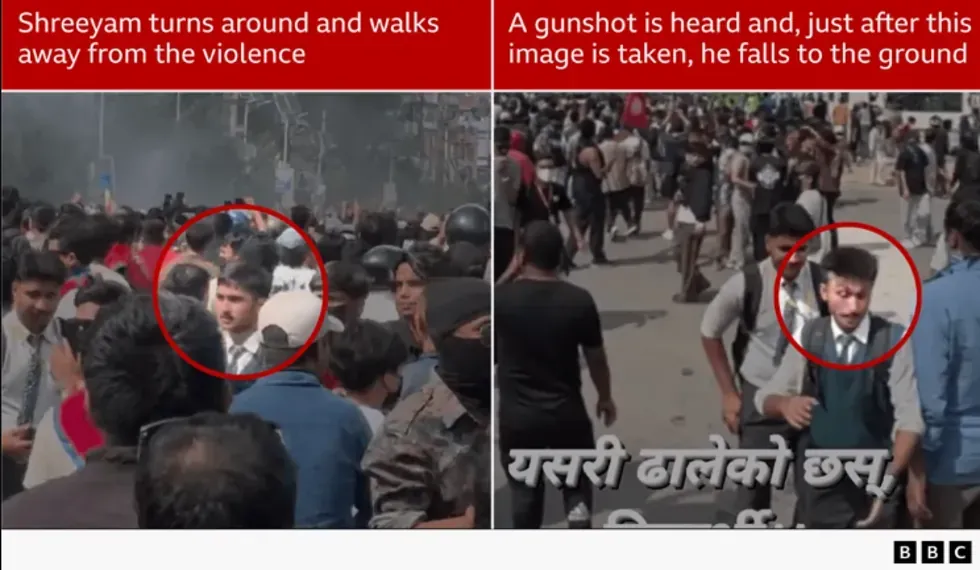
In September 2025, a protest in Kathmandu led by young Nepalis escalated into deadly violence after police were authorised to use live fire. Nineteen people, including teenagers in school uniforms, were killed, highlighting failures in crowd management, planning, and political oversight. The unrest exposed deeper social frustrations among Nepal’s Generation Z and triggered the resignation of the prime minister.
Nepal’s September 2025 protests marked a turning point in the country’s young democratic history. What began as demonstrations against political corruption quickly spiraled into a confrontation with police forces that resulted in multiple deaths and injuries. The incident underscores the challenges facing Nepal’s security apparatus, the limitations of crowd control strategies, and the unresolved frustrations of a generation grappling with economic insecurity and political disillusionment. It also illustrates the evolving role of social media platforms in organising civic action, particularly among digitally native youth.
The protests have left an enduring impact on Nepal’s political landscape. A former police chief authorised the use of lethal force amid unprecedented street mobilisations, leading to intense public scrutiny and calls for accountability. This explainer examines the causes, systems, historical context, and implications behind these events, drawing on verified reports, government statements, and international reporting.

Causes of the 8 September Protests
The immediate trigger for the protests was widespread frustration over political corruption and perceived nepotism. Social media platforms amplified discontent, with Generation Z activists sharing the term “nepo baby” to highlight elite privileges in Nepalese politics. The government’s restriction of platforms like Facebook, YouTube, Instagram, and X on 4 September 2025 further motivated youth to move organising activities to Discord, a gaming-focused chat platform.
Economic pressures also played a significant role. Estimates suggest that roughly 20% of young Nepalis were unemployed, creating a climate of frustration and disillusionment. The youth’s engagement was particularly visible online, where they mobilised quickly and in ways unfamiliar to traditional law enforcement, contributing to security underestimation.
Security System and Police Response
The police response on 8 September revealed structural gaps in Nepal’s law enforcement and emergency management systems. Security forces faced a crowd of approximately 30,000 protesters—ten times the anticipated size. Officers lacked a comprehensive understanding of the situation, hindered by limited live feeds from CCTV cameras, unstable internet connections, and inadequate communication between command centres and units on the ground.
At 12:30 local time, the chief district officer imposed a curfew, declaring the protests illegal. Officers initially relied on non-lethal measures, including tear gas, batons, and water cannons, but were ultimately authorised to use live ammunition at 12:40 after repeated requests. The order originated from the call sign “Peter 1,” later identified as Chandra Kuber Khapung, the former inspector general of Nepal Police. Khapung and other officials have since offered differing accounts of responsibility, with the police citing authorisation by a government security committee, while the committee’s chair denied approving live fire.
Sequence of Events During the Protests
Protesters initially gathered at Maitighar Mandala, a major intersection in Kathmandu. Barricades were established to prevent access to parliament, but the crowd quickly breached security lines. Video analysis and eyewitness accounts show peaceful protesters, including 17-year-old Shreeyam Chaulagain, attempting to retreat when they were shot.
■ Related News

Live fire resulted in multiple deaths, with the first recorded fatality at 13:15, followed by continued shootings through mid-afternoon. Nineteen people, ranging from teenagers to adults, were killed, and dozens more injured. The shootings were captured on thousands of videos and photos, providing a detailed chronology of the day’s events.
The violence triggered further unrest the following day. Angered by the killings, citizens of all ages took to the streets, leading to mob violence against police and government buildings. Arson attacks targeted parliamentary offices, the supreme court, and other state facilities. Security forces and protesters clashed, resulting in a total of 77 deaths and the resignation of Prime Minister KP Sharma Oli. The army assumed control later that evening.
Historical and Political Context
Nepal is a young republic, established in 2008 following a decade-long civil war that left more than 17,000 dead. A new constitution promised democratic renewal, yet many young Nepalis feel those promises remain unfulfilled. Generational frustrations reflect broader economic inequalities, limited employment opportunities, and perceptions of political corruption, with young people increasingly seeking to voice dissent online.
These protests highlight the tensions inherent in a transitioning democracy. While youth movements have previously mobilised for political change, the 8 September demonstrations revealed both the organisational sophistication of Generation Z and the inability of traditional law enforcement to respond effectively. The disconnect between institutional structures and social movements exacerbated the risk of violence.
Structural Failures in Crowd Management
Several factors contributed to the escalation of violence. Security forces underestimated crowd size, lacked reliable intelligence, and had insufficient coordination between police, armed police, and military units. Communication gaps and unclear command authority created confusion, particularly regarding the use of lethal force.
Additionally, the security committee responsible for overseeing public order did not exercise clear decision-making during the crisis. Conflicting statements from key officials, combined with a lack of accountability mechanisms, left law enforcement officers on the ground making critical decisions under pressure. These failures demonstrate the need for systemic reforms in Nepal’s approach to civil unrest.
Regional and Global Implications
The events in Kathmandu resonate beyond Nepal, illustrating the challenges faced by young democracies confronting rapid social mobilisation. Globally, Generation Z has increasingly used digital platforms for civic engagement, raising questions about how governments and law enforcement adapt to fast-moving, decentralized protests.
The Nepal case underscores broader concerns regarding proportionality of force, transparency in law enforcement, and the protection of human rights during demonstrations. International organisations monitoring governance and youth participation may interpret these events as a cautionary example of how unprepared institutional responses can exacerbate tensions in fragile democracies.
Conclusion
The 8 September 2025 protests in Kathmandu exemplify the intersection of political frustration, youth activism, and systemic vulnerabilities in public order management. Verified evidence shows unarmed protesters, including teenagers, were killed following an authorisation for live fire, while structural failures in planning, communication, and command compounded the tragedy.
What remains unresolved is the question of accountability, as no individual or institution has been formally held responsible for the deaths, and a public inquiry is ongoing. The protests also reveal deeper societal issues, including generational inequality, digital mobilisation, and persistent governance challenges. The events continue to shape Nepal’s political landscape, highlighting the stakes of youth-led civic engagement in emerging democracies.
Source: BBC – Shot in school uniform: BBC reveals police order led to Gen Z protest killings