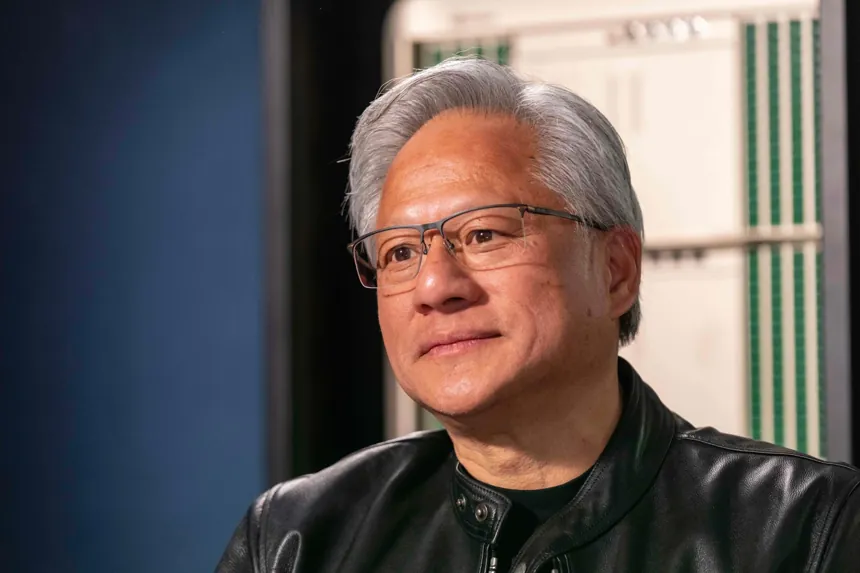
The Nvidia chief argues that artificial intelligence should be embraced rather than feared. His comments arrive as governments, businesses and communities struggle to determine how rapidly advancing AI should fit into everyday life.
Artificial intelligence is no longer a niche technology confined to research laboratories and Silicon Valley. It is increasingly shaping workplaces, education, public policy and economic strategy. As Nvidia CEO Jensen Huang calls for society to develop “new social norms” around AI, his remarks highlight a broader debate over how people, governments and industries should adapt to one of the most consequential technological shifts in decades.
For much of the past three years, public discussion about artificial intelligence has been dominated by extremes. Some advocates portray AI as a transformational force capable of accelerating scientific discovery, boosting productivity and unlocking new economic growth. Critics warn that the technology could disrupt labor markets, deepen inequality, strain infrastructure and create new security risks.

Into that debate stepped Nvidia chief executive Jensen Huang, whose company has become one of the most influential firms in the global AI ecosystem. In an interview with The Associated Press, Huang argued that society should focus less on resisting AI and more on learning how to live alongside it. He suggested that the technology requires the creation of “new social norms” similar to those that emerged around automobiles, electricity and the internet as they became integrated into daily life.
The comments come at a pivotal moment. AI systems are expanding into education, healthcare, software development, scientific research and government services. At the same time, concerns about employment, regulation, energy consumption and geopolitical competition are becoming increasingly prominent.
Huang’s argument raises a broader question that extends beyond technology companies: What does societal adaptation to AI actually look like, and who gets to define the rules?
The Rise of Nvidia and the AI Economy
Any discussion of Huang’s influence begins with Nvidia’s extraordinary rise.
Originally known for producing graphics processing units, or GPUs, for gaming, Nvidia spent years developing hardware that eventually became essential for training and operating advanced AI systems. When generative AI applications surged following the release of large language models, demand for Nvidia’s chips accelerated dramatically.
■ Related News



That demand helped transform Nvidia into the first publicly traded company to surpass a $5 trillion market valuation, underscoring its central role in the AI boom. The company’s hardware powers a significant portion of the infrastructure used by AI developers, cloud providers and research organizations around the world.
As a result, Huang’s views increasingly carry weight beyond the technology sector. Investors, policymakers and business leaders often view Nvidia as a proxy for the broader trajectory of artificial intelligence.
His latest comments therefore reflect more than personal optimism. They represent a perspective from a company that sits at the center of the AI economy.
What Huang Means by ‘New Social Norms’
Huang’s comparison between AI and automobiles offers insight into his thinking.
Cars initially created significant public concerns regarding safety, infrastructure and social disruption. Over time, societies developed traffic laws, road systems, licensing requirements, sidewalks and safety regulations. The technology remained, but the surrounding institutions evolved.
Huang appears to believe AI will follow a similar path.
Rather than viewing artificial intelligence as a force that must be stopped, he argues that individuals should engage with it directly. In his view, widespread familiarity may help reduce fear while enabling people to identify practical uses that improve productivity and access to knowledge.
Supporters of this approach contend that AI could lower barriers to entry for technical work. Tasks that once required specialized programming knowledge can increasingly be performed through natural language instructions. Huang specifically pointed to activities such as website design, document analysis and research assistance as examples of how AI may broaden access to digital capabilities.
Yet critics argue that adaptation is not solely a matter of individual behavior. Social norms alone may not address concerns about economic concentration, misinformation, surveillance or labor displacement. For many observers, questions about governance remain just as important as questions about adoption.
Why AI Has Become a Political Issue
The political landscape surrounding AI has changed rapidly.
Only a few years ago, debates about artificial intelligence were largely confined to technology conferences and academic institutions. Today, AI has become a central topic in discussions about economic competitiveness, national security and industrial policy.
Several factors have contributed to that shift.
First, AI is increasingly viewed as a strategic technology. Governments see leadership in AI as linked to economic strength, military capability and technological influence.
Second, the technology has become highly visible to the public through chatbots, image generators and workplace automation tools.
Third, the infrastructure supporting AI—including data centers, semiconductor manufacturing facilities and power generation projects—has direct impacts on communities.
As new facilities are proposed across the United States, some local residents have raised concerns about environmental effects, electricity demand, land use and quality-of-life issues. These debates have transformed data centers from largely invisible infrastructure into a source of political controversy.
Huang’s comments acknowledge this reality. His appeal for broader public engagement with AI can be viewed partly as a response to growing skepticism surrounding the technology’s rapid expansion.
The Labor Question
Among the most persistent concerns surrounding AI is its effect on employment.
Historically, technological revolutions have often displaced certain jobs while creating new industries and occupations. Economists continue to debate whether AI will follow a similar pattern or produce more disruptive outcomes.
Huang generally aligns with the view that AI will augment human capabilities rather than simply replace workers. He has argued that AI can help individuals perform more advanced tasks without requiring years of technical training.
However, uncertainty remains.
Many businesses are already experimenting with AI systems that can automate portions of administrative work, customer service, software development and content creation. While advocates argue these tools improve efficiency, critics worry that productivity gains could be accompanied by workforce reductions.
The long-term balance between job creation and job displacement remains unclear.
Researchers, policymakers and business leaders continue to debate how labor markets may evolve as AI capabilities advance. The outcome will likely depend on factors that extend beyond technology itself, including education systems, workforce training programs and economic policy.
National Security and the AI Race
Another major theme in Huang’s remarks involves national security.
Artificial intelligence is increasingly viewed through the lens of strategic competition, particularly between the United States and China. Governments regard advanced semiconductors, AI models and computing infrastructure as assets with potential military and economic significance.
The United States has imposed various restrictions on advanced technology exports to China in recent years. Nvidia has frequently been at the center of these debates because its chips are critical components in AI development. Huang has previously questioned whether broad export restrictions ultimately strengthen American leadership or encourage the development of alternative technologies elsewhere.
At the same time, Huang emphasized that national security concerns are legitimate and should remain a priority. His argument is that policymakers should clearly define the risks they seek to address before implementing controls.
This position reflects a broader tension facing governments around the world. Officials seek to protect sensitive technologies while also preserving innovation and global competitiveness.
That balancing act is likely to remain one of the defining policy challenges of the AI era.
Regulation Without Stifling Innovation
One of the most difficult questions surrounding AI is how much regulation is appropriate.
Calls for stronger oversight have emerged from lawmakers, researchers and civil society groups concerned about safety, privacy and security. Meanwhile, technology companies often caution that excessive restrictions could slow innovation or weaken competitiveness.
The regulatory environment in the United States continues to evolve. Recent federal actions have included greater attention to security reviews and oversight of advanced AI systems.
Huang has expressed support for some degree of regulation and safety standards while also emphasizing the importance of maintaining technological leadership.
The challenge for policymakers is that AI encompasses a wide range of applications. Rules designed for national security concerns may not address labor issues. Measures aimed at privacy protection may not resolve questions about misinformation or market concentration.
As a result, many experts argue that regulation will likely emerge through a combination of industry standards, sector-specific rules and broader government oversight rather than a single comprehensive framework.
The Energy Challenge Behind AI Expansion
Perhaps the most immediate practical challenge identified by Huang is energy.
Modern AI systems require enormous computational resources. The data centers that train and operate advanced models consume significant amounts of electricity, making power availability an increasingly important factor in AI development.
The U.S. Energy Information Administration has reported that data centers are becoming a major driver of electricity demand growth in the United States. Demand has risen substantially compared with previous decades, with data center expansion identified as a key factor.
Huang argues that America’s ability to maintain leadership in AI depends partly on expanding energy production and infrastructure. He warned that insufficient power generation could become a bottleneck for future growth.
Research examining AI-related infrastructure has also highlighted concerns about regional grid stress and rising electricity consumption as computing demand grows. While estimates vary, analysts generally agree that AI will require substantial investments in power systems and transmission infrastructure.
This issue extends beyond technology policy. It intersects with environmental policy, industrial development and long-term economic planning.
Wealth Concentration and Economic Inequality
The extraordinary success of AI companies has also renewed debates about economic concentration.
Nvidia’s rise, alongside the rapid growth of major AI developers, has generated vast amounts of wealth. Supporters argue that these companies are creating jobs, generating tax revenue and advancing innovation.
Critics counter that much of the financial benefit remains concentrated among investors, executives and large technology firms.
Proposals aimed at distributing AI-related gains more broadly have begun to emerge. Some policymakers and technology leaders have floated ideas ranging from public ownership stakes to new mechanisms for sharing the benefits of automation. Huang expressed skepticism about government ownership of AI companies, arguing that Americans already benefit through investment exposure, tax revenue and job creation.
The debate reflects a larger question that extends beyond Nvidia or AI itself: How should societies distribute the economic gains produced by transformative technologies?
History suggests there is no simple answer.
The Human Dimension of Technological Change
Amid discussions about chips, regulations and infrastructure, Huang’s comments also reveal something more fundamental.
Technological revolutions are ultimately social transformations.
The introduction of railroads altered settlement patterns. Electricity changed daily life. The internet reshaped communication, commerce and information access.
AI appears poised to influence how people work, learn and interact with knowledge. The exact trajectory remains uncertain. Predictions about technological change have often proven both overly optimistic and excessively pessimistic.
What is clear is that AI is moving beyond the confines of specialized industries and becoming part of broader public life.
Huang’s call for “new social norms” can therefore be interpreted as an acknowledgment that technical innovation alone is insufficient. Societies must also develop institutions, expectations and safeguards that allow new technologies to be integrated responsibly.
What Remains Unresolved
Despite rapid progress, many questions remain unanswered.
The long-term impact of AI on employment is still uncertain.
The effectiveness of emerging regulatory frameworks remains untested.
Debates over privacy, intellectual property and algorithmic transparency continue.
Energy infrastructure may struggle to keep pace with growing computational demand.
Geopolitical competition could further complicate international cooperation on AI governance.
Details surrounding some future developments remain unclear, and many projections depend on technological advances that have not yet occurred.
What appears increasingly certain is that AI will remain a defining issue for policymakers, businesses and communities for years to come.
Jensen Huang’s vision is rooted in the belief that adaptation, rather than resistance, offers the best path forward. Whether society ultimately embraces that perspective may depend not only on the capabilities of AI systems, but also on how effectively governments, institutions and citizens respond to the challenges that accompany them.
Tags: Artificial Intelligence, Jensen Huang, Nvidia, AI Regulation, Data Centers, U.S.-China Technology Competition, AI Infrastructure, National Security, Future of Work, Energy Policy