The president of the John F. Kennedy Center for the Performing Arts has sharply criticized a longtime musician who canceled a Christmas Eve concert following the Kennedy Center Trump renaming. The dispute has drawn national attention and raised legal questions about changes to the federally chartered arts institution.
Letter from Kennedy Center leadership
Richard Grenell, president of the Kennedy Center, said on Friday that musician Chuck Redd’s decision to withdraw from the holiday performance caused financial harm to the nonprofit institution. Grenell made the remarks in a letter sent to Redd and shared with The Associated Press.
Grenell accused Redd of canceling at the last moment in direct response to the recent renaming of the center. He described the move as political intolerance and said it imposed significant costs on the organization. In the letter, Grenell said he would seek $1 million in damages over what he called a “political stunt.”

Redd did not immediately respond to requests for comment after the letter became public.
Cancellation follows White House announcement
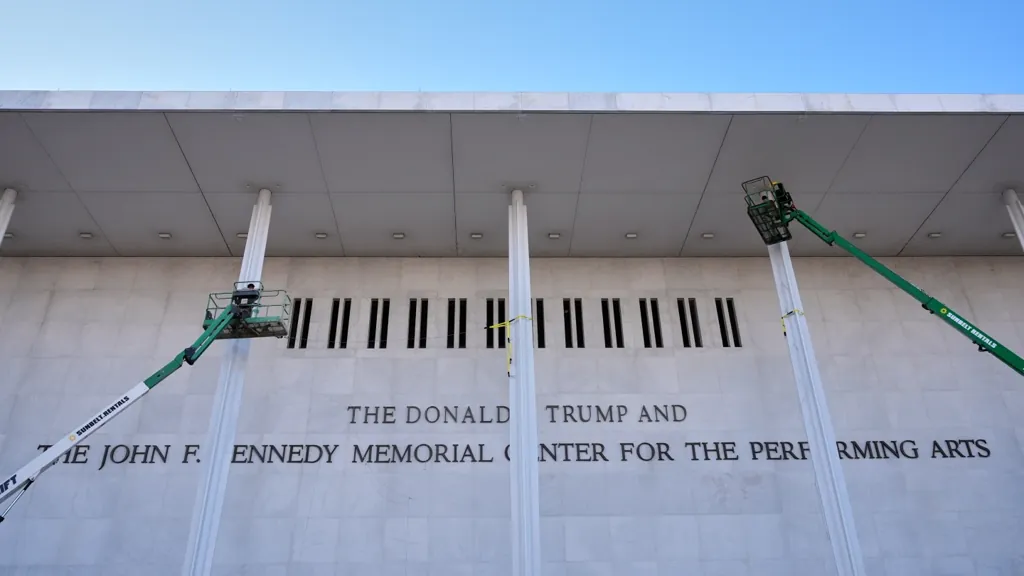
The dispute followed a White House announcement earlier in the week that Trump’s name had been added to the Kennedy Center. According to Redd, the change appeared first on the institution’s website and later on the building itself.
In an email to the AP on Wednesday, Redd said the name change prompted his decision to cancel the concert. “When I saw the name change on the Kennedy Center website and then hours later on the building, I chose to cancel our concert,” he said.
Redd did not criticize the venue’s staff or audience. Instead, he framed the move as a personal response to the renaming.
A long-running holiday tradition
Redd is a drummer and vibraphone player who has led the Kennedy Center’s holiday “Jazz Jams” since 2006. He succeeded bassist William “Keter” Betts and became a regular fixture of the center’s Christmas season programming.
Over the years, the event built a reputation as a popular holiday tradition. Redd said he often invited at least one student musician to perform alongside established artists.
He described canceling the show as a difficult decision. “One of the many reasons that it was very sad to have had to cancel,” he told the AP, pointing to the disappointment for audiences and young performers.
Legal foundation of the Kennedy Center
Congress established the Kennedy Center as a living memorial to President John F. Kennedy, who was assassinated in 1963. Lawmakers passed the enabling legislation the following year, naming the center in his honor and defining its purpose as a national home for the performing arts.
That law now sits at the center of the controversy. Legal scholars and historians have long noted that the statute restricts how the building can be named and used. It bars the board of trustees from designating the center as a memorial to anyone other than Kennedy.
The law also prohibits placing another individual’s name on the exterior of the building without congressional approval.
Questions over board authority
Grenell, a close ally of Trump, assumed leadership of the Kennedy Center after the president removed the previous management. The White House has said that Trump’s handpicked board approved adding his name to the building.
Critics dispute that the board has the authority to make such a change. Former House historian Ray Smock has said any alteration to the memorial designation would require explicit action by Congress, not a decision by trustees alone.
Several scholars have echoed that view, arguing that the law leaves little room for reinterpretation.
Kennedy family reaction
Members of the Kennedy family have also objected to the renaming. Kerry Kennedy, a niece of the late president, has publicly vowed to remove Trump’s name from the building once he leaves office.
Her comments highlight the symbolic importance of the center, which many Americans view not only as a premier arts venue but also as a national memorial tied closely to Kennedy’s legacy.
Politics and public arts institutions
The episode has renewed debate over how politics should intersect with publicly supported cultural institutions. The Kennedy Center receives federal funding but depends heavily on private donations, ticket sales, and sponsorships to sustain its programming.
Arts leaders often emphasize political neutrality as essential to maintaining broad public trust and financial stability. Disputes that draw national political attention can complicate those efforts.
Grenell’s letter argued that artists should not allow political objections to disrupt scheduled performances or impose financial losses on the institution. He framed Redd’s cancellation as a breach of professional responsibility.
Redd, however, has said his decision reflected personal objection to the name change rather than opposition to the Kennedy Center itself.
What happens next
As of Friday, the Kennedy Center had not said whether it would replace or reschedule the canceled Christmas Eve event. The legal status of the renaming also remains unresolved, with critics signaling that congressional review may be required.
For now, the dispute continues to unfold against the backdrop of broader questions about governance, law, and the place of politics in America’s most prominent cultural institutions.
This article was rewritten by JournosNews.com based on verified reporting from trusted sources. The content has been independently reviewed, fact-checked, and edited for accuracy, neutrality, tone, and global readability in accordance with Google News and AdSense standards.
All opinions, quotes, or statements from contributors, experts, or sourced organizations do not necessarily reflect the views of JournosNews.com. JournosNews.com maintains full editorial independence from any external funders, sponsors, or organizations.
Stay informed with JournosNews.com — your trusted source for verified global reporting and in-depth analysis. Follow us on Google News, BlueSky, and X for real-time updates.