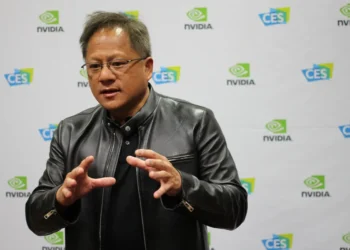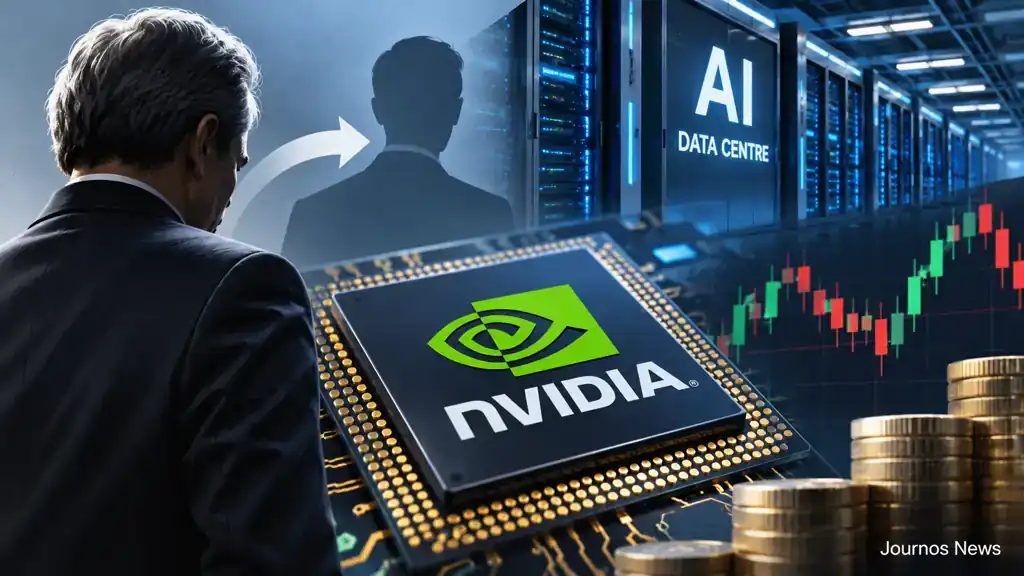
SANTA CLARA, United States – Nvidia’s leadership crisis is testing investor confidence in the wider artificial intelligence industry, after co-founder Jensen Huang resigned as chief executive following reports of personal misconduct and a company investigation into an alleged foreign intelligence effort targeting him.
The company announced on November 12 that Chief Financial Officer Colette Kress would become interim chief executive while its board searches for a permanent successor. Harvey C. Jones, a longtime director, was appointed the company’s first board chair.
The leadership change has raised concerns beyond Nvidia’s immediate business. Investors are questioning whether the company will continue financing customers and supporting infrastructure projects that have helped accelerate the global expansion of artificial intelligence computing.

Huang’s departure creates a leadership vacuum
Huang co-founded Nvidia in 1993 and led its transformation from a graphics-chip manufacturer into the dominant supplier of processors used to train and operate advanced AI systems.
His influence extended beyond product development. He became a central figure in the industry’s investment decisions, partnerships and infrastructure expansion, helping Nvidia establish relationships with major technology companies, cloud providers and AI developers.
The company’s board announced an independent investigation on November 8 after reports that Huang had been targeted by a foreign intelligence effort. The investigation is being overseen by independent directors with outside legal counsel.
In its statement, the board said it had no reason to believe that US national security or Nvidia’s confidential information had been compromised. Huang agreed to cooperate with the review.
Nvidia did not state in its November 12 announcement that the investigation was the reason for Huang’s resignation. The timing nevertheless places the leadership transition within a broader period of scrutiny over corporate governance and national-security concerns.
■ Related News




Investors question Nvidia’s role as an AI financier
The company’s importance to the AI industry extends beyond selling advanced processors. Nvidia has invested in technology businesses, supported data-centre development and entered financing arrangements intended to help customers secure the infrastructure needed to deploy its chips.
That strategy has helped build demand for Nvidia products while strengthening its position across the AI supply chain. It has also created financial and commercial links between the company and businesses that depend on its technology.
Nvidia’s July 2026 quarterly filing disclosed $279 billion in future supply and capacity commitments, reflecting arrangements to secure components and manufacturing capacity for its products. The same filing reported $36 billion in future AI cloud-service agreements and $25 billion in committed equity investments, among other obligations. These are different categories of commitments and should not be treated as a single investment or debt figure.
Investors are now considering whether a new chief executive will maintain the same appetite for financing and supporting the wider ecosystem. A reduction in those commitments could affect companies whose data-centre expansion depends partly on Nvidia’s backing.
Market reaction spreads across technology stocks
Nvidia shares fell nearly 5% by 1600 GMT on November 12, after earlier losses during trading. The company’s market value slipped below $4 trillion, while shares in some AI infrastructure businesses also declined.
CoreWeave, a data-centre operator backed by Nvidia, lost more than 6% in the reported session. South Korean internet company Naver, which received Nvidia investment connected to a data-centre expansion, also fell.
The reaction was not uniform across the semiconductor industry. Shares in rivals Advanced Micro Devices and Broadcom rose as investors considered whether Nvidia’s leadership upheaval could create opportunities for competing chip suppliers. Chinese graphics-processing-unit manufacturers also recorded gains.
The market movements indicate concern about Nvidia’s position and its influence over the AI investment network, but they do not establish that demand for AI computing is collapsing.
Kress faces challenge of maintaining strategic continuity
Kress, who joined Nvidia in 2013, has led the company’s finance organisation through a period of rapid expansion. Her appointment provides continuity while the board searches for a permanent chief executive.
Her immediate challenge will be to reassure customers, suppliers, investors and employees that the company can maintain its product roadmap and commercial commitments during the transition.
The question is whether Nvidia can preserve the strategic approach that made it central to the AI industry without relying on Huang’s personal leadership and extensive business relationships.
Nvidia’s board said its experienced leadership team would continue executing the company’s strategy and meeting customer commitments. The company also confirmed that its fiscal third-quarter 2027 results would be released on November 17 as previously scheduled.
AI investment faces broader questions
The leadership crisis comes as investors assess the scale and sustainability of spending on AI infrastructure. Technology companies have committed substantial resources to data centres, advanced processors, networking equipment and energy capacity in anticipation of growing demand for AI services.
Nvidia has benefited from that spending while also helping finance parts of the ecosystem. Its overlapping roles as chip supplier, investor and infrastructure partner have made its business strategy increasingly important to other companies in the sector.
A leadership transition does not automatically change the demand for Nvidia’s processors or the commercial value of its technology. However, a change in the company’s financing strategy could affect businesses that rely on its investments, guarantees or purchasing commitments.
The next phase of Nvidia’s leadership transition will therefore be watched as a test of whether the AI industry can sustain its investment momentum through a major change at one of its most influential companies.
Primary Sources: NVIDIA Corporation, “NVIDIA Announces CEO Transition,” November 12, 2026, confirming Jensen Huang’s resignation as president, chief executive and board member, Colette Kress’s appointment as interim CEO, Harvey C. Jones’s appointment as board chair and the initiation of a permanent CEO search; NVIDIA Board of Directors, “Statement from NVIDIA Board of Directors,” November 8, 2026, announcing an independent investigation into reports that Huang had been targeted by a foreign intelligence effort and stating that the board had no reason to believe national security or Nvidia secrets had been compromised; NVIDIA Corporation, Form 10-Q for the quarter ended July 26, 2026, filed with the US Securities and Exchange Commission, disclosing future supply and capacity commitments, AI cloud-service agreements and committed equity investments.