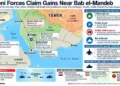
WASHINGTON (Journos News) – Questions over the intelligence foundations of the U.S. war with Iran intensified Wednesday as Director of National Intelligence Tulsi Gabbard declined to clarify whether President Donald Trump had been fully warned about the conflict’s potential consequences, including retaliatory strikes and disruption to global energy routes.
Testifying before the Senate Intelligence Committee, Gabbard described Iran’s leadership structure as “intact but largely degraded,” signaling a complex operational picture that stops short of regime collapse. Yet her repeated refusal to address what intelligence had been shared with the White House sharpened scrutiny over whether policymakers entered the conflict with a full understanding of its risks.
As first reported by The Associated Press, the hearing unfolded against mounting political and economic fallout tied to Iran’s response, including attacks on Gulf states and the effective closure of the Strait of Hormuz — a critical artery for global oil shipments.

Command Transparency Erodes Under Congressional Pressure
Democratic lawmakers repeatedly sought to establish whether intelligence agencies had anticipated Iran’s retaliatory actions and whether those assessments were clearly communicated to the president. Gabbard declined to discuss her briefings with Trump, citing the confidentiality of executive-level intelligence exchanges.
The lack of direct answers drew visible frustration. Senator Mark Warner described the hearing as a rare public accountability moment that failed to deliver clarity, underscoring concerns that critical intelligence judgments remain shielded from legislative scrutiny.
The tension reflects a broader institutional challenge: balancing executive privilege with congressional oversight during an active conflict. In this case, the absence of clear disclosures risks undermining confidence in how intelligence informs military decision-making.
Strategic Forecasting Under Strain as War Risks Materialize
Central to the hearing was whether U.S. intelligence had accurately forecast Iran’s response to last year’s strikes, which Gabbard said had “obliterated” Tehran’s nuclear program. While the administration has maintained that military action was necessary to counter an imminent threat, Gabbard avoided endorsing that characterization.
Her distinction — that determining imminence is not solely the intelligence community’s role — exposed a critical ambiguity between intelligence assessment and political interpretation. Senator Jon Ossoff challenged that position directly, arguing that threat evaluation lies at the core of intelligence responsibilities.



CIA Director John Ratcliffe offered a more assertive stance, stating that intelligence assessments did support the existence of a threat, though without detailing its immediacy. The divergence in tone highlighted potential inconsistencies in how intelligence conclusions are conveyed publicly versus internally.
Economic Chokepoints Amplify Strategic Consequences
The effective closure of the Strait of Hormuz — whether partial or selective — has emerged as a defining consequence of the conflict. The waterway handles a significant share of global oil and gas flows, and its disruption has introduced volatility into energy markets while complicating U.S. military planning.
Despite assertions from the White House that contingency planning for such a scenario had long been in place, lawmakers questioned whether the scale and immediacy of the disruption had been fully anticipated. Senator Mark Kelly pressed officials on whether the president had understood the potential downside, including the economic ripple effects.
The administration has yet to outline a clear multinational strategy to secure the waterway, particularly after key allies signaled reluctance to participate. That gap underscores the broader challenge of translating military action into sustainable regional control.
Institutional Friction Deepens Across Security Leadership
The hearing also followed the resignation of Joe Kent, who publicly stated he could not support the war or the premise of an imminent Iranian threat. His departure introduced an additional layer of internal dissent within the national security apparatus.
Meanwhile, FBI Director Kash Patel faced separate questioning over domestic terrorism risks after recent attacks in Michigan and Virginia. Though not directly tied to Iran, the incidents reinforced concerns that external conflict may intersect with internal security pressures.
Gabbard herself came under scrutiny for her presence at a federal investigation into election systems in Georgia, raising questions about the boundaries between foreign intelligence responsibilities and domestic political activity.
Diplomatic and Intelligence Risks Converge Moving Forward
With the House Intelligence Committee set to hold its own hearing, the current trajectory suggests continued pressure on intelligence officials to clarify their role in shaping — or challenging — the administration’s war rationale.
The broader implication extends beyond a single conflict. As intelligence assessments become increasingly central to justifying military action, gaps in transparency risk eroding both domestic trust and international credibility. Whether future disclosures narrow or widen those gaps may shape not only congressional oversight but also the strategic latitude of U.S. foreign policy in ongoing and future crises.