Iran’s Supreme Leader Ayatollah Ali Khamenei signaled an impending crackdown on nationwide protests, accusing demonstrators of damaging their own cities to serve the interests of the United States. The remarks came as protests continued despite a near-total internet and communications blackout imposed by Iranian authorities, and as international leaders condemned reports of deadly violence.
Protests that erupted across Iran in late December over worsening economic conditions intensified on Friday night, according to videos shared by activists and witnesses, even as authorities restricted internet access and cut international telephone lines. The unrest has evolved into one of the most serious challenges to Iran’s ruling establishment in years.
At least 65 people have been killed since the protests began, according to the U.S.-based Human Rights Activists News Agency, while more than 2,300 have been detained. Iranian authorities have not released comprehensive nationwide casualty figures.

Speaking to supporters at his Tehran compound, Khamenei dismissed expressions of support from U.S. President Donald Trump and portrayed the protests as foreign-driven. Demonstrators, he said, were “ruining their own streets … in order to please the president of the United States,” adding that Trump should “pay attention to the state of his own country instead.” State television broadcast footage of the crowd chanting “Death to America!”
Iranian state media later described protesters as “terrorists,” language that analysts say often precedes a harsher security response. Iran’s judiciary chief, Gholamhossein Mohseni-Ejei, reinforced that message, vowing punishment that would be “decisive, maximum and without any legal leniency.”
International reactions and U.S. warnings
Late on Friday, German Chancellor Friedrich Merz, British Prime Minister Keir Starmer and French President Emmanuel Macron issued a joint statement condemning reported lethal force against demonstrators and urging Iranian authorities to allow peaceful expression without fear of reprisal.
Trump, who has repeatedly voiced support for the protesters, warned Iran against using violence. He said any U.S. response would not involve ground troops but would involve striking Iran “very, very hard where it hurts.”
“Iran’s in big trouble,” Trump said, adding that protesters appeared to be taking control of areas previously considered secure for the government. “You better not start shooting because we’ll start shooting too.”
The remarks followed heightened tensions after a recent U.S. military operation in Venezuela, which Trump cited as an example of American resolve, though U.S. officials have not announced any specific plans regarding Iran.
Protests persist despite communications blackout
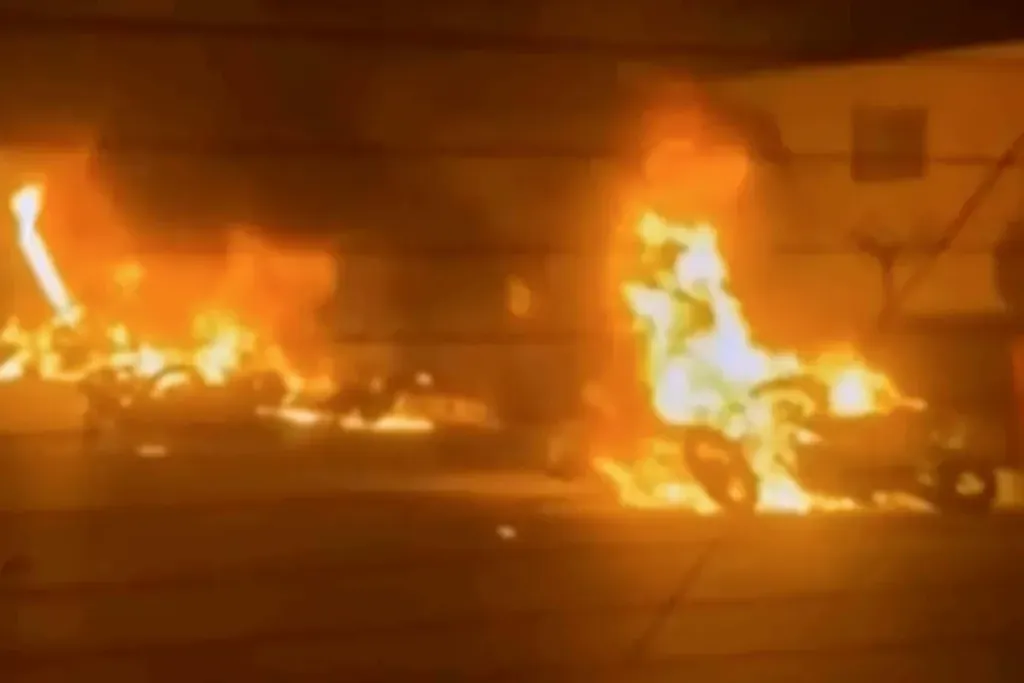
Despite the communications shutdown, short videos circulating online appeared to show protesters chanting slogans against Iran’s leadership around bonfires in Tehran and other cities. In one clip from the Saadat Abad neighborhood of northern Tehran, a large crowd could be seen gathered around a fire, with chants of “Death to Khamenei!” audible.
Authorities had warned families to keep children at home, but demonstrations resumed Friday night. The full scale of the protests was difficult to assess because of the blackout, which also appeared to disrupt Iran’s state-run and semi-official news agencies.
Iranian state television acknowledged the protests on Friday morning, its first official confirmation since the unrest escalated. It later aired footage of pro-government forces riding motorcycles through Tehran and reported that overnight violence had killed six people in the western city of Hamedan and two members of the security forces in Qom. State TV said protests involved arson attacks on private vehicles and public infrastructure, but did not provide nationwide casualty figures.
Role of Reza Pahlavi and protest slogans
The demonstrations have also tested the influence of Reza Pahlavi, the son of Iran’s last shah, who was overthrown in the 1979 Islamic Revolution. Pahlavi, who lives in exile, called for Iranians to take to the streets at 8 p.m. on Thursday and Friday, a timing that witnesses said coincided with a surge in chanting across Tehran neighborhoods.
Chants included “Death to the dictator!” and “Death to the Islamic Republic!” along with slogans praising the former monarchy. Support for the shah — once punishable by death — has emerged as a striking feature of the protests, underscoring the depth of anger among some demonstrators rather than indicating a unified political agenda.
Holly Dagres, a senior fellow at the Washington Institute for Near East Policy, said Pahlavi’s call appeared to galvanize participation. “Per social media posts, it became clear that Iranians had delivered and were taking the call seriously to protest in order to oust the Islamic Republic,” she said, adding that the internet shutdown likely aimed to prevent global scrutiny while giving security forces freer rein.
On Friday, Pahlavi appealed directly to Trump, urging him to intervene. He warned that Khamenei intended to use the communications blackout to carry out lethal repression, calling protesters “young heroes.” Pahlavi’s past support for Israel has drawn criticism, particularly following a brief but intense conflict between Israel and Iran earlier in the year, and it remains unclear whether chants invoking the shah reflect support for Pahlavi personally or nostalgia for life before the revolution.
Wider unrest and uncertainty ahead
Protests were also reported in Zahedan, in Iran’s restive Sistan and Baluchestan province, a region that has previously seen deadly clashes between security forces and demonstrators. The breadth of locations suggests the unrest is not confined to major urban centers.
With communications largely severed, independent verification remains limited. What is clear is that Iran’s leadership is framing the protests as externally driven and preparing a forceful response, while international pressure mounts for restraint. Whether the demonstrations can be sustained under tightening security conditions remains uncertain, but the confrontation has already exposed deep fractures within Iranian society.
This article was rewritten by JournosNews.com based on verified reporting from trusted sources. The content has been independently reviewed, fact-checked, and edited for accuracy, neutrality, tone, and global readability in accordance with Google News and AdSense standards.
All opinions, quotes, or statements from contributors, experts, or sourced organizations do not necessarily reflect the views of JournosNews.com. JournosNews.com maintains full editorial independence from any external funders, sponsors, or organizations.
Stay informed with JournosNews.com — your trusted source for verified global reporting and in-depth analysis. Follow us on Google News, BlueSky, and X for real-time updates.