India’s Gen Z — an estimated 370 million people under 25 — represents one of the largest, most digitally connected youth populations in the world. Yet, despite their constant exposure to political and social issues online, their presence on the streets remains limited.
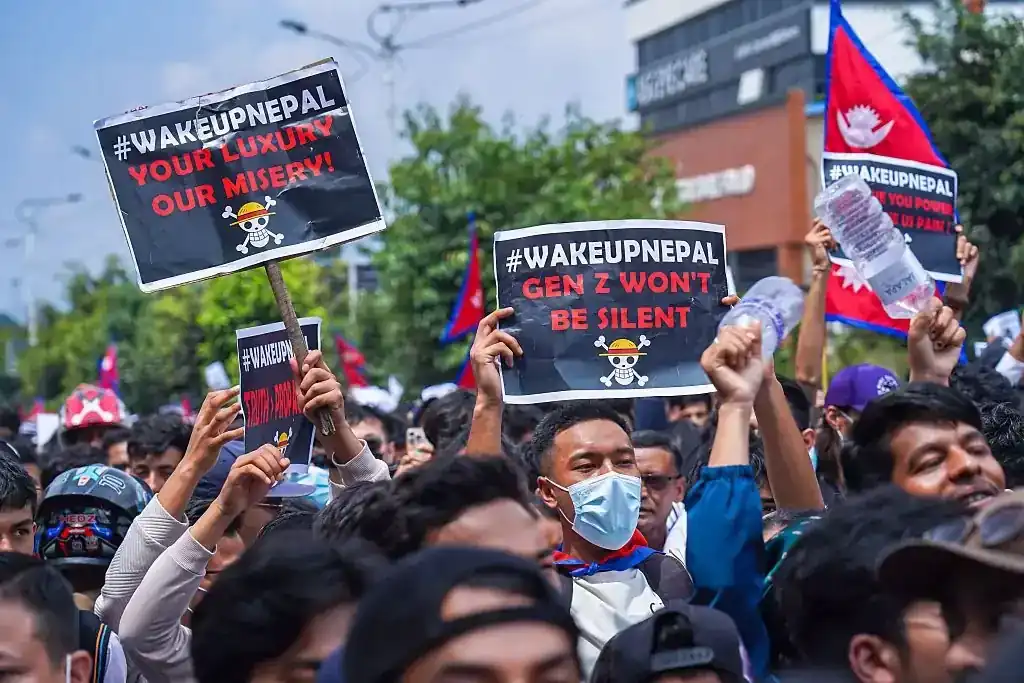
Across South Asia and Africa, their peers have taken bold political action: protesters in Nepal brought down a government in 48 hours, youth in Madagascar toppled their leader, and frustrated Indonesians and Bangladeshis forced sweeping reforms through mass protests. In India, however, the country’s young generation appears wary of confrontation, constrained by fear, fragmentation, and disillusionment.
Digital Awareness, Real-World Restraint
India’s youth are more informed than ever. Smartphones, social media, and citizen media expose them daily to debates on corruption, inequality, and governance. But while online engagement flourishes, offline activism faces deep barriers.

“Taking to the streets feels risky,” says 23-year-old political science graduate Dhairya Choudhary. “You risk being branded anti-national.”
That label, often used by politicians and TV anchors to discredit dissent, has made public protest a dangerous act. Many students and young professionals fear social or professional repercussions if they are seen challenging authority.
This caution contrasts sharply with their peers abroad, who have mobilized through encrypted apps and decentralized networks. India’s young generation, by contrast, channels much of its frustration into digital spaces — where heated debates on platforms like Reddit and X (formerly Twitter) remain deeply divided.
Fragmented Anger, Local Battles
Despite shared frustrations over unemployment, corruption, and inequality, India’s Gen Z lacks a unifying cause. Youth activism here tends to flare around local or identity-based issues rather than national movements.
“I don’t see a single force uniting us,” says Vipul Kumar, a 26-year-old journalist from Bihar. “Power in India is decentralised, and so is the anger of its youth.”




Experts agree. Sudhanshu Kaushik, founder of the Centre for Youth Policy, calls India an “outlier” in regional youth politics. “Age is not the only differentiator,” he explains. “Young people are aligned with regional, linguistic, and caste identities, often putting them at odds with one another.”
In practice, that means different causes dominate in different regions:
Urban youth rally around job opportunities and infrastructure.
Dalit youth focus on caste discrimination and social justice.
Tamil youth mobilize over language rights and regional autonomy.
Upper-caste youth in Gujarat and Haryana have protested for affirmative action.
This complex patchwork of priorities makes it difficult for a national youth movement to emerge — even as discontent simmers across social classes.
Fear and Fatigue in India’s Campuses
India’s universities once served as hotbeds of political mobilization, from the anti-Emergency protests of the 1970s to the student uprisings of the 2010s. But in recent years, that tradition has waned.
“These institutions, once centres of anti-government activism, have lost that spirit,” says 23-year-old researcher Hajara Najeeb.
Campus restrictions, tightened surveillance, and disciplinary threats have discouraged open political expression. The 2019 protests against the Citizenship Amendment Act (CAA) — one of the largest youth-led movements in decades — ended with violent crackdowns at Delhi’s Jamia Millia Islamia and Aligarh Muslim University.
Student leader Umar Khalid remains in jail five years later, accused of being a “key conspirator” in the 2019 Delhi riots — allegations he denies. Such outcomes, say activists, have deterred many young Indians from future demonstrations.
“The government has demonised protest to such an extent that few people even think of protesting,” says Jatin Jha, a 26-year-old youth fellow at the State Bank of India.
A Generation Redefining Politics
Despite low street visibility, India’s Gen Z is not politically apathetic. Many engage online, volunteer locally, or focus on personal advancement as a form of quiet resistance. However, only 38% of 18-year-olds registered to vote in the 2024 general election — a figure analysts say reflects growing disillusionment with traditional politics.
A survey by a citizen media platform found that 29% of young Indians avoid politics altogether. Yet paradoxically, the ruling Bharatiya Janata Party (BJP) continues to maintain strong youth support — 40% in 2019 and only slightly less in 2024 — suggesting that political engagement, when it occurs, often aligns with nationalist narratives.
Sociologist Dipankar Gupta believes this reflects a generational pattern: “Youth energy is fleeting. Each generation finds its own causes rather than inheriting old ones.”
Economic Pressure and Quiet Aspiration
While the government promotes youth empowerment through employment schemes and entrepreneurship initiatives, economic anxiety remains pervasive.
“India may be doing better than many countries, but unemployment anxiety continues to grow,” Kaushik says. “Young people are taking things into their own hands — with migration abroad increasing year after year.”
For many, leaving the country now feels more achievable than reforming it. This shift toward individual survival over collective protest reflects both pragmatism and fatigue.
Still, scattered sparks of activism persist — from Ladakh’s recent protests for statehood to local campaigns for environmental justice, education reform, and gender equality. Whether these movements can merge into a larger political awakening remains uncertain.
A Watchful, Wary Generation
India’s Gen Z has inherited a legacy of protest but lives in an era where dissent is often stigmatized. Their silence does not necessarily mean apathy; rather, it signals a generation calculating the cost of confrontation.
They are restless but cautious, informed yet disillusioned — their activism migrating from the streets to the screens. As one youth observer put it: “They’re not marching, but they’re watching — and waiting for their moment.”
Source: BBC – Gen Z rising? Why young Indians aren’t taking to the streets