NICOSIA, Cyprus — The European Union is stepping up efforts to reshape its energy and trade security architecture following the disruption of global fuel markets linked to the Iran war, Associated Press reporting indicated, as policymakers warn that reliance on traditional Middle Eastern shipping routes leaves the bloc exposed to future geopolitical shocks.
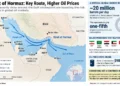
European leaders are now weighing a mix of long-term infrastructure projects and regional partnerships aimed at reducing dependence on the Strait of Hormuz, a critical chokepoint for global energy flows that has repeatedly been threatened by regional instability.
Push for new intercontinental trade corridors
A central element of the EU’s emerging strategy is renewed interest in the India-Middle-East-Europe Economic Corridor (IMEC), a proposed network of transport, energy, and digital links connecting South Asia to Europe via the Gulf and Israel.

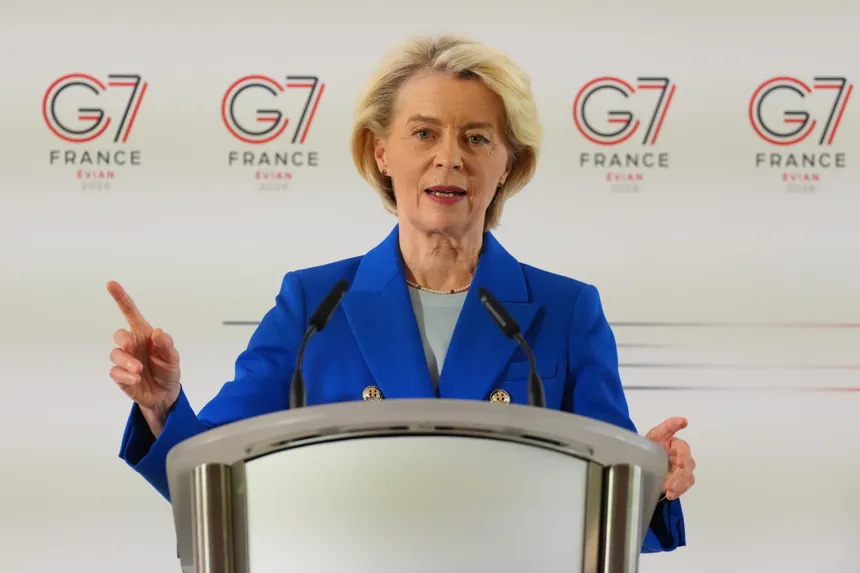
European Commission President Ursula von der Leyen told G7 leaders that “alternative export routes have been created that are more resilient and offer choices” and added that “other routes will be built — for example, a typical one is IMEC.”
The initiative is viewed within EU policy circles as a potential mechanism for strengthening supply-chain diversification and strategic autonomy, particularly as tensions with Russia persist and transatlantic economic alignment faces new strains.
While the EU has endorsed IMEC through a memorandum of understanding, only a limited number of its 27 member states are formal signatories. A senior EU diplomat, speaking on condition of anonymity due to restrictions on disclosing internal discussions, said political support for the project remains strong, with ongoing efforts to move it from concept to implementation.
“The focus now is on translating that vision into practical implementation across its three pillars: transport and trade connectivity, energy connectivity and digital connectivity,” the diplomat said, noting that future infrastructure could include pipelines and transmission networks.
Diplomatic conditions and regional constraints
IMEC’s viability remains closely tied to regional diplomatic developments, particularly normalization between Israel and Saudi Arabia, which analysts and officials describe as a key prerequisite for full implementation.
■ Related News
Lianne Pollak-David, co-founder of the Israel-based Coalition for Regional Security, said during a recent briefing that U.S. involvement would be essential. “Without normalization between Israel and Saudi Arabia, IMEC cannot be truly realized,” she said.
Saudi Arabia has indicated it would only normalize relations with Israel if there is a clear pathway toward Palestinian statehood, a position that remains at odds with Israeli leadership. How the Iran war, which involved U.S. and Israeli military action and affected Gulf states, may influence Saudi calculations remains uncertain.
Saudi officials have not publicly commented on the initiative.
Europe weighs Gulf partnerships and alternative routes
European leaders are also examining shorter-term measures to reduce exposure to disruptions in the Strait of Hormuz. European Commission officials have pointed to significant increases in energy import costs during the early phase of the conflict, with President von der Leyen stating the EU spent 25 billion euros ($29 billion) more on oil and gas in the first 54 days of the war.
At an EU leaders’ meeting in April, von der Leyen and European Council President Antonio Costa said the bloc was prepared to deepen cooperation with Gulf countries to develop infrastructure that bypasses high-risk maritime corridors.
French Foreign Ministry spokesperson Pascal Confavreux said G7 discussions included financing infrastructure that could “go outside of the track of the Strait of Hormuz.”
Existing regional infrastructure has also drawn attention, including Saudi Arabia’s East-West Pipeline, which runs from eastern oil fields to the Red Sea and reportedly reached maximum capacity transport levels during the conflict period.
Renewable ambitions alongside fossil infrastructure
An EU official said the bloc may also encourage European companies to invest in renewable energy projects in Gulf states to support long-term diversification of supply. The official spoke on condition of anonymity because they were not authorized to discuss internal planning.
Analysts caution that near-term projects are more likely to focus on oil and gas pipelines or the repair of damaged infrastructure, while longer-term plans would need to align with EU climate policy goals, potentially including “dual-use” systems capable of transporting hydrogen in the future.
Gabriel Mitchell of the German Marshall Fund said such projects would take time to develop but could form part of a broader strategic shift in energy policy.
Mediterranean interconnection project gains attention
Another major initiative under discussion is the Great Seas Interconnector (GSI), an EU-backed subsea electricity cable intended to stretch 1,208 kilometers to link continental Europe’s power grid with Cyprus and Israel, with potential expansion toward broader regional integration.
The project, while delayed by financing and regulatory hurdles, is seen by supporters as a key step in reducing energy isolation in parts of the Eastern Mediterranean and enabling integration with wider intercontinental energy networks.
Gallia Lindenstrauss of the Israel-based Institute for National Security Studies described it as a “very pragmatic solution for the modern energy needs,” adding that it could support future transitions toward renewable energy systems.
The United States has also expressed interest in strengthening Eastern Mediterranean energy cooperation. U.S. Energy Secretary Chris Wright said last week the region is “an increasingly important region for global energy development,” highlighting cooperation on natural gas and infrastructure initiatives.
Despite growing political momentum, EU officials acknowledge that most projects remain in early planning stages, with financing, diplomacy, and regional stability continuing to shape their feasibility.
Tags: European Union, Iran war, energy security, Strait of Hormuz, IMEC, Cyprus, Middle East