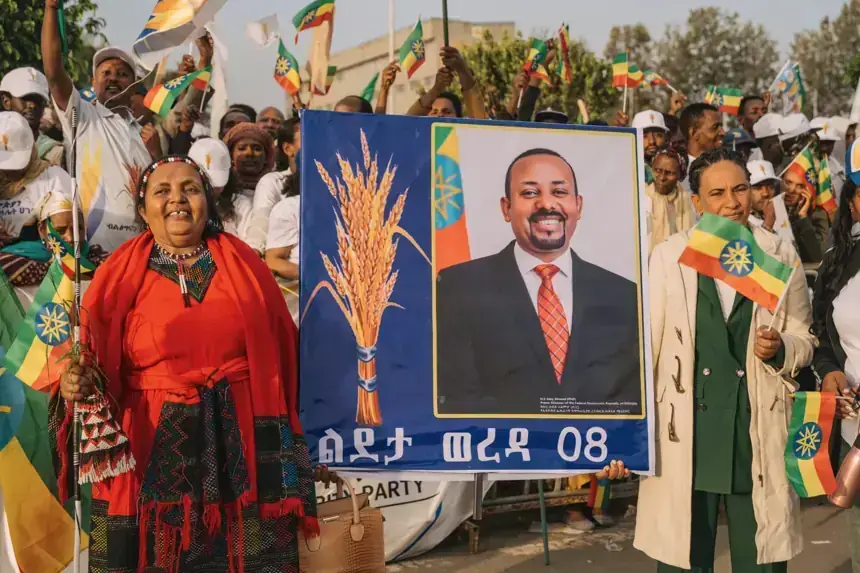
Ethiopians headed to the polls on Monday in a national election widely expected to deliver another decisive victory for Prime Minister Abiy Ahmed’s ruling Prosperity Party, extending its dominance in parliament amid ongoing security challenges and political tensions across parts of the country. Election officials said about 50 million people were eligible to vote in a contest that will determine the composition of Ethiopia’s House of Representatives and regional councils.
The vote carries significance beyond Ethiopia’s borders because the country is Africa’s second-most populous nation and hosts the headquarters of the African Union. The election comes as Ethiopia continues to grapple with the aftermath of recent conflicts and seeks to project stability following years of political and security upheaval.
Ruling Party Favored to Retain Control
Prime Minister Abiy Ahmed’s Prosperity Party currently controls more than 500 seats in the national legislature and is expected to secure another parliamentary majority, according to reporting by The Associated Press and other observers. Ethiopia’s electoral system requires voters to elect members of parliament, who then choose the prime minister.

The opposition enters the election fragmented and weakened by internal divisions. Several opposition leaders have argued that the political environment favors the ruling party, while government officials have rejected allegations that opposition groups face unfair restrictions.
Much of the campaign focused on national reconciliation, economic development and security, reflecting concerns over continued instability in several regions. Government candidates highlighted infrastructure projects and economic reforms, while opposition parties called for broader political reforms and changes to the country’s governance system.
Security Challenges Affect Voter Participation
The election takes place against a backdrop of continuing unrest in parts of the Amhara and Oromia regions, where insecurity is expected to reduce voter participation. Authorities have increased security measures in the capital, Addis Ababa, and other areas ahead of the vote.
Political tensions remain elevated following years of conflict. The war in the Tigray region between 2020 and 2022 resulted in widespread devastation before a peace agreement was signed in November 2022. Despite that accord, divisions remain unresolved and concerns persist about renewed instability.
The election will not be held in the Tigray region, which remains without representation in the federal parliament. The federal government and the Tigray People’s Liberation Front continue to disagree over political arrangements in the region, contributing to uncertainty over the implementation of the peace agreement.




African Union Monitors Election
Former Kenyan President Uhuru Kenyatta is leading a 73-member observer mission from the African Union to monitor the election process. Upon arriving in Ethiopia, Kenyatta emphasized the importance of a peaceful vote, noting Ethiopia’s central role on the continent.
Election officials declared Monday a national holiday and closed government offices to encourage voter participation. Results are expected to be announced in the coming days after ballots are counted across the country’s constituencies.
Vote Seen as Test of Abiy’s Leadership
The election serves as another major test for Abiy, who came to power in 2018 promising democratic reforms and political openness. He received international recognition in 2019 when he was awarded the Nobel Peace Prize for helping end a long-running conflict with neighboring Eritrea.
Since then, his administration has faced criticism from opposition groups and human rights organizations over political freedoms and the government’s handling of internal conflicts. Government officials have denied allegations of systematic abuses and maintain that security measures are necessary to preserve stability.
With the ruling party expected to remain firmly in control, the election’s broader significance may lie less in determining the winner than in whether it helps strengthen confidence in Ethiopia’s political institutions during a period of continued uncertainty. Questions surrounding security, national reconciliation and regional tensions are likely to remain central challenges regardless of the outcome.