A deadly Colombia military plane crash has triggered urgent scrutiny over aviation safety and emergency preparedness after a transport aircraft carrying 121 people went down shortly after takeoff in the country’s southern Amazon region. The incident, which occurred near Puerto Leguizamo in Putumayo province, has left at least 33 people dead and dozens more injured, with authorities warning the toll could rise.
The crash underscores the operational risks faced by military logistics networks in remote regions and highlights broader concerns about infrastructure, response capacity, and fleet readiness in one of Latin America’s most challenging terrains.
Emergency Response Tested in Remote Region
Local officials described a rapid but strained emergency response in the isolated town of Puerto Leguizamo, which borders Ecuador and Peru. According to reporting from The Associated Press, Deputy Mayor Carlos Claros said local clinics were quickly overwhelmed as injured passengers were brought in before being transferred to larger hospitals.

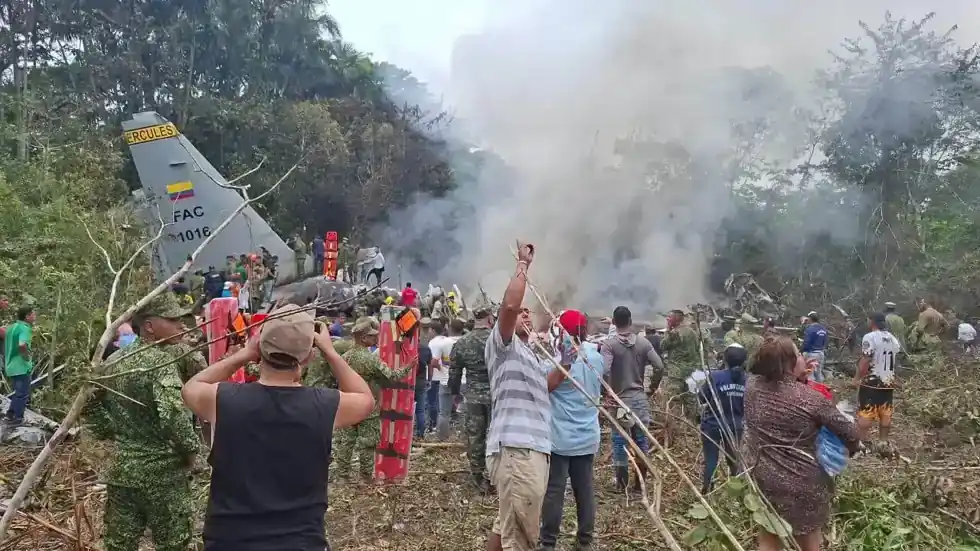
Residents played a critical role in the immediate aftermath, helping extinguish fires and transporting injured survivors from the crash site. Images broadcast by Colombian media showed thick smoke rising from a field surrounded by dense vegetation, illustrating the logistical difficulties responders faced.
Authorities said at least 77 people were rescued with injuries, while efforts continued to determine the final number of casualties.
Military Operations Disrupted
Colombia’s Defense Ministry confirmed the aircraft was transporting troops within Putumayo, a region that remains strategically significant due to security operations and its proximity to international borders.
The aircraft involved was a Hercules C-130, commonly used for military transport missions. Officials said 110 soldiers and 11 crew members were on board at the time of the crash.
Air force commander Carlos Fernando Silva said the plane encountered a problem shortly after takeoff and crashed approximately two kilometers from the airport. The cause of the incident remains under investigation.
■ Related News


Safety Questions and Political Pressure Mount
The crash has intensified debate over the condition and readiness of Colombia’s military aviation fleet. President Gustavo Petro called for accountability, emphasizing the need to modernize equipment and address what he described as bureaucratic obstacles hindering reforms.
Critics, however, argue that reduced flight hours under the current administration may have impacted pilot experience and operational readiness. These concerns add a political dimension to the investigation, as authorities seek to determine whether systemic issues contributed to the حادث.
Aviation analyst Erich Saumeth noted that the aircraft had undergone a comprehensive overhaul in recent years, suggesting that mechanical failure alone may not fully explain the crash. Investigators are expected to examine whether engine performance or operational factors played a role.
Regional Security Context Remains Key
Defense officials said there is no evidence so far that the aircraft was targeted by armed groups, despite the presence of insurgent organizations in the broader region. The Putumayo area has historically seen activity from armed groups involved in narcotics trafficking and insurgency.
While early indications point to an accident, authorities are continuing to assess all possible scenarios as part of the investigation.
Strategic Implications for Military Readiness
The Colombia military plane crash highlights the vulnerabilities of operating in remote and high-risk environments, where limited infrastructure can complicate both missions and emergency response.
Beyond the immediate tragedy, the incident is likely to influence defense policy discussions, particularly around fleet modernization, pilot training, and logistical resilience. Analysts say ensuring operational safety will be critical as Colombia continues to rely on air mobility for both military and humanitarian missions.
As investigations proceed, the findings could have lasting implications for how the country manages its defense capabilities and responds to crises in geographically challenging regions.