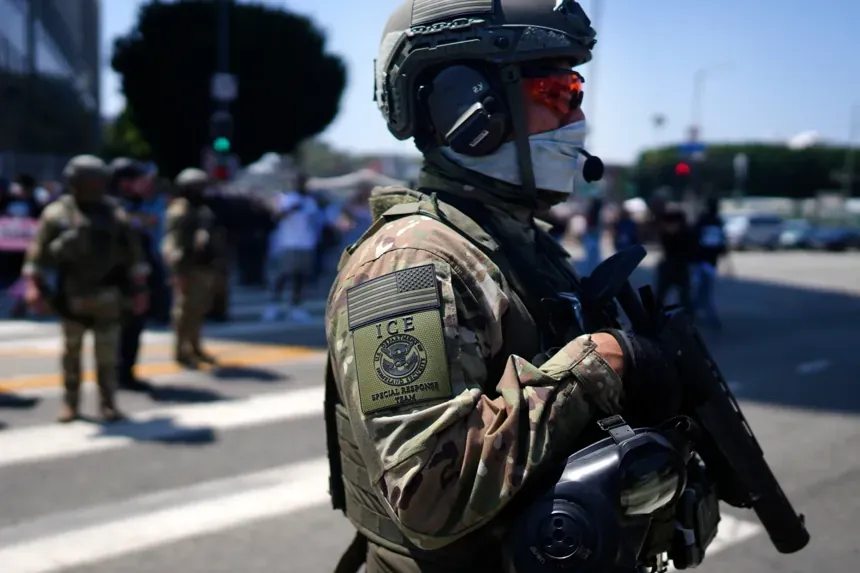
WASHINGTON – The Department of Homeland Security (DHS) is facing renewed scrutiny after confirming that Immigration and Customs Enforcement (ICE) officers involved in the fatal shooting of a man in Houston were not equipped with body cameras, despite a congressional appropriation to expand their deployment and previous commitments by department leadership.
The issue has intensified calls for greater accountability as DHS continues to expand immigration enforcement under President Donald Trump’s administration. Critics argue that the absence of body camera footage has complicated efforts to determine what occurred during the fatal encounter involving Lorenzo Salgado Araujo, a Mexican national who had lived in the United States for more than 35 years.
According to DHS, an ICE officer opened fire after Salgado Araujo allegedly rammed an ICE vehicle while officers pursued his van. Witnesses have disputed that account, and no publicly released evidence has emerged to independently verify the department’s description of the incident.

Congressional Funding and Deployment Timeline
The latest controversy comes months after then-Homeland Security Secretary Kristi Noem announced that the department would “rapidly acquire and deploy” body-worn cameras for DHS law enforcement personnel nationwide following two fatal shootings involving American citizens in Minneapolis earlier this year.
At the time, Noem said the Minneapolis deployment marked the beginning of a nationwide rollout as funding became available. She has since been succeeded as Homeland Security secretary by Markwayne Mullin.
Congress subsequently appropriated $20 million in April for the procurement, deployment and operation of body-worn cameras for officers carrying out immigration enforcement duties.
On Thursday, DHS said body cameras have now been deployed to more than half of ICE field offices nationwide and that the remaining offices are expected to receive them within the next 60 days.
Rep. Sylvia Garcia, a Texas Democrat whose district includes parts of Houston, said she spoke with acting ICE Director David Venturella following the shooting and criticized the pace of deployment.
■ Related News



Garcia said Venturella told her that fewer than one-third of ICE officers nationwide had been issued body cameras but pledged that all officers would receive them by the end of July.
Garcia said she intends to hold the agency accountable for meeting that commitment.
Accountability Debate Intensifies
The Houston shooting has become a focal point in the broader debate over transparency in federal immigration enforcement.
Michelle Gross, president of the Minnesota-based advocacy organization Communities United Against Police Brutality, said ICE officers conducting enforcement operations should be equipped with body cameras before carrying out arrests.
The department has previously relied on body camera footage during other investigations. Following the January shooting death of Alex Pretti in Minneapolis, DHS said four Border Patrol agents at the scene were wearing body cameras, and investigators used that footage along with other evidence while reviewing the incident.
DHS has not publicly stated whether ICE officers involved in the January shooting death of Renee Good, a 37-year-old mother of three, were equipped with body cameras. Publicly circulated bystander videos from both incidents drew significant public attention.
Former acting ICE Director Todd Lyons told Congress after the Minneapolis shootings that body camera footage from that incident would eventually be released publicly, although it has not yet been made public. During the same testimony, Lyons expressed support for expanding body camera use across immigration enforcement operations.
Political Dispute Over Rollout Delays
DHS has attributed delays in fully equipping officers to recent government funding disruptions, stating that the Houston officers had not yet received body-worn cameras because of “back-to-back Democrat shutdowns.”
Those funding disputes were driven by Democratic opposition to the Trump administration’s immigration policies and efforts to secure changes to Homeland Security programs.
Garcia rejected the department’s explanation, arguing that Congress had already approved dedicated funding for the equipment and that DHS had committed to implementing the program.
The debate over body cameras has also reached the courts. During immigration enforcement operations in Chicago as part of “Operation Midway Blitz,” a federal judge ordered immigration officers to wear body cameras, finding they could provide important evidence during enforcement actions.
The Houston shooting has added pressure on DHS to complete the nationwide deployment of body-worn cameras as Congress and advocacy groups continue monitoring the department’s implementation of the federally funded program.
This report is based on reporting by The Associated Press.
Article Topics: Department of Homeland Security | ICE | Body Cameras | Immigration Enforcement | Congressional Funding | Accountability | Federal Oversight