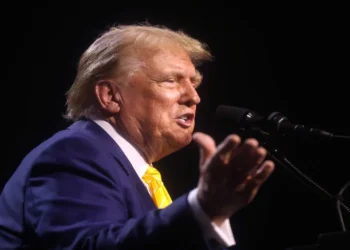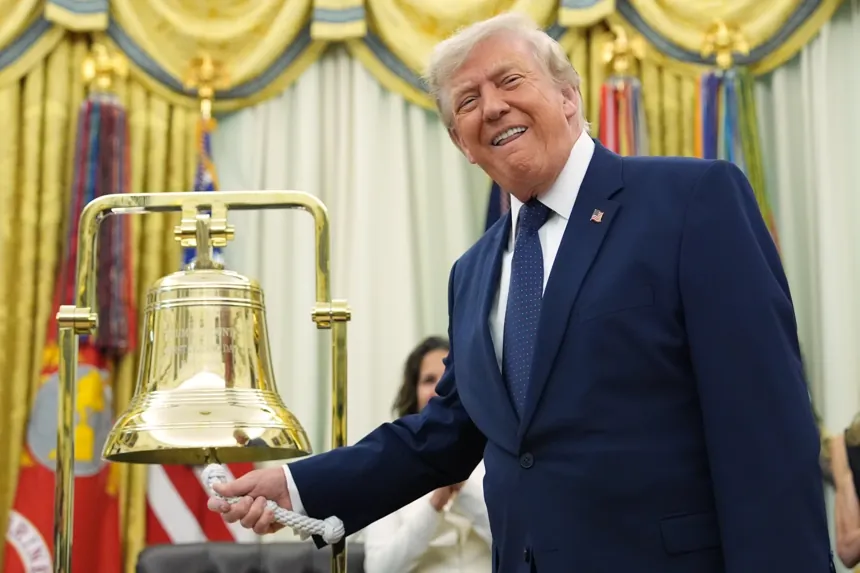
President Donald Trump on Monday ceremonially rang the opening bells for both the New York Stock Exchange and the Nasdaq from the Oval Office, underscoring the administration’s growing emphasis on stock market performance as a measure of its economic agenda.
Speaking after marking the start of trading, Trump predicted continued gains for U.S. markets.
“It’s going to go up — I think the market’s going to go through the roof,” Trump said.
The event reflected the White House’s effort to connect the administration’s economic policies with investment growth, even as inflation continues to challenge public perceptions of the economy ahead of the November midterm elections.

According to a June survey conducted by The Associated Press-NORC Center for Public Affairs Research, 33% of U.S. adults approve of Trump’s handling of the economy.
Trump Accounts Take Center Stage
The Oval Office ceremony also promoted the launch of Trump Accounts, an investment program established under Republicans’ 2025 tax and spending legislation.
The accounts are designed to provide children with investments tied to stock market indexes, with the administration presenting the initiative as a way to encourage long-term participation in financial markets.
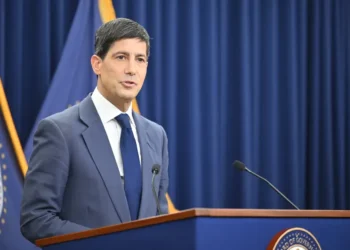
Treasury Secretary Scott Bessent said many American households remain disconnected from equity investments.
Before the opening bell ceremony, Bessent stated that “38% of American families do not have any exposure to our great equity markets.”



The administration argues that expanding access to investment accounts could allow more families to benefit from long-term market growth.
Stock Market Gains Contrast With Inflation Concerns
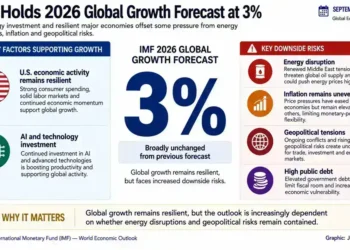
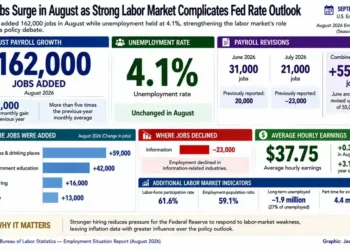
Although U.S. equity markets have continued to perform strongly, inflation has remained a significant political challenge for the administration.
The benchmark S&P 500 gained 17.9% during 2025 after posting annual returns of 25% in 2024 and 26.3% in 2023 during former President Joe Biden’s administration. The index has risen roughly 10% so far this year.
Despite those gains, higher consumer prices have continued to affect public sentiment.
Trump entered office after campaigning on lowering household costs, but his administration’s tariff policies and the outbreak of war involving Iran have added new inflationary pressures.
The consumer price index has increased 4.2% over the past 12 months, compared with 3% when Trump began his second term in January 2025.
Billionaires Back New Investment Initiative
The Trump Accounts initiative has also attracted support from several prominent business leaders and investors beyond the government’s initial $1,000 contribution for eligible accounts.
Michael Dell, founder of Dell Technologies, and his wife Susan Dell joined Trump at Monday’s event after pledging $6.25 billion toward the program.
Additional commitments have come from investor Ray Dalio and Gwynne Shotwell, president of SpaceX. Shotwell announced Monday that she plans to donate company stock to support the accounts.
The administration has argued that such investments could give future generations a stronger financial stake in the U.S. economy through long-term ownership of stock market assets.
Trump also joked during the event that children had missed out on earlier market gains because of the delay in launching the investment program.
This report is based on reporting by The Associated Press.
Topics: Donald Trump | Trump Accounts | Stock Market | Treasury Department | Economic Policy | Inflation | Wall Street