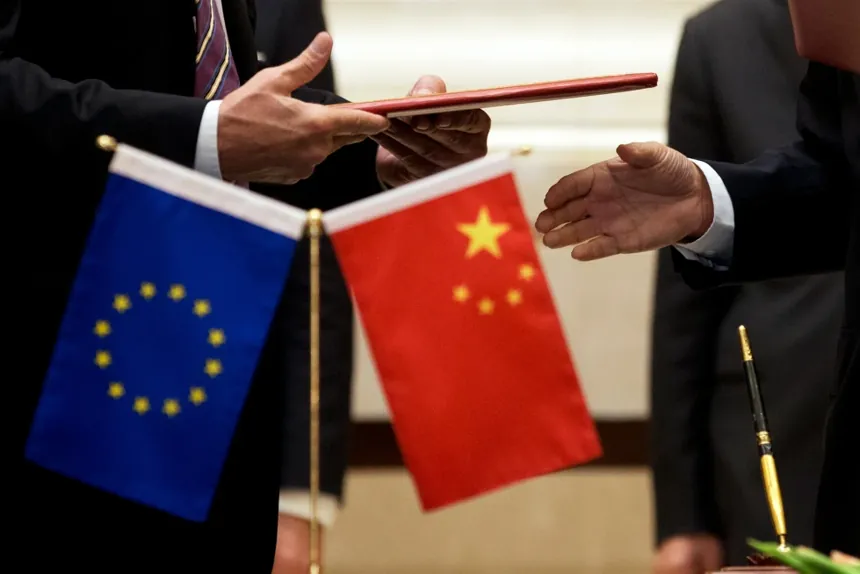
HONG KONG – Beijing announced a new consultation mechanism that will bring Chinese and European Union trade officials together regularly as both sides work to address trade imbalances, industrial concerns, and cooperation in emerging technologies.
China and the European Union have agreed to establish regular ministerial-level trade consultations, marking a renewed effort to strengthen economic engagement while addressing longstanding concerns over trade imbalances and market access.
China’s Ministry of Commerce announced Thursday that the new China-EU trade and investment consultation mechanism will provide a structured platform for discussions once or twice each year. The initiative comes as both economies navigate growing commercial tensions alongside shared interests in technology and clean energy development.

Commerce Ministry spokesperson He Yadong said Beijing has invited European Union Trade Commissioner Maroš Šefčovič to visit China this autumn, following discussions held earlier this week between Šefčovič and Chinese Commerce Minister Wang Wentao in Brussels.
According to the ministry, both sides also intend to expand cooperation in sectors including artificial intelligence and the transition toward renewable energy technologies.
Trade Imbalance Remains a Central Issue
The agreement follows increasing concern within the European Union over its expanding trade deficit with China.
The EU’s trade gap with China reached approximately 360 billion euros (about $410 billion) last year, averaging nearly 1 billion euros in deficit each day. Chinese exports, particularly electric vehicles, batteries, and other manufactured products, have continued to grow across European markets.
Following Monday’s meeting in Brussels, Šefčovič emphasized that Europe must strengthen efforts to protect its industrial base while pursuing fairer trading conditions globally. He has set an October target for achieving meaningful progress on measures aimed at rebalancing trade relations between the two economies.


New EU Trade Measures Target Key Imports
The announcement also comes shortly after new European Union trade protection measures took effect on Wednesday.
The policies are designed to support the European steel industry while tightening rules governing low-value e-commerce parcel imports. Although the measures do not exclusively name China, they are widely expected to have a significant impact on Chinese exporters and online retailers serving European consumers.
European policymakers have increasingly argued that stronger safeguards are needed to ensure fair competition for domestic manufacturers facing growing imports from China.
Beijing Calls for Reduced Export Restrictions
Chinese officials have maintained that trade relations can become more balanced through greater market access on both sides.
Last week, Yuyuantantian, a social media account affiliated with Chinese state media, said China is willing to increase imports from the European Union. However, it argued that European governments should ease export controls on advanced technology products destined for China and avoid using trade and economic issues as geopolitical tools.
The comments reflect one of Beijing’s longstanding concerns regarding restrictions on access to high-tech products and advanced manufacturing technologies.
Broader Global Trade Environment
The renewed trade dialogue also unfolds against a backdrop of wider international efforts to diversify critical supply chains.
In June, leaders of the Group of Seven (G7) nations issued a joint declaration aimed at strengthening supply chains for critical minerals used in high-technology industries, renewable energy production, and defense manufacturing. The initiative forms part of broader efforts by advanced economies to reduce dependence on Chinese supply networks for strategically important materials.
Despite ongoing disagreements over market access, industrial policy, and trade practices, the newly established consultation mechanism signals that both China and the European Union intend to maintain regular dialogue as they seek practical solutions to increasingly complex economic challenges.
Tags: China, European Union, Trade Relations, Trade Policy, Maroš Šefčovič, Wang Wentao, Artificial Intelligence, Renewable Energy, Global Trade, Supply Chains