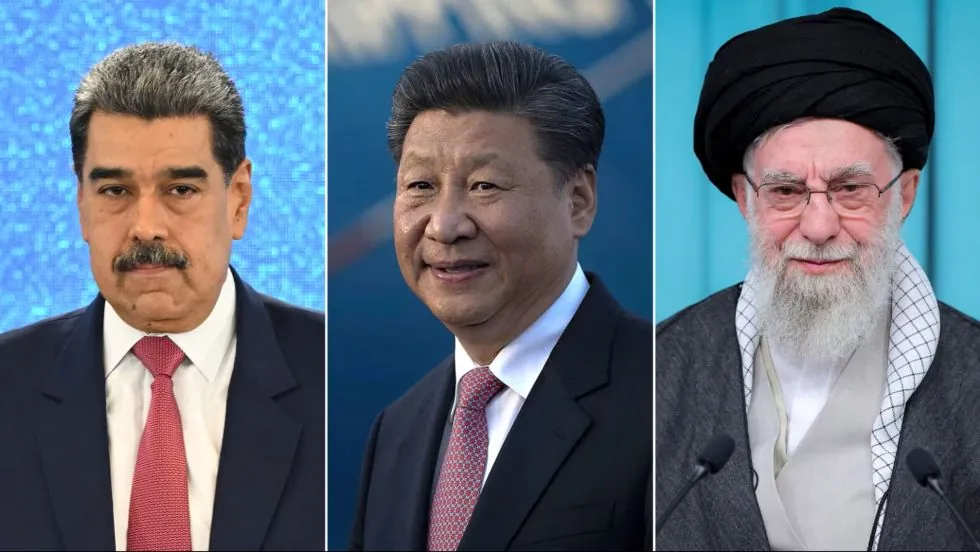
China’s foreign policy has faced intense global scrutiny after recent US military actions against two countries that Beijing has treated as strategic partners — the capture of Venezuelan President Nicolás Maduro and the killing of Iran’s Supreme Leader, Ayatollah Ali Khamenei. Both events have posed difficult diplomatic choices for Beijing, highlighting enduring tensions between China’s stated principles and the geopolitical constraints shaping its global ambitions.
China condemned the US actions as violations of sovereignty and international law, calling for diplomatic solutions and stability. But beyond strong rhetoric and calls for peace, Beijing has offered few concrete measures to support either Tehran or Caracas. Understanding this restraint requires an examination of China’s foreign policy doctrine, its economic imperatives, institutional priorities, and the broader geopolitical landscape in which it operates.
China’s cautious stance matters for global diplomacy because it factors into how power dynamics shape conflicts, international norms around sovereignty, and the future of global energy markets — particularly given China’s heavy reliance on imported crude oil from the Middle East and Latin America. It also reflects Beijing’s broader strategic calculus about how to compete with the United States without triggering direct confrontation.

Historical evolution
China’s modern foreign policy has been shaped by its experience as both a developing nation and a major global power.
After the founding of the People’s Republic of China in 1949, Beijing adopted a doctrine of “independent foreign policy” and “non‑interference in internal affairs,” aimed at winning legitimacy among newly independent post‑colonial states and asserting China’s sovereignty against superpower competition. Over time, this evolved into a strategic emphasis on stability, economic development, and opposition to external military interventions in sovereign states.
During the Cold War, China maintained a cautious diplomatic engagement with movements and governments aligned against Western powers, but it rarely committed to foreign military interventions even for allied regimes. This extended into the post‑Cold War era, with Beijing often supporting multilateral sanctions or diplomatic initiatives rather than direct deployment of force. China’s policy toward North Korea, for example, demonstrated repeated restraint despite deep ties and shared strategic interests.
That legacy informs contemporary relations with both Iran and Venezuela. China forged closer ties with Tehran after sanctions isolated the Islamic Republic in the early 21st century, and a “comprehensive strategic partnership” was formalized in 2021. China also became one of Venezuela’s largest creditors and crude oil buyers in the 2010s, designating Caracas an “all‑weather” partner — a rare diplomatic distinction.
Yet Beijing’s historical reluctance to engage militarily outside its periphery persisted as a fundamental constraint. Even as China expanded its role on the world stage, its leaders remained wary of entangling alliances and costly foreign wars.
■ Related News


Institutional framework
China’s foreign policy apparatus is centrally controlled by the Communist Party of China (CPC), with the Ministry of Foreign Affairs (MFA) and key party organs shaping diplomatic messaging and strategic priorities. At formal press events, Chinese officials have articulated core themes: opposition to unilateral military actions, insistence on respect for sovereignty, and calls for peaceful resolution of disputes through dialogue.
Official statements have strongly condemned US strikes in Iran as a violation of international norms and characterized actions in Venezuela as “hegemonic.” MFA spokespeople have repeatedly underscored China’s objection to forceful interventions and urged all parties to respect the United Nations Charter.
Beijing has also emphasized the importance of energy security and stable supply chains as central policy concerns. With China the world’s largest crude importer, disruptions in the Middle East and Latin America carry significant economic risks.
Institutionally, China faces structural limits on military expeditionary operations. Although its People’s Liberation Army (PLA) has grown substantially and established an overseas base in Djibouti, the PLA’s projection capabilities beyond Asia remain modest compared with US global reach. China’s diplomatic institutions prioritize economic partnerships, multilateral engagement, and crisis management rather than hard military commitments in distant theaters.
Structural drivers
Several structural factors underpin Beijing’s limited response to US military actions:
Economic interdependence with the US: The Sino‑American relationship is the world’s largest bilateral economic partnership. China’s leadership views stable ties with Washington as vital for trade, investment, and technology flows. A direct confrontation over conflicts in the Middle East or Latin America could jeopardize that relationship, making Beijing cautious about escalation.
Energy security concerns: China imports a significant portion of its crude oil from the Middle East, including Iranian shipments that represented roughly 13 per cent of its seaborne oil imports as of 2025. Disruptions caused by conflict in the Persian Gulf can affect global prices and supply routes like the Strait of Hormuz, prompting Beijing to stress stability and call for ceasefires rather than confrontational postures.
Risk‑averse foreign policy tradition: Beijing’s long‑standing emphasis on non‑interference and avoidance of foreign entanglements drives its preference for rhetorical protest and diplomatic engagement over military or coercive actions. Chinese analysts often cite historical lessons from US wars in Afghanistan and Iraq as cautionary examples.
Multipolar image management: China promotes itself as a champion of sovereign equality and multilateralism. Intervening militarily on behalf of allies would conflict with this image and might undermine its advocacy for alternatives to Western security paradigms.
Economic dimensions
China’s global economic footprint has grown to encompass extensive trade networks, infrastructure investment programs like the Belt and Road Initiative (BRI), and strategic commodity partnerships. Iran and Venezuela have been important components of this strategy, particularly as sources of energy and markets for Chinese goods.
However, Beijing has diversified its supply chains and trading partners over the past decade, reducing reliance on any single source. In the event of disruptions to Iranian exports, China has options such as increasing imports from Russia or tapping strategic petroleum reserves. This diversification lessens the pressure for Beijing to undertake direct action to defend any one supplier.
Beijing has also navigated sanctions regimes carefully, claiming that its trade with sanctioned states complies with international law while avoiding overt defiance that could trigger secondary sanctions or financial isolation.
Political dynamics
China’s leadership balances domestic priorities — economic growth, social stability, technological advancement — with its external ambitions. Direct military engagement in distant conflicts could strain resources, generate domestic opposition, and distract from core initiatives like development and regional security near China’s borders.
Politically, Beijing must also consider its broader strategy toward the Global South and efforts to build influence through institutions like BRICS and regional diplomacy. Supporting allies rhetorically while avoiding binding security guarantees allows China to maintain relationships without overextending itself.
At the same time, China’s restrained response raises questions about the reliability of its partnerships. Observers and governments in developing regions may reevaluate alignment choices when Beijing’s support proves limited in moments of crisis.
Regional impact
China’s approach to the US‑led actions in Iran and Venezuela reverberates across multiple regions:
Middle East: Beijing’s calls for ceasefire and dialogue reflect its desire for stability that keeps energy flows steady. Its established relations with both Iran and Gulf states — including Saudi Arabia — are part of a delicate balancing act designed to protect economic interests across rival blocs.
Latin America: In Venezuela, China’s condemnation of US intervention and protest against perceived violations of sovereignty align with regional concerns about external interference. But the absence of military or urgent financial support may diminish Beijing’s influence compared with other actors.
Indo‑Pacific: The US military’s focus on conflicts outside Asia has raised concerns among Asian allies about stretched resources and security commitments. China may view a diverted US strategic focus as an opportunity to advance its objectives in areas like Taiwan and the South China Sea without confrontation.
International response
Global reactions to US military actions have varied. Many countries in Asia, Africa, and Latin America have criticized the strikes as violations of international law and expressions of hegemonic power. Calls for multilateral diplomacy and peaceful conflict resolution have been echoed in forums such as the United Nations.
Some states see China’s diplomatic stance as a form of soft balancing against US dominance, even if Beijing stops short of hard power deployment. Others argue that China’s reluctance to intervene militarily reflects the limits of its current global influence and raises questions about its capacity to lead an alternative security order.
Long‑term implications
China’s restrained responses to high‑profile US military actions underscore a complex and evolving foreign policy. Beijing’s prioritization of economic ties, strategic stability, and avoidance of direct confrontation with the United States shapes its behavior in moments of international crisis. This pattern is consistent with long‑standing principles and institutional preferences but may have long‑term consequences for China’s credibility as a security partner.
In the broader contest between great powers, China’s emphasis on economic leverage and diplomatic positioning avoids escalation in the short term but could limit its ability to shape hard security outcomes. How other nations interpret China’s restraint — as prudence or weakness — will influence future alignments and the global balance of power.