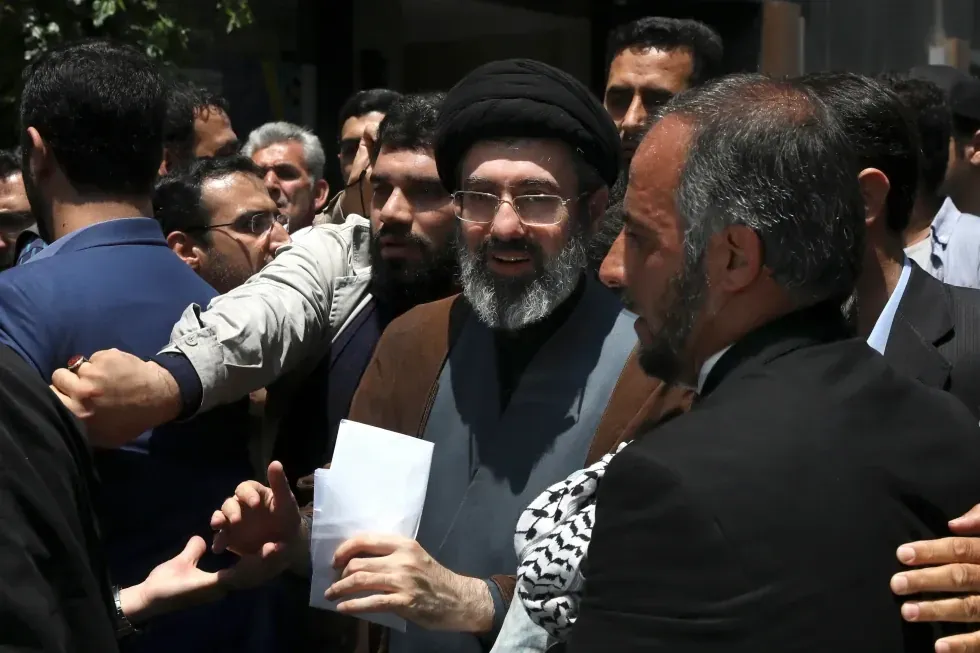
DUBAI, United Arab Emirates (Journos News) — Iran’s leadership transition has shifted from a long-managed clerical process into a wartime calculation, with Iran supreme leader succession now unfolding under active Israeli and U.S. military pressure. The death of Ali Khamenei in an Israeli strike has accelerated a decision that will determine not only Iran’s domestic balance of power but also the trajectory of a regional conflict already widening.
As first reported by The Associated Press, Mojtaba Khamenei — long viewed inside the Islamic Republic as a potential successor — has not appeared publicly since the strike that killed his father. Iranian state media have not disclosed his location as air operations continue.
The question confronting Tehran is no longer theoretical: who assumes ultimate authority over a state at war, with an expanding missile exchange and an advanced uranium program under scrutiny?

Command Authority Narrows Under Fire
At the center of the transition is Mojtaba Khamenei, a cleric who has never held elected office but has operated for years within his father’s inner circle. Diplomatic cables published by WikiLeaks previously described him as a principal gatekeeper within the supreme leader’s office — a figure with access to security commanders and intelligence channels.
His candidacy, however, carries institutional risk. Iran’s 88-member Assembly of Experts — the clerical body empowered to select the next supreme leader — must weigh continuity against legitimacy concerns. Critics inside Iran have long warned that elevating the son of a supreme leader risks blurring the Islamic Republic’s distinction from the monarchy it overthrew in 1979 under Ruhollah Khomeini.
In peacetime, such debate might have unfolded behind closed doors over months. In wartime, delay carries strategic cost.
Military Leverage Consolidates Around the Guard
Any successor will immediately assume command authority over Iran’s armed forces, including the powerful Islamic Revolutionary Guard Corps, designated a terrorist organization by Washington in 2019. The Guard oversees Iran’s ballistic missile arsenal and its regional network of allied armed groups often described by Tehran as its “Axis of Resistance.”
Mojtaba Khamenei has reportedly maintained close relationships with elements of the Guard, including commanders associated with its external operations wing. The U.S. Treasury sanctioned him during the administration of Donald Trump, alleging he worked to advance his father’s regional strategy and influence domestic political outcomes.

In the current climate, proximity to the Guard may be both an asset and a liability — strengthening operational continuity while narrowing political maneuverability.
Nuclear Threshold Decisions Approach
The next supreme leader will also inherit authority over Iran’s highly enriched uranium stockpile. While Tehran maintains its program is civilian in nature, Western governments argue the material could be diverted toward weaponization if political leadership chose to do so.
That authority rests solely with the supreme leader. The timing of succession, therefore, intersects directly with nuclear brinkmanship. A leadership figure perceived as consolidating hard-line influence could intensify international pressure and reduce diplomatic space.
This intersection of military command and nuclear oversight heightens the stakes of what might otherwise have been an internal clerical decision.
Institutional Stability Faces a Stress Test
Iran has experienced only one prior leadership transfer at the top of its political system — when Ruhollah Khomeini died in 1989 and Ali Khamenei assumed office. That transition occurred after the Iran-Iraq war but outside the context of direct foreign strikes on Tehran.
Today’s environment differs markedly. Israel has signaled sustained operations aimed at degrading Iranian capabilities, while U.S. officials have framed their posture as preventing further escalation and limiting nuclear risk.
Within this compressed timeframe, the Assembly of Experts must balance continuity, clerical legitimacy, and military cohesion. Any perception of internal fragmentation could invite further external pressure.
Regional Deterrence Calculus Tightens
Iran’s supreme leader is not merely a ceremonial authority but the apex decision-maker across defense, intelligence, and strategic doctrine. The office defines red lines and calibrates retaliation.
Should Mojtaba Khamenei emerge as successor, regional actors will assess whether continuity signals entrenched hard-line policy or whether wartime necessity prompts recalibration. Conversely, a compromise or collective leadership arrangement could signal internal caution but risk projecting uncertainty.
The outcome will shape not only Iran’s immediate war footing but also the architecture of deterrence across the Gulf and Levant.
A Wartime Mandate With Long-Term Consequences
The succession question has become inseparable from the battlefield. The clerical deliberations underway in Tehran now carry implications far beyond domestic hierarchy — touching nuclear diplomacy, regional militia networks, and the durability of Iran’s governing model.
Whether Mojtaba Khamenei consolidates authority or the Assembly opts for an alternative figure, the next supreme leader will begin his tenure not with consolidation but with confrontation.
The transition, compressed by war, may prove as consequential as the conflict itself.