PARIS – As leaders of the Group of Seven nations gather for their latest summit, questions are resurfacing about whether one of the world’s most influential economic powers can continue to remain outside the forum.
The debate centers on China, whose economic and geopolitical influence has expanded dramatically since the G7 was established in 1975. While the group was created as a gathering of leading industrial democracies to address global economic challenges, China’s rise has transformed the international landscape, making its absence increasingly noticeable.
The issue underscores a broader strategic question facing the world’s leading democracies: whether global challenges can be effectively addressed without direct participation from the world’s second-largest economy.

China’s Economic Rise Changes the Equation
When leaders first met at the Château de Rambouillet outside Paris in 1975, China was undergoing significant political and economic upheaval under the leadership of Mao Zedong. At the time, the country was far from becoming a central player in the global economy.
Over the decades that followed, China experienced rapid economic growth, emerging as a major manufacturing center and trading power. Today, its economy exceeds those of most G7 members, with only the United States maintaining a larger economic output among the group’s countries.
John Kirton, a University of Toronto specialist on the G7, said China’s transformation has prompted increasing discussion about whether the organization would benefit from Chinese participation.
He described China’s evolution from a relatively limited economic actor into a major global force, arguing that some observers see potential advantages in including Beijing within the forum.
Democracy Remains a Core Membership Principle
Despite China’s economic weight, membership in the G7 has traditionally been linked to democratic governance.
■ Related News


The leaders who established the group emphasized their shared responsibility for governing open and democratic societies committed to individual liberty and social progress. That principle has remained a defining characteristic of the organization.
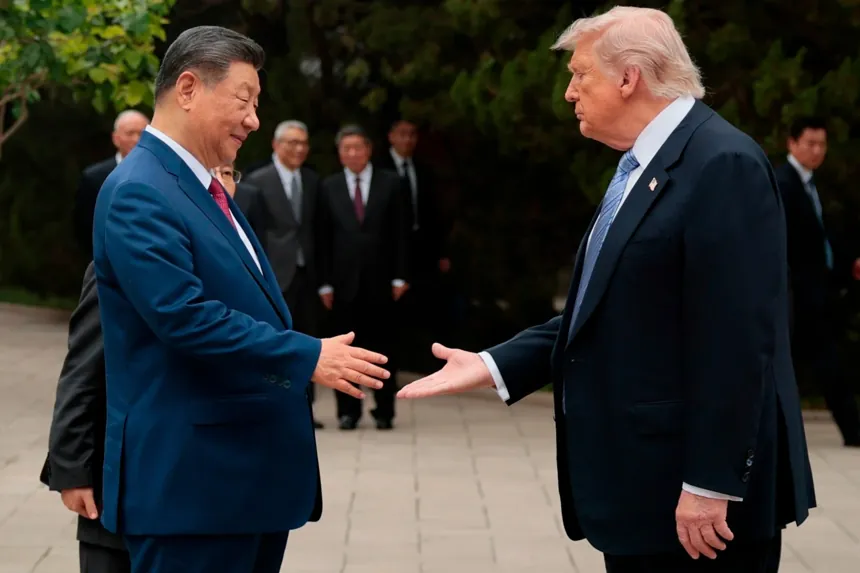
Under the leadership of Chinese President Xi Jinping, China continues to operate under a one-party political system led by the Communist Party. Various international assessments of political freedoms and civil liberties place China well below G7 countries on measures of democratic governance.
The democratic foundation of the group remains one of the most significant obstacles to any discussion about expanding membership to include China.
China Expected to Dominate Summit Discussions
Although China is not a participant, its influence is expected to feature prominently in discussions among G7 leaders.
China’s large trade surplus, control of critical mineral supplies, advances in technology, expanding military capabilities, and role as the world’s largest emitter of greenhouse gases have made it a central issue for many advanced economies.
French President Emmanuel Macron, hosting the summit, has allocated time for discussions on trade relations with China amid concerns that growing Chinese exports could place additional pressure on industries in G7 countries.
Cédric Dupont of the Geneva Graduate Institute said China may represent one of the few issues capable of generating broad agreement among leaders who have recently differed on several international questions.
Beijing Watches Closely
China’s government has previously criticized the G7 as an exclusive grouping that reflects outdated geopolitical divisions.
Ahead of the summit, China’s Foreign Ministry told The Associated Press that the G7 should promote international cooperation rather than deepen confrontation and division.
At the same time, analysts note that Beijing continues to pay close attention to the forum because of the substantial economic, technological, financial, and military influence represented by its members.
Wang Zichen, a Beijing-based analyst, said Chinese officials view the G7 as increasingly aligned with Western efforts to address challenges associated with China’s growing power.
Concerns Over Membership Expansion
While some observers argue that China’s participation could improve international cooperation, others believe its inclusion would undermine the group’s ability to operate effectively.
Analysts point to differences over governance, security issues, and foreign policy positions involving Russia, Iran, and other major international concerns. They also warn that China’s economic influence could create divisions among existing members.
Kirton argued that Chinese membership could test the unity of the organization by encouraging countries to pursue individual economic advantages rather than collective positions.
Chris Alden of the London School of Economics and Political Science similarly suggested that adding China would make consensus-building within the group considerably more difficult.
Russia’s Experience Still Shapes the Debate
The G7’s previous expansion remains a significant factor in discussions about membership.
Russia joined the group in 1998, creating what became known as the G8. However, Moscow’s participation ended after Russian President Vladimir Putin’s annexation of Crimea in 2014, leading the remaining members to suspend Russia’s involvement.
The experience reinforced concerns among many G7 governments about extending full membership to countries that do not share the democratic principles that underpin the organization.
As global power continues to shift, China’s exclusion remains both a symbol of the G7’s democratic identity and a reminder of the challenges facing international institutions in an increasingly multipolar world.
Tags: China, G7, Donald Trump, Xi Jinping, Global Economy