Asian stock markets delivered a mixed performance on Wednesday while oil prices remained below $80 per barrel, as investors assessed the implications of an interim agreement between the United States and Iran aimed at ending the conflict that has disrupted global energy markets.
Market participants also turned their attention to the U.S. Federal Reserve, which was set to announce its latest interest-rate decision following a two-day policy meeting. Expectations broadly pointed to no immediate change in benchmark borrowing costs, even as concerns persisted over inflation pressures linked to higher energy prices.
Oil Prices Stabilize After Sharp Decline
Crude oil prices steadied after suffering significant losses earlier in the week as traders responded positively to prospects for reduced tensions in the Middle East and the potential reopening of key energy shipping routes.

Brent crude, the international benchmark, fell 0.3% to $78.76 per barrel in early trading after dropping more than 5% on Tuesday. U.S. benchmark crude slipped 0.4% to $75.78 per barrel.
Although prices have retreated, crude remains elevated compared with levels seen before the conflict began. Market attention has focused on the future of the Strait of Hormuz, a critical corridor for global oil and gas shipments.
Economists at HSBC noted in a recent research note that restoring normal energy flows could take time. They cited challenges including mine clearance operations, insurance reinstatement, the reduction of excess regional oil inventories, vessel repositioning, and the restart of previously idled production facilities.
Japanese Stocks Gain on Export Strength
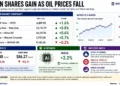
Japan’s stock market outperformed many regional peers after government trade data showed exports increased 17% in May compared with a year earlier. Strong demand for technology-related products contributed to the rise.
The Nikkei 225 advanced 0.8% to 69,926.08, remaining close to a record high reached earlier in the week.
■ Related News

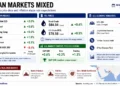
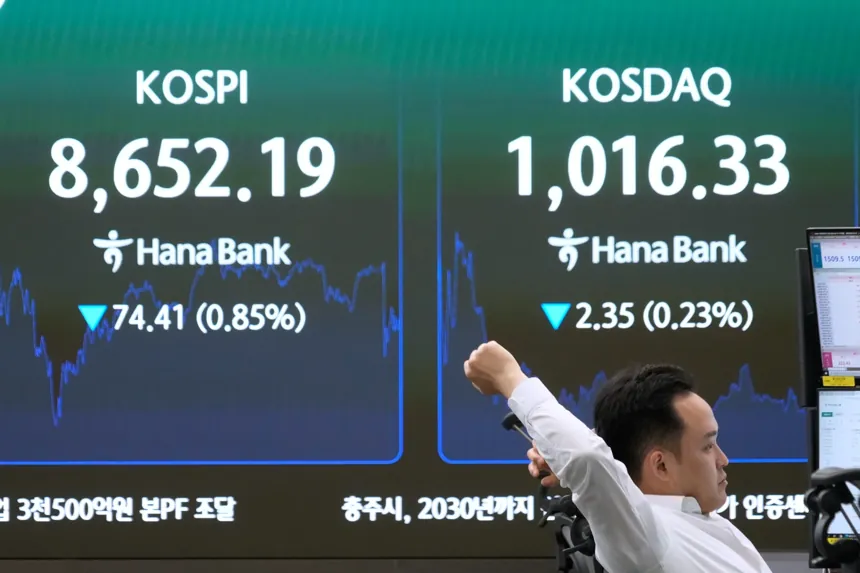
Elsewhere in the region, South Korea’s Kospi edged 0.2% lower to 8,706.10 as major technology shares weakened. Samsung Electronics, one of the market’s largest companies, declined 1.9%.
Hong Kong’s Hang Seng Index fell 0.8% to 24,273.95, while mainland China’s Shanghai Composite Index slipped 0.1% to 4,089.26.
Australia’s S&P/ASX 200 gained 0.5% to 8,965.30. Taiwan’s Taiex declined 0.5%, while India’s Sensex rose 0.3%.
Federal Reserve Decision in Focus
The Federal Reserve’s latest policy meeting marked the first under Chair Kevin Warsh. Investors were closely monitoring the outcome as policymakers balanced economic growth concerns against inflation risks associated with energy market disruptions.
President Donald Trump has continued to advocate for lower interest rates to support economic activity. However, rising energy costs tied to the Middle East conflict have complicated the inflation outlook.
Bond markets reflected cautious positioning ahead of the Fed announcement. The yield on the benchmark 10-year U.S. Treasury note fell below 4.44%, compared with 4.47% late Monday.
Morningstar Chief U.S. Economist Preston Caldwell wrote that underlying inflation pressures appeared relatively subdued due to weak wage growth and slowing rent increases. He said those factors could contribute to lower inflation once the effects of higher energy prices ease.
Wall Street Ends Mixed Near Record Levels
U.S. equity markets closed with mixed results on Tuesday as investors rotated away from some technology shares while maintaining interest in other sectors.
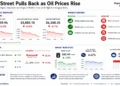
The S&P 500 declined 0.6% to 7,511.35 after recently reaching a record high. The Dow Jones Industrial Average rose 0.6% to 51,999.67, setting another all-time high.
The Nasdaq Composite fell 1.2% to 26,376.34 amid renewed concerns surrounding valuations in artificial intelligence-linked stocks.
Chipmaker Nvidia dropped 2.4%, while Broadcom fell 4.4%. Micron Technology lost 6.2%.
Corporate Developments Draw Attention
Several company-specific developments also influenced trading activity.
SpaceX gained 4.8%, extending a recent rally following its debut on Wall Street.
Yum Brands advanced 1.9% after announcing plans to sell Pizza Hut in a deal valued at $2.7 billion. The company said most restaurant assets would be acquired by private equity firm LongRange Capital.
Currency Markets
In foreign-exchange trading, the U.S. dollar weakened slightly against the Japanese yen, falling to 160.30 yen from 160.42 yen. The euro edged higher to $1.1612 from $1.1608.
While investors welcomed signs of progress toward ending the U.S.-Iran conflict, questions remain over the implementation of the interim agreement and its impact on regional stability. Energy markets, central bank policy, and geopolitical developments are likely to remain key drivers of market sentiment in the coming weeks.
Tags: Asian Markets, Oil Prices, Brent Crude, U.S.-Iran Agreement, Federal Reserve, Inflation, Wall Street, Global Economy, Energy Markets, Treasury Yields