BANGKOK — Global financial markets rallied sharply on Monday after a tentative agreement was announced to end the Iran war and reopen the Strait of Hormuz, according to reporting from the Associated Press. The development triggered a surge in Asian equities and a sharp drop in oil prices, as investors responded to expectations of improved energy supply stability.
Benchmarks in Tokyo and Seoul jumped more than 5% in early trading, while Brent crude fell more than $4 per barrel at one point. In futures markets, the S&P 500 rose 1% and the Dow Jones Industrial Average gained 0.9%, signaling strong early momentum for Wall Street.
U.S. President Donald Trump confirmed the initial agreement and authorized an end to the U.S. naval blockade of Iranian ports. Iran also confirmed the deal but indicated implementation would not begin until a formal signing, which Pakistan said is scheduled for Friday in Switzerland. Broader negotiations, including discussions around Iran’s nuclear program, are expected to continue over the next 60 days.

Energy markets react sharply to supply outlook shift
In early trading, Brent crude oil, the international benchmark, fell $3.61 to $83.64 per barrel. U.S. West Texas Intermediate dropped $4.27 to $80.61 per barrel.
Market participants said the easing of geopolitical risk reduced immediate concerns about supply disruptions through the Strait of Hormuz, a critical route for global oil shipments. However, analysts cautioned that price stability may take time to return after weeks of volatility linked to the conflict.
Stephen Innes of SPI Asset Management noted that markets were still balancing headline developments against execution risks, saying sentiment remained sensitive to whether any agreement would be fully implemented.
“The reopening of Hormuz is a relief valve, not a full peace dividend,” Innes said in a report. “The market can remove some crude panic, but it still has to price the gap between a headline, a signature, and a regime that actually complies.”
Asian equities extend rally on easing geopolitical risk
Stocks across Asia posted broad gains as investors welcomed the reduction in geopolitical tension. Japan’s Nikkei 225 surged 5.4% to 69,603.91, marking another record high. The rally was led by technology shares, particularly companies tied to artificial intelligence, which have been a key driver of Japan’s market gains over the past year.
■ Related News


“The decline in New York crude oil futures is supporting this positive market,” said Takashi Hiroki, chief strategist at Monex. “Buying by foreign investors is leading the market with expectations of easing tensions around the situation in the Middle East.”
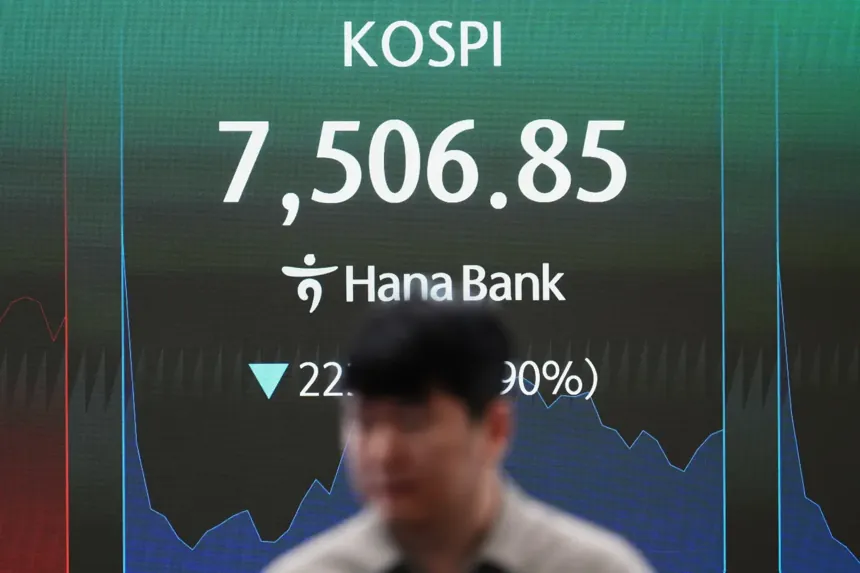
Elsewhere, South Korea’s Kospi rose 4.9% to 8,517.93. Hong Kong’s Hang Seng index gained 0.6% to 24,867.94, while the Shanghai Composite climbed 1.1% to 4,073.08. Australia’s S&P/ASX 200 advanced 1.4% to 8,922.90, and Taiwan’s Taiex rose 2.5%.
Global markets brace for central bank decisions
The market rally comes as investors also focus on a series of major central bank meetings scheduled this week. The U.S. Federal Reserve and the Bank of England are expected to announce interest rate decisions on Thursday, while the Bank of Japan is set to update its monetary policy on Tuesday.
The Bank of Japan is widely expected to raise its benchmark interest rate to 1%, up from 0.75%, which would mark the highest level in more than three decades.
In currency markets, the U.S. dollar edged up to 160.20 Japanese yen from 160.12 yen late Friday. The euro rose slightly to $1.1595 from $1.1578.
U.S. equities extend winning streak ahead of key week
On Wall Street, stocks closed the previous session higher, with the S&P 500 up 0.5%, marking its 10th gain in the last 11 weeks. The Dow Jones Industrial Average rose 353 points, or 0.7%, while the Nasdaq Composite added 0.3%.
Investor sentiment has also been supported by continued interest in artificial intelligence-linked companies, following a strong market debut earlier in the week by Elon Musk’s SpaceX, which was reported to have drawn significant demand in its listing and reached a valuation of $2.1 trillion.
Tags: Iran War Deal, Global Markets, Asian Stocks Rally, Oil Prices, Brent Crude, Geopolitics, Strait of Hormuz, Wall Street Futures, Nikkei 225, Central Banks, Energy Markets, Interest Rates