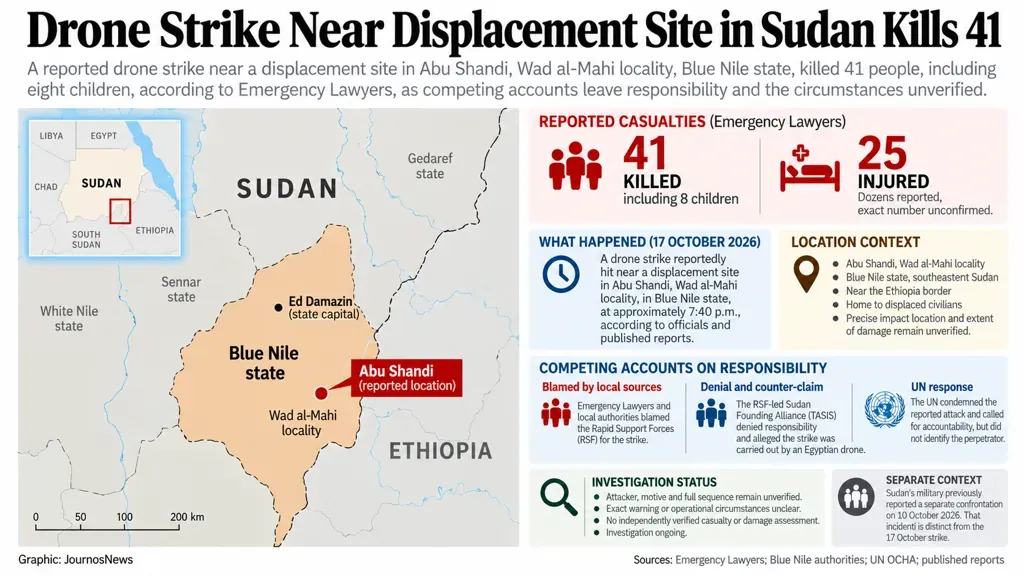
BLUE NILE, Sudan – A drone strike near a displacement site in southeastern Sudan killed 41 people, including eight children, according to the rights group Emergency Lawyers. The group blamed the Rapid Support Forces (RSF) for the October 9 attack in Abu Shandi, near the Ethiopian border.
Local authorities initially reported at least 30 deaths. Emergency Lawyers later raised the toll to 41. Reports also described dozens of wounded people, but no single, independently confirmed injury count was available.
The United Nations condemned the reported attack and called for accountability. However, it did not identify who carried out the strike. The RSF-led Sudan Founding Alliance, known as TASIS, denied responsibility and blamed an Egyptian drone. No independent evidence reviewed for this article confirmed that claim.

Death toll rises to 41
The strike occurred on October 9 in Abu Shandi, part of Wad al-Mahi locality in Blue Nile state. Fighting has intensified in the region, which borders Ethiopia.
Emergency Lawyers said the dead included eight children and many women. The group described the victims as displaced people who had fled fighting elsewhere in Sudan.
Reports differ on exactly where the strike hit. Some describe an attack at or near a displacement shelter. Others say the victims had gathered near an informal gold-mining site beside the shelter.
The available reports do not establish the precise point of impact. They also do not confirm whether the strike hit the shelter, a nearby gathering or several locations.
These details matter when assessing the attack. The reports identify the victims as displaced civilians, but they do not establish the intended target or show that the attacker deliberately targeted civilians.
■ Related News


RSF-led alliance denies responsibility
Emergency Lawyers blamed the RSF for the strike. Local authorities also accused the paramilitary force.
However, these accusations do not independently establish who operated the drone or where it was launched.
TASIS later rejected responsibility through its spokesman, Ahmed Tugud Lisan, according to published reports. The alliance claimed that an Egyptian drone carried out the attack. It also alleged that Egyptian technicians launched the drone from a police facility in Wad al-Mahi.
The reports reviewed did not provide independent evidence to support that allegation. The claim also conflicts with the accusations made by Emergency Lawyers and local authorities.
The Associated Press reported that an RSF spokesperson had not responded to its request for comment. JournosNews did not independently obtain a response from the RSF or the Sudanese Armed Forces.
No independent investigation establishing responsibility for the strike was identified in the material reviewed. The drone’s operator, its launch point and the circumstances of the attack remain unclear.
UN calls for accountability
The UN Office for the Coordination of Humanitarian Affairs (OCHA) condemned reports of the strike near a displacement site.
Denise Brown, the UN resident and humanitarian coordinator in Sudan, called for accountability. She also stressed that all parties must respect international humanitarian law and warned that civilians continued to suffer as the war dragged on.
The UN’s statement highlighted the danger facing people displaced by the fighting. However, it did not publicly attribute the attack to a specific force.
Blue Nile state has faced renewed fighting and displacement. Many families already struggle to find shelter, medical care and other basic services.
Local authorities called for an investigation into the strike. However, the material reviewed did not establish whether the UN or another independent body had opened a formal investigation into this specific incident.
Fighting puts displaced families at risk
The attack occurred amid a wider escalation of fighting in Blue Nile state. The Sudanese Armed Forces have fought the RSF and the Sudan People’s Liberation Movement-North in parts of the region, including areas near the Ethiopian border.
UN Security Council reporting has described intensified fighting in the state. It has also reported attacks on Ed Damazin, the state capital.
Other reports have documented drone strikes elsewhere in Sudan, including attacks that killed or injured civilians in residential areas and near displacement sites. These incidents show the wider risks facing civilians, but they do not establish who carried out the Abu Shandi strike.
Displacement has placed further pressure on humanitarian services. The International Organization for Migration reported that an estimated 99,277 people had been displaced across Blue Nile state between January 11 and August 23, 2026.
That figure covers displacement across the state during the reporting period. It does not represent the number of people displaced by the Abu Shandi attack.
A UN Population Fund report published in October said renewed fighting in Blue Nile during August forced about 21,000 people to flee. The report also described growing risks for women and girls and pressure on health services.
These figures provide context for the region’s humanitarian crisis. However, they do not give a complete picture of conditions on October 20.
Sudan’s wider war deepens the crisis
Sudan’s war began in April 2023, when fighting erupted between the Sudanese Armed Forces and the RSF. The conflict has forced millions from their homes and created widespread humanitarian needs.
A recent Associated Press report, citing UN figures, said more than 12.4 million people had been forced to flee their homes. It also reported that 33.7 million people would need urgent assistance in 2026.
These are countrywide estimates. They are separate from the deaths and injuries reported in Abu Shandi.
The conflict has also increased the risks facing people who flee to areas near front lines or across state borders. Displaced families may have limited access to safe shelter, food, medical care and protection.
The reported strike has raised fresh concerns about the safety of civilians who have already escaped fighting. However, wider patterns of drone attacks do not establish responsibility for this particular incident.
Important details remain unconfirmed
Several questions remain unanswered. The reports reviewed do not provide a complete casualty list, a final count of wounded people or an independent account of the precise location struck.
The reported injury figures also vary. One early account cited 26 women with serious injuries, while other reports gave different totals for wounded people. These figures should not be combined or treated as a confirmed final count.
The available evidence also does not establish whether military personnel, weapons or installations were near the site when the strike occurred. Without reliable information about the location and intended target, it would be premature to draw a firm conclusion about the attacker’s intent.
International humanitarian law requires parties to a conflict to distinguish civilians from combatants. It also requires them to distinguish civilian objects from military objectives and take precautions to limit civilian harm.
Whether the Abu Shandi strike violated these rules depends on the facts. The UN has called for accountability, but the public statements reviewed do not amount to a final legal finding about the attack.
As of October 20, Emergency Lawyers remained the main identified source for the figure of 41 deaths and the accusation against the RSF. Local authorities also blamed the paramilitary force. TASIS denied responsibility and accused Egypt, while the UN condemned the attack without publicly identifying the perpetrator.
The final casualty figures, the precise circumstances of the strike and responsibility for the attack remain unresolved.
Reporting Credit: The Associated Press and other published reporting for Emergency Lawyers’ casualty account, the response from the RSF-led alliance and the UN’s condemnation; Sudan Tribune for local-authority statements and initial casualty figures; the UN Office for the Coordination of Humanitarian Affairs and UN Security Council reporting for humanitarian and conflict context; and the International Organization for Migration and UN Population Fund for dated displacement and protection information.