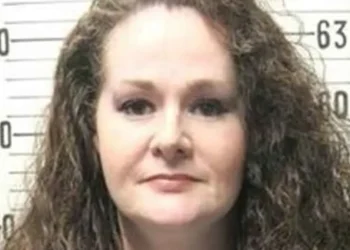
LAS VEGAS, United States – Authorities have identified Edward Lelburian Jackson, an Arkansas man whose remains were discovered inside a rusted barrel at Lake Mead in May 2022, more than four years after investigators opened a homicide case that remains unsolved.
Clark County Coroner Melanie Rouse announced the identification on October 15, while Las Vegas Metropolitan Police Department homicide investigators said they were continuing to seek information about Jackson’s killing. Authorities believe he was in his mid- to late 50s when he died, and they have placed the estimated time of death between the mid-1970s and early 1980s.
The identification resolves a central question in the case: the victim’s identity. It does not establish who killed him, why he was killed or why his remains were left at the lake.

How investigators identified Jackson
Boaters discovered the barrel near Hemenway Harbor on May 1, 2022, after falling water levels exposed previously submerged shoreline. Investigators determined that the man had suffered a gunshot wound to the head and classified the death as a homicide.
Clark County’s original public appeal documented the early identification effort. Authorities released facial-approximation images created by the FBI laboratory in Quantico, Virginia, and entered the case information into the National Missing and Unidentified Persons System, known as NamUs.
The coroner’s office also pursued DNA-based identification. According to the account given by officials at the October 15 announcement, an early genealogy-profile lead did not produce a sufficiently strong match. Oklahoma State University’s School of Forensic Sciences later developed a stronger lead, followed by comparison with a person believed to be a family member.
Officials said the resulting genetic evidence established Jackson’s identity. The full laboratory documentation and underlying comparison records have not been independently examined for this report, so the precise technical methodology and its limitations cannot be assessed here.
A life spanning several states
Investigators said Jackson was from Hot Springs, Arkansas, and had connections to other parts of the United States, including California and Utah.



Family members told investigators that Jackson enjoyed traveling and could appear unexpectedly before leaving again. Relatives had not reported him missing, according to the account given by police, because his independent travel was familiar to them.
That history helps explain why identifying him was difficult: investigators were working from unidentified remains without a conventional missing-person report that clearly matched the victim.
Police also described a brief criminal history in Utah in the early 1980s, including charges involving aggravated arson and conspiracy to commit fraud. That information does not establish a motive for the homicide or a connection between Jackson and any person suspected of killing him.
His precise movements before his death, the reason he was in the Las Vegas area and the people he may have encountered remain unresolved.
Organized-crime theories remain unproven
The barrel discovery revived speculation about a possible connection to organized crime because the method of concealing the body recalled cases associated with Las Vegas’s earlier mob era.
Investigators have not identified evidence directly linking Jackson’s killing to organized crime, according to statements attributed to homicide investigators at the identification announcement. Police have not ruled out that possibility, but they have not established it as an explanation.
The distinction is important. The way a body was concealed, the historical period in which a killing occurred and a victim’s criminal history cannot independently establish who committed a homicide or why.
No verified evidence reviewed for this article identifies a suspect or demonstrates that organized crime was involved.
The homicide investigation continues
Identifying Jackson gives investigators a name around which to build a more complete account of his life and final movements. It may also help investigators locate people who knew him, recall his travels or possess information that was never connected to the unidentified-victim case.
But the identification is a step in the investigation, not its conclusion. Authorities have not publicly established the killer, a motive or the precise circumstances that brought Jackson to Lake Mead.
Lake Mead homicide case remains open, and investigators are asking anyone with relevant information about Jackson or his death to contact the Las Vegas Metropolitan Police Department’s Homicide Section at 702-828-3521. People wishing to provide information anonymously can contact Crime Stoppers at 702-385-5555.
The case began with unidentified remains and a homicide that had gone unexplained for decades. Investigators now know the victim’s identity. The central questions—who killed Jackson, why, and how he came to be at Lake Mead—remain unanswered.
Reporting Credit: Clark County Office of the Coroner/Medical Examiner’s original unidentified-victim case announcement; statements attributed to Clark County Coroner Melanie Rouse and Las Vegas Metropolitan Police Department Homicide Lt. Robert Price concerning the October 15, 2026, identification announcement. The original October 15 briefing transcript and laboratory records were not independently obtained for this report.