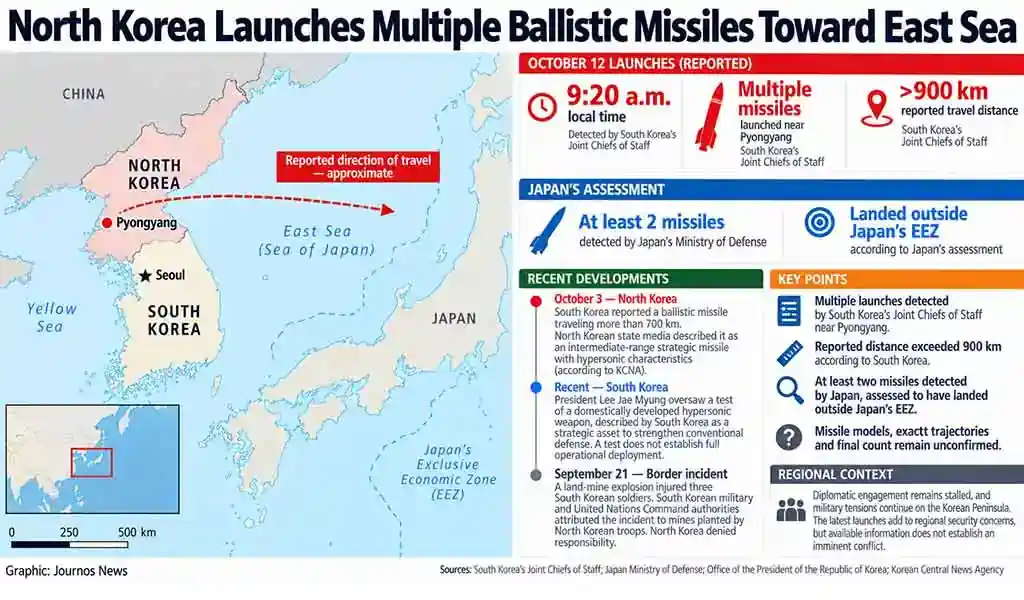
SEOUL, South Korea – North Korea fired multiple ballistic missiles toward waters off its eastern coast on October 12, South Korea’s military said, in another weapons launch amid strained relations on the Korean Peninsula.
South Korea’s Joint Chiefs of Staff said it detected the launches at about 9:20 a.m. near Pyongyang. The missiles traveled more than 900 kilometers, according to the military statement cited by South Korean media.
Japan’s Defense Ministry said it detected at least two missiles and assessed that they landed in waters outside Japan’s exclusive economic zone (EEZ). South Korea had not immediately disclosed its final count of the missiles detected.

Authorities were continuing to assess the launches. The information released so far did not identify the missile models or establish their precise technical capabilities.
The latest launch follows North Korea’s October 3 test of a missile it described as an intermediate-range hypersonic weapon. It also comes days after South Korean President Lee Jae Myung oversaw a test of a domestically developed hypersonic weapon.
The sequence adds to regional military tensions, but the launches alone do not establish that either side is preparing for an imminent conflict.
South Korea and Japan Assess the Launches
South Korea’s Joint Chiefs of Staff said the missiles were launched from the Pyongyang area and flew toward the East Sea, also known internationally as the Sea of Japan.
The military said it had increased surveillance and maintained readiness for further launches. It was also sharing information with the United States and Japan, according to the statement cited in South Korean reporting.



Japan’s Defense Ministry separately reported detecting at least two missiles. It assessed that they landed outside Japan’s EEZ.
An exclusive economic zone gives a coastal state specific rights over marine resources and certain economic activities. It is not the same as territorial waters, where a state exercises sovereignty subject to international law.
The available reports did not indicate that the missiles struck Japanese territory or caused damage to aircraft or vessels. Nor did they establish that the launches targeted Japan or South Korea.
The exact number of missiles, their individual flight paths and their landing points remained unclear in the information available at publication.
Latest Launch Follows October 3 Missile Test
North Korea conducted another ballistic missile test on October 3, when South Korea’s military reported that a missile flew more than 700 kilometers toward waters off the country’s eastern coast.
North Korean state media later described that weapon as an intermediate-range strategic missile with hypersonic characteristics. It said leader Kim Jong Un oversaw the test and presented it as part of efforts to strengthen the country’s nuclear deterrent.
North Korean officials also claimed the missile traveled about 1,000 kilometers and used a trajectory designed to challenge missile defenses. South Korea’s military reported that it detected and tracked the launch, disputing claims that the weapon had escaped its monitoring.
Those descriptions of the October 3 test should not be applied automatically to the October 12 launches. Authorities had not publicly identified the latest missiles or confirmed that they belonged to the same weapons system.
North Korea has continued developing nuclear-capable missiles despite international sanctions and repeated calls to return to negotiations.
South Korea Tests Its Own Hypersonic Weapon
South Korea recently publicized a separate development in its missile program. President Lee oversaw the first test of a domestically developed hypersonic weapon, which his office described as a strategic asset intended to strengthen conventional defense.
The test took place amid rising tensions with the North. South Korean officials have emphasized the need to develop advanced weapons and reduce reliance on foreign defense systems.
Hypersonic weapons generally travel at more than five times the speed of sound. Some designs can maneuver during flight, making their paths harder to predict. However, speed alone does not establish that a weapon can evade every missile defense system.
The South Korean test and North Korea’s October 3 test occurred close together. The timing places both developments in the wider regional arms competition, but the available evidence does not establish that either test directly caused the other.
South Korea’s announcement also does not confirm that its weapon has entered full operational service. A successful test is a development milestone, not proof that a system has completed every stage required for deployment.
Diplomacy Remains Stalled
The launches come amid a prolonged breakdown in diplomacy involving North Korea, South Korea and the United States.
North Korean leader Kim has rejected repeated offers to resume talks. His government has demanded that Washington abandon what it calls a hostile policy and has resisted denuclearization as a condition for negotiations.
South Korean President Lee has called for renewed engagement with Pyongyang while also supporting stronger conventional defenses. North Korea has continued to reject Seoul’s overtures.
The broader diplomatic impasse dates back to the collapse of major nuclear negotiations between Washington and Pyongyang in 2019. Since then, North Korea has continued weapons development while sharply reducing cooperation with South Korea.
The latest launches add to that strained environment. However, authorities have not established a direct link between the October 12 test and a specific diplomatic decision or military operation.
Land-Mine Incident Adds to Border Tensions
Relations between the two Koreas also deteriorated after a land-mine explosion near the border injured three South Korean soldiers on September 21.
South Korea’s military and the United Nations Command, which oversees the armistice framework, concluded that mines planted by North Korean troops caused the blast. Seoul demanded an apology and described the incident as a violation of the 1953 armistice.
North Korea denied responsibility and rejected South Korea’s findings. Pyongyang has also warned against actions by South Korean forces along the border.
The competing accounts remain important to the wider security context. The findings announced by South Korean and United Nations Command authorities should be attributed to those bodies, while North Korea’s denial should also remain clear.
The mine incident and the missile launches have occurred during the same period of heightened tensions. But the available evidence does not show that the two events formed part of a single operation.
Regional Security Outlook
South Korea, Japan and the United States routinely coordinate on monitoring North Korean missile activity. South Korea’s military said it was sharing information with Washington and Tokyo after the latest launches.
The public statements reviewed for this report did not confirm a new coordinated military response beyond monitoring, information-sharing and maintaining readiness.
North Korea’s missile program remains a security concern for neighboring countries. At the same time, the technical significance of the October 12 launches cannot be fully assessed without further details about the missile types, trajectories and performance.
For now, South Korea has confirmed multiple launches from the Pyongyang area, while Japan has reported detecting at least two missiles that landed outside its exclusive economic zone. The latest incident follows separate weapons tests by both Koreas and comes as diplomatic efforts remain stalled.
Further assessments from South Korean and Japanese authorities may clarify the number of missiles involved and their flight characteristics. Until then, the available information supports reporting another North Korean missile launch, but not claims that it marks an imminent escalation into war.
Reporting Credit: South Korea’s Joint Chiefs of Staff; Japan Ministry of Defense; Office of the President of the Republic of Korea; Korean Central News Agency.